flagOntario

Grade 12

Master Grade 12 MAP4C

Watch college math videos, practice with real-world problems

students image

I was failing MAP4C until StudyPug. The exponential equation videos finally made sense. Went from D to B+ in one semester.

Jordan Chen

pug

Why Grade 12 Foundations for College Mathematics Students Choose StudyPug

The complete learning system to master MAP4C
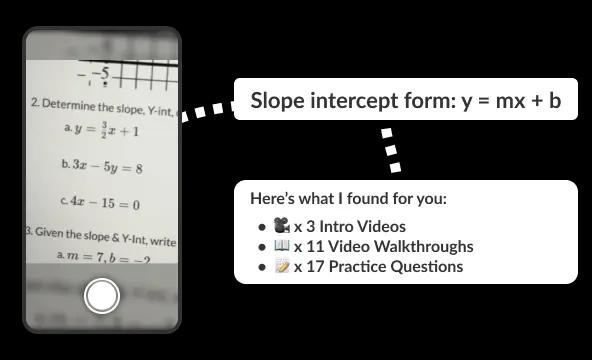
Search with Photo

Search with Photo

Snap a photo of any problem and get the exact lesson
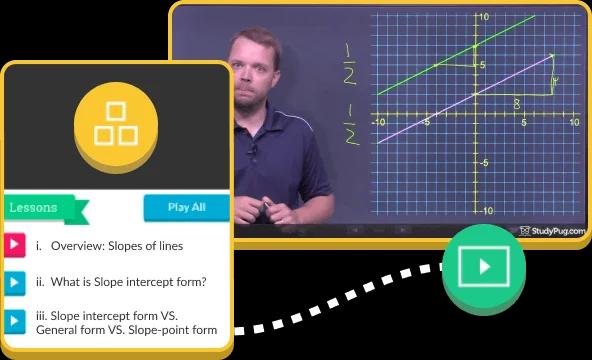
Expert Video Teaching

Expert Video Teaching

Certified teachers explain exponentials, personal finance, and trigonometry clearly
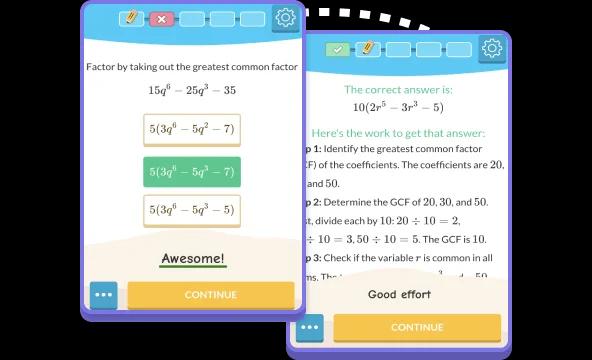
Unlimited Practice

Unlimited Practice

Thousands of practice questions with step-by-step solutions for MAP4C success

How Ontario Students Use StudyPug

1

Select Grade Level
Select Grade Level

Choose your Ontario grade (K-12) and current math topics.

2

Get Unstuck
Get Unstuck

Upload homework problems or browse curriculum-aligned lessons.

3

Practice & Master
Practice & Master

Work through similar problems until concepts stick.

4

See Results
See Results

Track progress and watch grades improve week by week.

Grade 12 MAP4C Help: Master Concepts FastHelp

Print

OE_ID

Expectations

StudyPug Topic

ON.OE.12FC.A1.1

12FC.A1.1: Determine, through investigation, the exponent laws for multiplying and dividing algebraic expressions involving exponents and the exponent law for simplifying algebraic expressions involving a power of a power

ON.OE.12FC.A1.2

12FC.A1.2: Simplify algebraic expressions containing integer exponents using the laws of exponents

ON.OE.12FC.A1.3

12FC.A1.3: Determine, through investigation using a variety of tools and strategies, the value of a power with a rational exponent

ON.OE.12FC.A1.4

12FC.A1.4: Evaluate, with or without technology, numerical expressions involving rational exponents and rational bases

ON.OE.12FC.A1.5

12FC.A1.5: Solve simple exponential equations numerically and graphically, with technology

ON.OE.12FC.A1.6

12FC.A1.6: Solve problems involving exponential equations arising from real-world applications by using a graph or table of values generated with technology from a given equation

ON.OE.12FC.A1.7

12FC.A1.7: Solve exponential equations in one variable by determining a common base

ON.OE.12FC.A2.1

12FC.A2.1: Interpret graphs to describe a relationship, using language and units appropriate to the context

ON.OE.12FC.A2.2

12FC.A2.2: Describe trends based on given graphs, and use the trends to make predictions or justify decisions

ON.OE.12FC.A2.3

12FC.A2.3: Recognize that graphs and tables of values communicate information about rate of change, and use a given graph or table of values for a relation to identify the units used to measure rate of change

ON.OE.12FC.A2.4

12FC.A2.4: Identify when the rate of change is zero, constant, or changing, given a table of values or a graph of a relation, and compare two graphs by describing rate of change

ON.OE.12FC.A2.5

12FC.A2.5: Compare, through investigation with technology, the graphs of pairs of relations by describing the initial conditions and the behaviour of the rates of change

ON.OE.12FC.A2.6

12FC.A2.6: Recognize that a linear model corresponds to a constant increase or decrease over equal intervals and that an exponential model corresponds to a constant percentage increase or decrease over equal intervals, select a model to represent the relationship between numerical data graphically and algebraically, using a variety of tools and strategies, and solve related problems

ON.OE.12FC.A3.1

12FC.A3.1: Solve equations of the form x^n = a using rational exponents

ON.OE.12FC.A3.2

12FC.A3.2: Determine the value of a variable of degree no higher than three, using a formula drawn from an application, by first substituting known values and then solving for the variable, and by first isolating the variable and then substituting known values

ON.OE.12FC.A3.3

12FC.A3.3: Make connections between formulas and linear, quadratic, and exponential functions, using a variety of tools and strategies

ON.OE.12FC.C1.1

12FC.C1.1: Perform required conversions between the imperial system and the metric system using a variety of tools, as necessary within applications

ON.OE.12FC.C1.2

12FC.C1.2: Solve problems involving the areas of rectangles, triangles, and circles, and of related composite shapes, in situations arising from real-world applications

ON.OE.12FC.C1.3

12FC.C1.3: Solve problems involving the volumes and surface areas of rectangular prisms, triangular prisms, and cylinders, and of related composite figures, in situations arising from real-world applications

ON.OE.12FC.C2.1

12FC.C2.1: Recognize, through investigation using a variety of tools and strategies, and explain the significance of optimal perimeter, area, surface area, and volume in various applications

ON.OE.12FC.C2.2

12FC.C2.2: Determine, through investigation using a variety of tools and strategies, the optimal dimensions of a two-dimensional shape in metric or imperial units for a given constraint

ON.OE.12FC.C2.3

12FC.C2.3: Determine, through investigation using a variety of tools and strategies, the optimal dimensions of a right rectangular prism, a right triangular prism, and a right cylinder in metric or imperial units for a given constraint

ON.OE.12FC.C3.1

12FC.C3.1: Solve problems in two dimensions using metric or imperial measurements, including problems that arise from real-world applications, by determining the measures of the sides and angles of right triangles using the primary trigonometric ratios, and of acute triangles using the sine law and the cosine law

ON.OE.12FC.C3.2

12FC.C3.2: Make connections between primary trigonometric ratios of obtuse angles and of acute angles, through investigation using a variety of tools and strategies

ON.OE.12FC.C3.3

12FC.C3.3: Determine the values of the sine, cosine, and tangent of obtuse angles

ON.OE.12FC.C3.4

12FC.C3.4: Solve problems involving oblique triangles, including those that arise from real-world applications, using the sine law and the cosine law, and using metric or imperial units

ON.OE.12FC.D1.1

12FC.D1.1: Distinguish situations requiring one-variable and two-variable data analysis, describe the associated numerical summaries and graphical summaries, and recognize questions that each type of analysis addresses

ON.OE.12FC.D1.2

12FC.D1.2: Describe characteristics of an effective survey, and design questionnaires or experiments for gathering two-variable data

ON.OE.12FC.D1.3

12FC.D1.3: Collect two-variable data from primary sources, through experimentation involving observation or measurement, or from secondary sources, and organize and store the data using a variety of tools

ON.OE.12FC.D1.4

12FC.D1.4: Create a graphical summary of two-variable data using a scatter plot, with and without technology

ON.OE.12FC.D1.5

12FC.D1.5: Determine an algebraic summary of the relationship between two variables that appear to be linearly related, using a variety of tools and strategies, and solve related problems

ON.OE.12FC.D2.2

12FC.D2.2: Describe examples of indices used by the media and solve problems by interpreting and using indices

ON.OE.12FC.D2.3

12FC.D2.3: Interpret statistics presented in the media, and explain how the media, the advertising industry, and others use and misuse statistics to promote a certain point of view
Complete Ontario Grade 12 Foundations for College Mathematics, College Preparation (MAP4C) Coverage

Grade 12 MAP4C Lessons

87

Video Explanations

531

Practice Problems

828

Ontario Standards

100% Aligned

Why Ontario Grade 12 MAP4C Students Love StudyPug

Success Stories

Read More

Ontario Grade 12 Foundations for College Mathematics, College Preparation (MAP4C) Math FAQ

We’ve got answers to some popular questions.

What are the main topics covered in Grade 1 math in Alberta?

Grade 1 math in Alberta covers counting to 100, basic addition and subtraction within 20, introduction to fractions (halves), shape recognition, and simple data representation through concrete graphs.

How can I help my child transition from kindergarten to Grade 1 math?

Encourage counting during daily activities, practice simple addition with objects, and explore shapes in your environment. Maintaining a positive attitude towards math is crucial for a smooth transition.

Are there specific math skills my child should master by the end of Grade 1?

By the end of Grade 1, children should confidently count to 100, add and subtract within 20, recognize basic shapes, understand the concept of half, and create simple concrete graphs.

Practice Smart, See Real Progress

Unlimited Targeted Practice

10,000+ questions adjust to your exact skill level. Never run out of problems that challenge you.
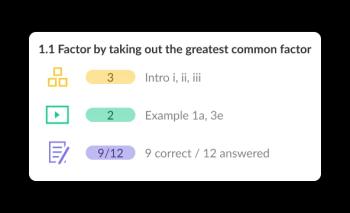
Visual Progress Tracking

See mastery percentage for every topic. Parents get weekly progress emails automatically.
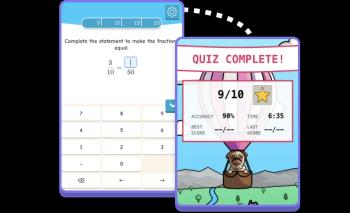
Achievement System
Achievement System

Earn badges for consistency and improvement. Build learning streaks that motivate daily practice
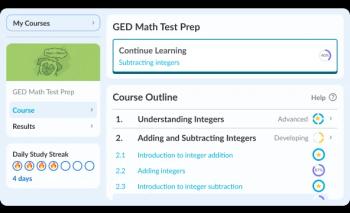
Detailed Analytics
Detailed Analytics

Time spent, problems solved, concepts mastered. Identify exactly where more practice is needed.

student
CallToActionContent

End Math Struggles Today

Ontario curriculum-aligned help that actually works

mathImage