Ontario
Master Grade 12 Workplace Math
Watch workplace math videos, practice with real-life problems

Budgeting was impossible until StudyPug. The real-world examples made everything click. Aced my personal finance unit.
Alex Nguyen

Why Grade 12 Mathematics for Work and Everyday Life, Workplace Preparation (MEL4E) Students Choose StudyPug
The complete learning system to master workplace math
Search with Photo
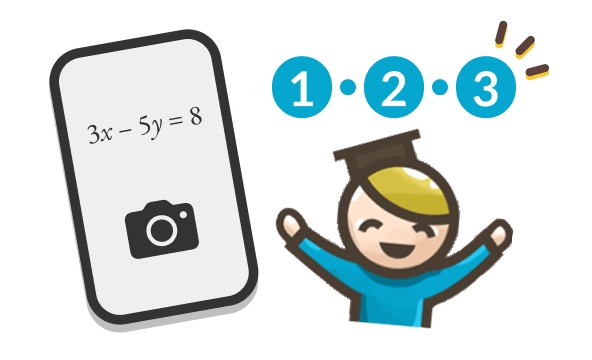
Search with Photo
Snap a photo of any problem and get the exact lesson
Expert Video Teaching
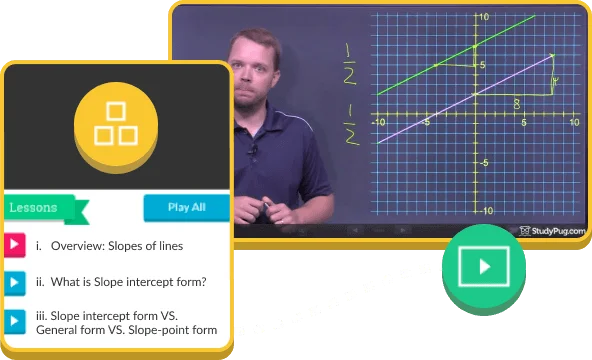
Expert Video Teaching
Certified teachers explain every concept with clear, real-world examples
Unlimited Practice
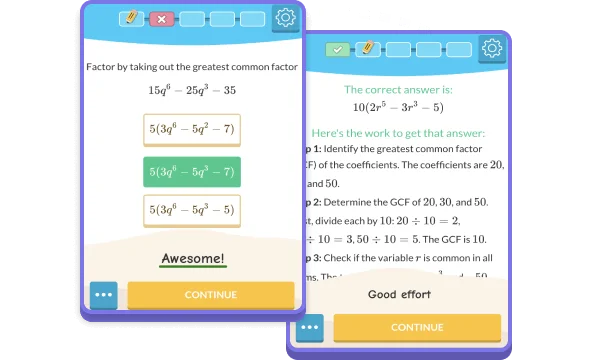
Unlimited Practice
Thousands of practice questions with step-by-step solutions
How Ontario Students Use StudyPug
1

Select Grade Level
Choose your Ontario grade (K-12) and current math topics.
2

Get Unstuck
Upload homework problems or browse curriculum-aligned lessons.
3

Practice & Master
Work through similar problems until concepts stick.
4

See Results
Track progress and watch grades improve week by week.
Find the right Ontario Grade 12 course
Grade 12 MEL4E Help: Master Workplace Math FastHelp
OE_ID | Expectations | StudyPug Topic |
|---|---|---|
ON.OE.12WE.A1.1 | 12WE.A1.1: Read and interpret graphs obtained from various sources |
ON.OE.12WE.A1.2 | 12WE.A1.2: Explain the distinction between the terms population and sample, describe the characteristics of a good sample, and explain why sampling is necessary |
ON.OE.12WE.A1.3 | 12WE.A1.3: Collect categorical data from primary sources, through experimentation involving observation or measurement, or from secondary sources, and organize and store the data using a variety of tools |
ON.OE.12WE.A1.4 | 12WE.A1.4: Represent categorical data by constructing graphs using a variety of tools |
ON.OE.12WE.A1.5 | 12WE.A1.5: Make inferences based on the graphical representation of data, and justify conclusions orally or in writing using convincing arguments |
ON.OE.12WE.A1.6 | 12WE.A1.6: Make and justify conclusions about a topic of personal interest by collecting, organizing, representing, and making inferences from categorical data |
ON.OE.12WE.A1.7 | 12WE.A1.7: Explain how the media, the advertising industry, and others use and misuse statistics to promote a certain point of view |
ON.OE.12WE.A1.8 | 12WE.A1.8: Gather, interpret, and describe information about applications of data management in the workplace and in everyday life |
ON.OE.12WE.A2.1 | 12WE.A2.1: Determine the theoretical probability of an event, and represent the probability in a variety of ways |
ON.OE.12WE.A2.2 | 12WE.A2.2: Identify examples of the use of probability in the media and various ways in which probability is represented |
ON.OE.12WE.A2.3 | 12WE.A2.3: Perform simple probability experiments, record the results, and determine the experimental probability of an event |
ON.OE.12WE.A2.4 | 12WE.A2.4: Compare, through investigation, the theoretical probability of an event with the experimental probability, and describe how uncertainty explains why they might differ |
ON.OE.12WE.A2.5 | 12WE.A2.5: Determine, through investigation using class-generated data and technology-based simulation models, the tendency of experimental probability to approach theoretical probability as the number of trials in an experiment increases |
ON.OE.12WE.A2.6 | 12WE.A2.6: Interpret information involving the use of probability and statistics in the media, and describe how probability and statistics can help in making informed decisions in a variety of situations |
ON.OE.12WE.B1.1 | 12WE.B1.1: Identify the financial implications and the non-financial implications associated with living independently |
ON.OE.12WE.B1.2 | 12WE.B1.2: Gather and compare, through investigation, information about the costs and the advantages and disadvantages of different types of rental accommodation in the local community |
ON.OE.12WE.B1.3 | 12WE.B1.3: Gather and compare, through investigation, information about purchase prices of different types of owned accommodation in the local community |
ON.OE.12WE.B1.4 | 12WE.B1.4: Gather, interpret, and compare information about the different types of ongoing living expenses associated with renting and owning accommodation and related costs |
ON.OE.12WE.B1.5 | 12WE.B1.5: Gather, interpret, and describe information about the rights and responsibilities of tenants and landlords |
ON.OE.12WE.B1.6 | 12WE.B1.6: Generate a checklist of necessary tasks associated with moving, and estimate the total cost involved under various conditions |
ON.OE.12WE.B2.1 | 12WE.B2.1: Categorize personal expenses as non-discretionary or discretionary |
ON.OE.12WE.B2.2 | 12WE.B2.2: Categorize personal non-discretionary expenses as fixed or variable |
ON.OE.12WE.B2.3 | 12WE.B2.3: Read and interpret prepared individual or family budgets, identify and describe the key components of a budget, and describe how budgets can reflect personal values |
ON.OE.12WE.B2.4 | 12WE.B2.4: Design, explain, and justify a monthly budget suitable for an individual or family described in a given case study that provides the specifics of the situation, with technology and without technology |
ON.OE.12WE.B2.5 | 12WE.B2.5: Identify and describe factors to be considered in determining the affordability of accommodation in the local community |
ON.OE.12WE.B2.6 | 12WE.B2.6: Make adjustments to a budget to accommodate changes in circumstances, with technology |
ON.OE.12WE.B3.1 | 12WE.B3.1: Explain why most Canadians are expected to file a personal income tax return each year, and identify and describe the major parts of a personal income tax return |
ON.OE.12WE.B3.2 | 12WE.B3.2: Gather, interpret, and describe the information and documents required for filing a personal income tax return, and explain why they are required |
ON.OE.12WE.B3.3 | 12WE.B3.3: Gather, interpret, and compare information about common tax credits and tax deductions |
ON.OE.12WE.B3.4 | 12WE.B3.4: Complete a simple personal income tax return, with or without tax preparation software |
ON.OE.12WE.B3.5 | 12WE.B3.5: Gather, interpret, and describe some additional information that a self-employed individual should provide when filing a personal income tax return |
ON.OE.12WE.B3.6 | 12WE.B3.6: Gather, interpret, and describe information about services that will complete a personal income tax return and resources that will help with completing a personal income tax return, and compare the services and resources |
ON.OE.12WE.B3.7 | 12WE.B3.7: Gather, interpret, and describe information about applications of the mathematics of personal finance in the workplace |
ON.OE.12WE.C1.1 | 12WE.C1.1: Measure, using a variety of tools, the lengths of common objects and the capacities of common containers, using the metric system and the imperial system |
ON.OE.12WE.C1.2 | 12WE.C1.2: Estimate lengths, distances, and capacities in metric units and in imperial units by applying personal referents |
ON.OE.12WE.C1.3 | 12WE.C1.3: Estimate quantities, and describe the strategies used |
ON.OE.12WE.C1.4 | 12WE.C1.4: Convert measures within systems, as required within applications that arise from familiar contexts |
ON.OE.12WE.C1.5 | 12WE.C1.5: Convert measures between systems, as required within applications that arise from familiar contexts |
ON.OE.12WE.C2.1 | 12WE.C2.1: Construct accurate right angles in practical contexts, and explain connections to the Pythagorean theorem |
ON.OE.12WE.C2.2 | 12WE.C2.2: Apply the concept of perimeter in familiar contexts |
ON.OE.12WE.C2.3 | 12WE.C2.3: Estimate the areas and volumes of irregular shapes and figures, using a variety of strategies |
ON.OE.12WE.C2.4 | 12WE.C2.4: Solve problems involving the areas of rectangles, triangles, and circles, and of related composite shapes, in situations arising from real-world applications |
ON.OE.12WE.C2.5 | 12WE.C2.5: Solve problems involving the volumes and surface areas of rectangular prisms, triangular prisms, and cylinders, and of related composite figures, in situations arising from real-world applications |
ON.OE.12WE.C2.6 | 12WE.C2.6: Construct a two-dimensional scale drawing of a familiar setting on grid paper or using design or drawing software |
ON.OE.12WE.C2.7 | 12WE.C2.7: Construct, with reasonable accuracy, a three-dimensional scale model of an object or environment of personal interest |
ON.OE.12WE.C2.8 | 12WE.C2.8: Investigate, plan, design, and prepare a budget for a household improvement, using appropriate technologies |
ON.OE.12WE.C3.1 | 12WE.C3.1: Identify and describe applications of ratio and rate, and recognize and represent equivalent ratios and equivalent rates, using a variety of tools |
ON.OE.12WE.C3.2 | 12WE.C3.2: Identify situations in which it is useful to make comparisons using unit rates, and solve problems that involve comparisons of unit rates |
ON.OE.12WE.C3.3 | 12WE.C3.3: Identify and describe real-world applications of proportional reasoning, distinguish between a situation involving a proportional relationship and a situation involving a non-proportional relationship in a personal and/or workplace context, and explain their reasoning |
ON.OE.12WE.C3.4 | 12WE.C3.4: Identify and describe the possible consequences of errors in proportional reasoning |
ON.OE.12WE.C3.5 | 12WE.C3.5: Solve problems involving proportional reasoning in everyday life |
ON.OE.12WE.C3.6 | 12WE.C3.6: Solve problems involving proportional reasoning in work-related situations |
Complete Ontario Grade 12 Mathematics for Work and Everyday Life, Workplace Preparation (MEL4E) Coverage
Grade 12 MEL4E Lessons
117
Video Explanations
895
Practice Problems
1183
Ontario Standards
100% Aligned
Why Ontario Grade 12 MEL4E Students Love StudyPug

OSSLT Preparation
OSSLT Preparation
Practice with real workplace math scenarios—be ready for everyday life applications

Canadian Certified Teachers
Canadian Certified Teachers
Learn from expert Ontario teachers who know exactly what you need for MEL4E
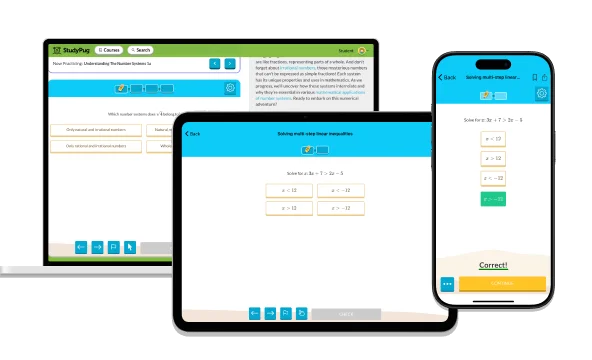
Learn Anywhere
Learn Anywhere
Desktop, tablet, or phone—your MEL4E lessons sync across all devices
Success Stories
Personal finance was confusing. The budget videos made it simple. Went from failing to passing in six weeks.
Jordan Smith
Measurement conversions never made sense. The photo search found exact lessons I needed. Finally understand metric and imperial.
Taylor Williams
Read More
Frequently Asked Questions
Everything you need to know about mastering Grade 12 MEL4E with StudyPug
What does Grade 12 MEL4E coverage include?
Complete MEL4E curriculum with video lessons on budgeting, data analysis, measurement, and workplace math. Includes practice problems, step-by-step solutions, and progress tracking for every topic.
How does photo search work?
Take a photo of any workplace math problem, and StudyPug finds the exact lesson teaching that concept. It's like having a personal tutor who knows exactly what you need.
Are the teachers certified Ontario educators?
Yes! Our teachers are Canadian certified Ontario educators who understand MEL4E curriculum and create lessons specifically for workplace preparation standards.
Can I use StudyPug on my phone or tablet?
Absolutely! StudyPug works on desktop, tablet, and mobile. Your progress syncs automatically so you can learn workplace math anywhere, anytime.
How will StudyPug help me with real-world applications?
We include practical scenarios for budgets, tax returns, measurement, and more. Students report improved confidence applying math to everyday life and workplace situations.
Practice Smart, See Real Progress

Unlimited Targeted Practice
10,000+ questions adjust to your exact skill level. Never run out of problems that challenge you.
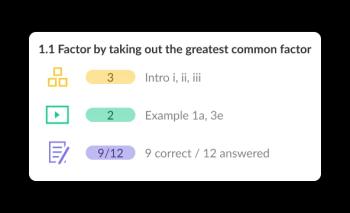
Visual Progress Tracking
See mastery percentage for every topic. Parents get weekly progress emails automatically.
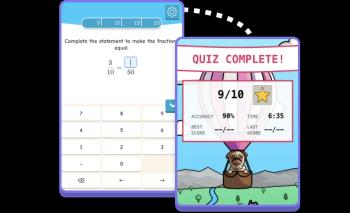
Achievement System
Earn badges for consistency and improvement. Build learning streaks that motivate daily practice
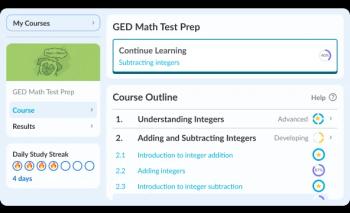
Detailed Analytics
Time spent, problems solved, concepts mastered. Identify exactly where more practice is needed.