Grade 12 Trigonometry Help — Video Lessons & Practice
Get clear, step-by-step explanations for every trig topic and build exam-ready confidence.
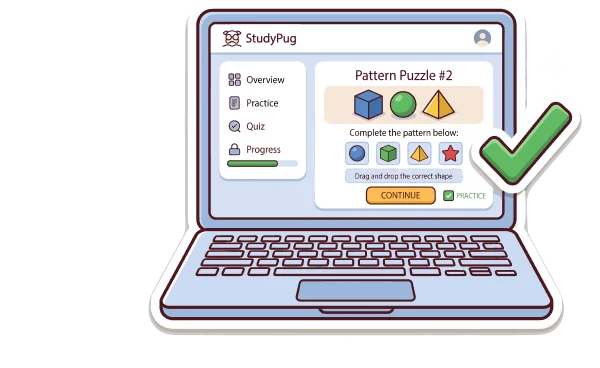
Value vs. Private Tutor
Expert trigonometry help without the cost.
Multi-Subject
One flexible plan for mastering every subject.
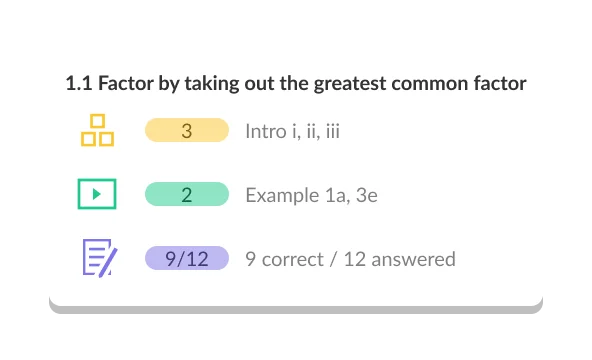
Practice Until Perfect
Practice trig daily until it clicks.
Try It Now
Test your knowledge
Our approach aligns with the evidence
Exam Scores
Better Recall
Less Anxiety
Trigonometry Topics
1. Right Triangle Trigonometry
2. Trigonometric Ratios and Angle Measure
3. Bearings
4. Graphing Trigonometric Functions
5. Applications of Trigonometric Functions
6. Trigonometric Identities
7. Solving Trigonometric Equations
8. Inverse Trigonometric Functions
9. Imaginary and Complex Numbers
9 Chapters · 60 Topics · 284 Videos
Discover Our Learning Areas
Explore key subjects and start learning with interactive content.




What Is Grade 12 Trigonometry?
Grade 12 Trigonometry is the study of angles, the unit circle, trigonometric functions, identities, and equations at an advanced level. In Canada, it forms a core part of courses such as Ontario's Advanced Functions (MHF4U), BC's Pre-Calculus 12, and Alberta's Math 30-1 and Math 30-2. If you are taking any of these courses, you will spend a significant portion of the year working through trig — and what you learn here directly shapes how well you perform in first-year university calculus.
Grade 12 Trig moves beyond the basic SOH-CAH-TOA from earlier grades. You will work with exact values, radian measure, the full unit circle, compound and double angle identities, and solving trig equations over defined domains. It is abstract, rigorous, and — with the right approach — completely learnable.
What Topics Are Covered in Grade 12 Trigonometry?
Grade 12 Trigonometry in Canadian curricula typically includes the following core areas:
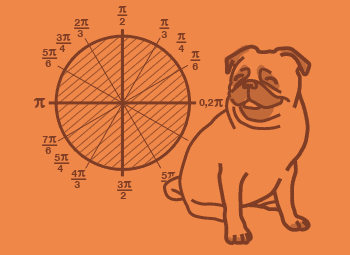
The Unit Circle and Radian Measure. Understanding how angles relate to coordinates on the unit circle, converting between degrees and radians, and recalling exact trig values for standard angles (30°, 45°, 60°, 90°, and their equivalents in radians) are foundational skills for everything that follows.
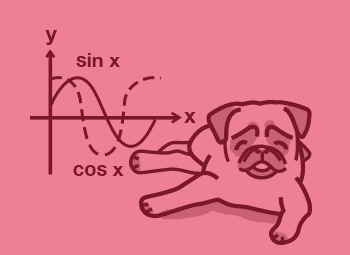
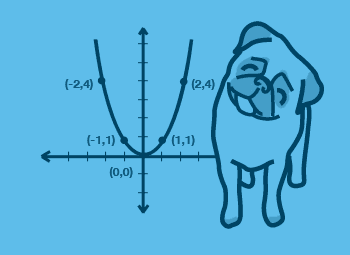
Trigonometric Functions and Their Graphs. You will analyse the graphs of sine, cosine, and tangent — including transformations such as amplitude, period, phase shift, and vertical shift. Understanding what each parameter does to the graph is a common source of exam questions.
Trigonometric Identities. Pythagorean identities, quotient identities, compound angle formulas, and double angle formulas are all tested. Proving identities is one of the most challenging skills in the course and requires both algebraic fluency and strategic thinking.
Solving Trigonometric Equations. This involves finding all solutions to equations like 2sin(x) − 1 = 0 over a given interval, applying factoring, substitution, and identity manipulation to reduce complex equations to solvable forms.
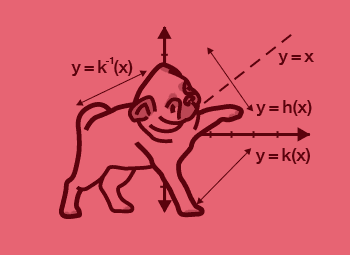
Inverse Trigonometric Functions. Understanding the domain restrictions that make inverse trig functions possible, and evaluating expressions involving arcsin, arccos, and arctan.
Is Grade 12 Trigonometry Hard?
Most students find it hard — and there are specific reasons why. The subject is cumulative: a shaky understanding of reference angles or the CAST rule from Grade 11 will create compounding problems as you move into identities and equations. Students often describe the difficulty not as the concepts being impossible, but as there being too many rules to keep track of without a clear structure for when to apply each one.
The good news is that the difficulty is predictable. Proving identities trips up students who try to memorise proof steps rather than learning the underlying strategy. Solving trig equations feels impossible until you realise it reduces to familiar algebra once you substitute the right identity. The pattern recognition needed for both skills comes from deliberate, varied practice — not from passively re-reading your textbook.
A diagnostic that shows you exactly where your gaps are is a much faster path to improvement than reviewing everything from scratch. That is how StudyPug's approach is built: identify the gap, watch the method, practise it adaptively until it sticks.
How Is Trigonometry Tested in Canadian Provinces?
The answer varies by province, but trig is heavily weighted across all of them.
In Ontario, Advanced Functions (MHF4U) is a required Grade 12 course for university-bound STEM students. There is no external provincial exam; your school administers the final. Trig units — including identities, equations, and function analysis — typically make up a large share of the course.
In British Columbia, Pre-Calculus 12 includes a provincial exam component that counts toward your final grade. Trig topics including the unit circle, identities, and transformations of trig functions are explicitly assessed.
In Alberta, Math 30-1 (for students heading to calculus-based university programs) and Math 30-2 both carry provincial diploma exams. Math 30-1 has a heavier trig identity and equation load; Math 30-2 focuses more on applications. Both diploma exams count for 30% of your final mark — making exam-style practice essential, not optional.
Across all provinces, being able to prove identities, solve equations algebraically, and interpret trig graphs under timed conditions is what separates high-achieving students from those who just scrape through.
Why StudyPug for Grade 12 Trigonometry?
StudyPug is built around three things that matter most for Grade 12 Trig: finding your gaps fast, understanding the method, and building the practice habit before the exam.
Diagnostic Assessment. When you start, a quick diagnostic assessment identifies exactly which trig topics you need to work on. You do not waste sessions reviewing material you already know — you go straight to what needs fixing. For a course where every topic builds on the last, this is the most efficient way to catch up or get ahead.
Certified-Teacher Video Lessons. Every lesson is taught by a certified teacher who walks you through the method, not just the final answer. For trig identities in particular, seeing someone narrate their thinking as they work through a proof — choosing where to start, which substitution to try, what to avoid — is what makes the strategy learnable. These lessons are not AI-generated; they are made by teachers who know where students get stuck and who structure explanations to prevent it.
Adaptive Practice. After watching a lesson, practice problems adjust in difficulty based on how you are performing. If you are getting questions right consistently, the difficulty increases to keep you challenged. If you are struggling, the system serves similar problems at a slightly simpler level so you build the underlying fluency before moving on. This is how you go from understanding a video to actually being able to perform on a test.
Provincial Curriculum Alignment. Lessons are organised to match Canadian provincial curricula. Whether you are working through Ontario MHF4U, BC Pre-Calculus 12, or Alberta Math 30-1 or 30-2, the topics in StudyPug map to what your course covers — so every session is relevant to your next test, not just trig in general.
What You Learn: Grade 12 Trigonometry Curriculum Coverage
StudyPug's Grade 12 Trigonometry coverage is aligned to the core outcomes across Canadian provinces. The main topic areas you will find include:
- Radian and degree measure; arc length and sector area
- The unit circle: coordinates, exact values, and the CAST rule
- Graphs of sine, cosine, and tangent: amplitude, period, phase shift, vertical shift
- Pythagorean, reciprocal, and quotient identities
- Compound angle and double angle formulas
- Proving trigonometric identities: strategy and worked examples
- Solving trigonometric equations algebraically and graphically
- Inverse trigonometric functions: domain restrictions and evaluation
- Applications of trig functions to real-world contexts
Each topic has its own video lesson, worked examples, and practice problem set. You can work through the full course in order, or jump directly to the topic your next test covers.
Note: No validated internal topic-page links are available for this course in the current sitemap. Links will be added once URLs are confirmed in the SP_PageFeed.
How to Use StudyPug for Grade 12 Trigonometry
The most effective StudyPug workflow for trig is straightforward. Start with the diagnostic to see where you stand across all trig topics. Then work lesson by lesson through the areas flagged as weak — watch the full video, take notes on the method, and immediately do the practice problems while the approach is fresh in your mind.
For exam prep, use the practice tests to simulate test conditions. Work through each question without pausing to check notes; then watch the video solution for every question you got wrong or were unsure about. This review loop — attempt, check, understand the method — is what builds the reliable performance you need on a timed provincial exam or school final.
You can access StudyPug on any device, so you can fit a lesson into a study block between classes or work through practice problems the night before a test. Free daily practice problems are available without a subscription. Full access to all video lessons, adaptive practice sets, and exam prep is available with a subscription, backed by a 30-day money-back guarantee.
Trigonometry FAQ
Unsure how StudyPug works? Need help with setting up? Check our frequently asked questions or contact us for help.
What do you learn in Grade 12 Trigonometry, and what topics does it cover?
Grade 12 Trigonometry covers advanced trig concepts including the unit circle, radian and degree measure, trig functions and their graphs, trigonometric identities (Pythagorean, compound angle, double angle), solving trig equations, and inverse trig functions. In most Canadian provincial curricula, these topics appear within the Advanced Functions or Pre-Calculus course. The goal is to build fluency with trig reasoning you will use directly in calculus and other STEM courses.
What is the difference between Trigonometry and Advanced Functions?
Trigonometry is a major unit within Advanced Functions (or Pre-Calculus 12, depending on province), not a fully separate course at most Canadian schools. Advanced Functions also covers polynomial, rational, exponential, and logarithmic functions. Trigonometry focuses specifically on angles, the unit circle, trig ratios, identities, and equations. Think of trig as one of the most exam-weighted chapters inside the broader Advanced Functions course — it typically accounts for a significant portion of provincial assessments.
Is Grade 12 Trigonometry hard, and where do students struggle most?
Many students find Grade 12 Trig genuinely challenging. The biggest stumbling blocks are trig identities (especially proving them), converting fluently between radians and degrees, and solving trig equations over a restricted domain. Students often struggle because earlier gaps in Grade 11 trig go unaddressed. The concepts build on each other quickly, so small misunderstandings about the unit circle or CAST rule compound fast. Targeted practice on each concept — rather than re-reading notes — is what closes those gaps most efficiently.
What should I take before Grade 12 Trigonometry, and what comes after it?
You should be comfortable with Grade 11 trig fundamentals — primary trig ratios (SOH-CAH-TOA), the CAST rule, reference angles, and basic trig equations — before tackling Grade 12 content. After Grade 12 Trig, the natural next step is university-level Calculus, where trig derivatives, integrals, and limits appear constantly. Students heading into engineering, physics, or computer science will also encounter trig in linear algebra, signals, and graphics. A strong Grade 12 trig foundation is one of the clearest predictors of success in first-year university math.
Is Trigonometry on the provincial exam, and how is it tested?
Yes. In Ontario, trig is a core part of the Grade 12 Advanced Functions (MHF4U) course, which is evaluated through your school's final exam — there is no external provincial exam, but the course is required for university STEM admission. In British Columbia, trig is assessed in Pre-Calculus 12, including the provincial exam component. In Alberta, it appears in Math 30-1 and Math 30-2, both of which have provincial diploma exams. Exam questions test identity proofs, solving equations algebraically and graphically, and interpreting trig graphs.
What is one of the hardest concepts in Grade 12 Trigonometry, and how do you tackle it?
Proving trigonometric identities is consistently the concept students find hardest. Unlike solving equations, proofs require you to transform one side of the equation into the other using algebraic manipulation and known identities — there is no single algorithm. The key strategy is to start with the more complex side, convert everything to sine and cosine, look for Pythagorean identity substitutions, and work systematically without touching the other side. Regular practice with a wide variety of identity types — not just memorising formulas — is what builds the pattern recognition you need on exams.




Written by the StudyPug Team
Last updated June 5, 2026
3 M+
students
★★★★★
4.8 average
K–12
all grades