TOPIC
Sorting Materials, Grouping by observable propertiesMY PROGRESS
Pug Score
0%
Getting Started
"Let's build your foundation!"
Best Streak
0 in a row
Study Points
+0
Overview
Practice
Read
Quiz
Next Steps
Get Started
Get unlimited access to all videos, practice problems, and study tools.
Back to Menu
Topic Progress
Pug Score
0%
Getting Started
"Let's build your foundation!"
Best Practice
No score
Read
Not viewed
Best Quiz
No attempts
Best Streak
0 in a row
Study Points
+0
Overview
Practice
Read
Quiz
Next Steps
Read
Sort and Group Objects by What You Can See and Feel!
You will learn how to sort and group objects by their observable properties, like color, shape, size, texture, and sound.
What Are Observable Properties?
You can learn about objects by looking at them, touching them, and listening to them. The things you notice are called observable properties.
You use your senses to find these properties. Your eyes, hands, and ears all help you sort!
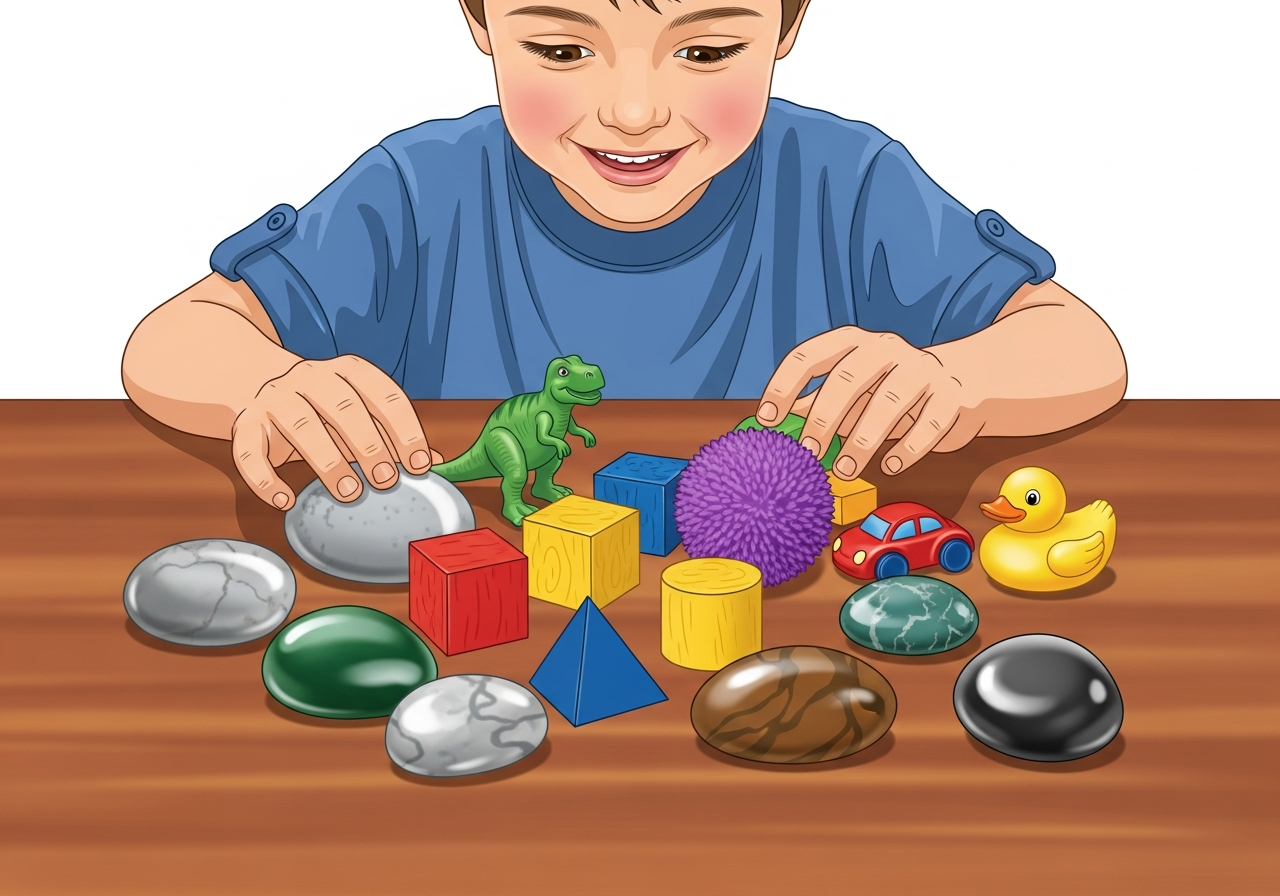
When you sort objects, you put things that are the same into one group. This is called classification!
Ways You Can Sort Objects
Sort by Color
You can look at objects and group them by color. Blue things go in the blue group. Red things go in the red group!
Sort by Shape
You can group objects by their shape. Round balls go in one box. Square blocks go in another box. That is sorting by shape!
Sort by Size
You can sort objects by how big or small they are. A tiny marble goes in the small group. A big ball goes in the large group.
Sort by Texture How Things Feel
You can feel objects with your hands. Some things feel rough, like a pinecone. Some things feel smooth, like a rock. This is called texture!
Some things feel soft, like a stuffed toy or a pillow. Some things feel hard, like a wooden block. You can sort soft things in one group and hard things in another.
Sort by Shine Shiny or Dull
You can look at rocks and objects to see if they shine. A shiny object sparkles when light hits it. A dull object does not shine. You can sort objects into a shiny group and a dull group!
Sort by Sound
You can shake objects and listen. Some objects are noisy they make a loud sound. Some objects are quiet they make no sound. You can sort them by how they sound!
Sort by Temperature
You can feel if something is warm or cold. This is called temperature. Warm things go in one group. Cold things go in another group.
Sort by Function What Things Do
You can also group toys by what they do. All toy cars go together. All stuffed animals go together. This is sorting by function!
Key Terms and Definitions
Observable Property: An observable property is something you can notice about an object using your senses. You can see color, feel texture, and hear sounds!
Sort: When you sort, you put objects into groups based on something they share. You might sort blocks by color or size.
Group: A group is a set of things that are alike in some way. All red objects make one group!
Color: Color is what you see when you look at an object. Red, blue, and yellow are all colors you can sort by.
Shape: Shape is how an object looks round, square, or triangle. You can sort blocks by their shape!
Size: Size tells you how big or small something is. You can sort objects into small, medium, and large groups.
Texture: Texture is how something feels when you touch it. A pinecone feels rough. A smooth rock feels flat and even.
Rough: Rough means bumpy and uneven when you touch it. A pinecone or tree bark feels rough.
Smooth: Smooth means flat and even when you touch it. A polished rock or a glass feels smooth.
Hard: Hard means an object does not squish when you press it. Wooden blocks and rocks are hard.
Soft: Soft means an object feels gentle and squishes a little. Stuffed toys, pillows, and blankets are soft.
Shiny: Shiny means an object sparkles or glows when light hits it. Some rocks and metal objects are shiny.
Dull: Dull means an object does not shine or sparkle. A rock that does not shine is dull.
Temperature: Temperature tells you if something feels warm or cold when you touch it. You can sort objects by temperature!
Function: Function means what something does or how it is used. You can group toys by their function like all cars together.
Classification: Classification means sorting things into groups based on what they have in common. You classify objects every time you sort them!
Fun Sorting Activities You Can Try
You can sort objects at home or in your classroom! Try sorting your crayons by color. Put all the red ones together and all the blue ones together.
You can also sort rocks from outside. Feel each rock is it smooth or rough? Is it shiny or dull? Put rocks that feel the same into one group.
Try sorting your toys! Put all the soft stuffed animals in one pile. Put all the hard toy cars in another pile. You are sorting by texture!
What You Already Know
You already use your senses every day! You look at things, touch things, and listen to sounds around you. These skills help you sort and group objects.
You know what colors look like. You know if something feels soft or hard. Now you can use what you know to sort and classify!
Related Topics and Connections
Sorting and grouping objects is a big idea in science! When you learn to sort by observable properties, you are learning the skill of classification. Scientists use classification to organize everything in the world around them.
You use sorting every day when you put toys away, when you pick out clothes by color, or when you group your crayons. These are all real-life examples of grouping by observable properties!
As you keep learning science, you will use sorting skills to group plants, animals, rocks, and many other things. The skills you learn here will help you in all your future science lessons.