Topic
My Progress
Pug Score
0%
Best Streak
0 in a row
Study Points
+0
Overview
Practice
Watch
Read
Quiz
Next Steps
Overview
Practice
Watch
Read
Quiz
Next Steps
Read
Discover Material Properties: Color, Texture, Hardness, and Flexibility!
You will learn how to describe objects by their color, texture, hardness, and flexibility these are called material properties.
Everything around you has special features. These features are called properties. You can use your eyes and hands to find them!
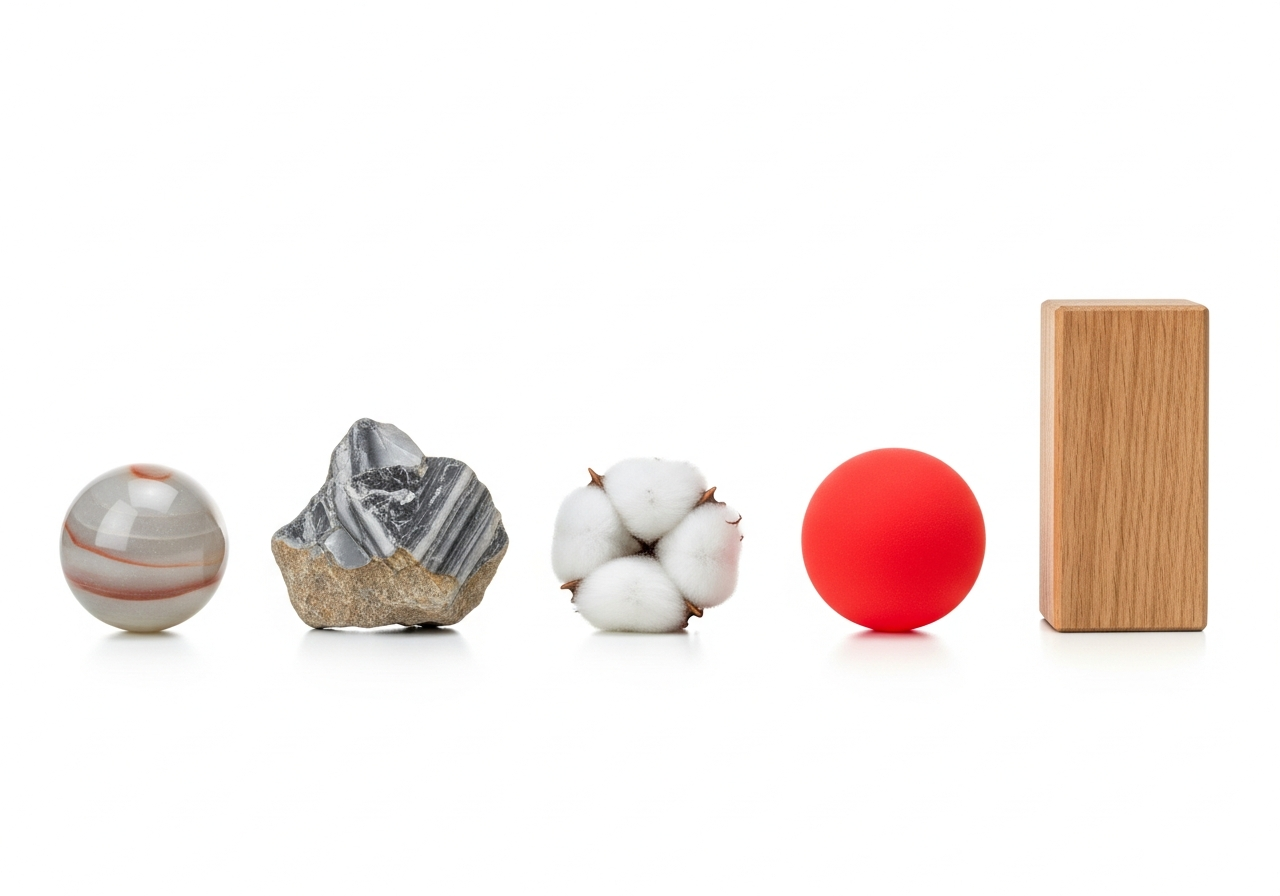
You can look at an object to see its color. You can touch it to feel its texture. You can press it to test if it is hard or soft. You can bend it to see if it is flexible.
Color
Color is what you see when you look at an object. A lemon is yellow. A brick is red. A cotton ball is white.
You can sort objects by their color. Try looking around your room what colors do you see?
Texture
Texture is how something feels when you touch it. Some things feel smooth, like a marble or a wooden block. Some things feel rough or bumpy, like a rock or sandpaper.
Some things feel soft and fluffy, like a cotton ball or a stuffed animal. Some things feel fuzzy, like a blanket.

Hardness
Hardness tells you if something is easy or hard to squish. A rock is hard you cannot squish it. A sponge is soft you can squish it easily.
Wood blocks, metal spoons, and coins are all hard. Cotton balls and stuffed animals are soft. You can test hardness by pressing on something with your fingers!
Flexibility
Flexibility means something can bend without breaking. A rubber ball is flexible it can change shape and bounce back. A rubber eraser can bend a little too.
Plastic wrap is also flexible you can fold and twist it. Hard things like rocks and wooden blocks are not flexible. They do not bend.
Other Properties You Can Observe
Some objects are fragile they break easily. A glass cup is fragile. You must be careful with fragile things!
Some objects are transparent you can see through them. Plastic wrap is transparent. Some objects are shiny, like a coin. Some objects feel heavy, like a pineapple or a wooden block.
Key Terms and Definitions
Properties: Properties are special features of an object. You can see or feel properties. Color, texture, hardness, and flexibility are all properties.
Color: Color is what you see when you look at something. A lemon is yellow. A brick is red. A cotton ball is white.
Texture: Texture is how something feels when you touch it. A rock feels rough and bumpy. A cotton ball feels soft and fluffy.
Smooth: Smooth means something feels flat and even when you touch it. A marble feels smooth. A wooden block can feel smooth too.
Rough: Rough means something feels bumpy or uneven. A rock feels rough. Sandpaper feels rough too.
Bumpy: Bumpy means you can feel little bumps on something. A lemon has a bumpy skin. A brick feels bumpy too.
Soft: Soft means something feels gentle and easy to squish. A cotton ball is soft. A stuffed animal is soft too.
Fluffy: Fluffy means something feels light and airy when you touch it. Cotton balls are fluffy and white.
Fuzzy: Fuzzy means something has tiny soft fibers you can feel. A fuzzy blanket feels soft and warm.
Hard: Hard means something does not squish or bend when you press it. A rock is hard. A wooden block is hard. A coin is hard.
Hardness: Hardness is a property that tells you how easy or hard it is to squish something. You test hardness by pressing on an object.
Flexibility: Flexibility means something can bend without breaking. A rubber ball is flexible. Plastic wrap is flexible too.
Flexible: Flexible means you can bend or fold something. Clay is flexible you can push it into different shapes.
Fragile: Fragile means something breaks easily. A glass cup is fragile. You must handle fragile things with care.
Transparent: Transparent means you can see through something. Plastic wrap is transparent. You can see what is under it!
Shiny: Shiny means something reflects light and looks bright. A coin is shiny. Metal objects are often shiny.
Heavy: Heavy means something weighs a lot when you pick it up. A pineapple feels heavy. A wooden block feels heavier than a plastic block.
Fun Ways to Practice Material Properties
You can pick up objects at home and sort them! Put hard things in one group and soft things in another group.
You can close your eyes and touch different things. Can you tell if something is smooth or rough just by feeling it? Try it with a rock, a cotton ball, and a wooden block!
You can also sort objects by color. Find all the red things, then all the yellow things. You are using your eyes to observe a property!
Getting Ready to Learn
You already know how to use your senses your eyes and your hands. That is all you need to start exploring material properties!
When you look at something, you can see its color. When you touch something, you can feel its texture and hardness. You are already a scientist!
Related Topics and Connections
Learning about material properties is a great start to science! As you keep learning, you will explore more about the world around you.
You are building skills to observe, sort, and describe objects. These skills will help you in all your science learning. Keep exploring and touching things around you every object has properties you can discover!