TOPIC
Scientific Tools, Basic measurement instrumentsMY PROGRESS
Pug Score
0%
Getting Started
"Let's build your foundation!"
Best Streak
0 in a row
Study Points
+0
Overview
Practice
Watch
Read
Quiz
Next Steps
Get Started
Get unlimited access to all videos, practice problems, and study tools.
Back to Menu
Topic Progress
Pug Score
0%
Getting Started
"Let's build your foundation!"
Videos Watched
0/0
Best Practice
No score
Read
Not viewed
Best Quiz
No attempts
Best Streak
0 in a row
Study Points
+0
Overview
Practice
Watch
Read
Quiz
Next Steps
Read
Discover Scientific Tools & Basic Measurement Instruments!
You will learn about scientific tools and basic measurement instruments, and you will discover which tool to use when measuring length, temperature, weight, time, and volume.
What Are Scientific Tools?
Scientists use special tools to measure and observe things. You can use these same tools to explore the world around you! Each tool has one special job it does best.

When you pick the right tool, you get the right answer. Learning which tool to use is an important science skill!
Tools That Measure Length
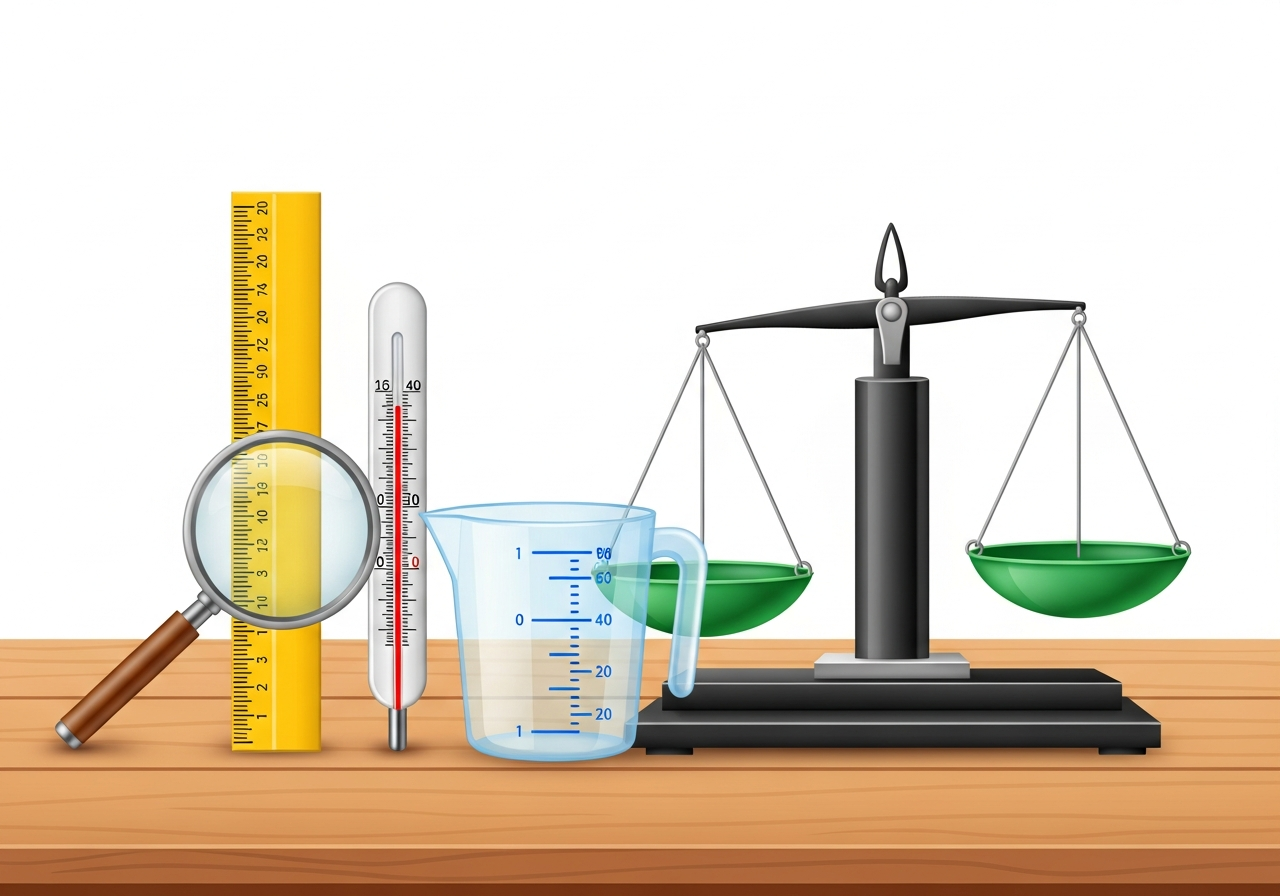
A ruler measures how long or tall something is. You can use a ruler to measure how tall a plant has grown or how deep a puddle is. Rulers show numbers in inches or centimeters.
A measuring tape is like a long, bendy ruler. You can use it to measure longer distances, like how far a paper airplane flies or how far apart to plant seeds in a garden.
Tools That Measure Temperature
A thermometer measures how hot or cold something is. It shows numbers called degrees. You can use a thermometer to check if a classroom is warm or to track when ice starts to melt.
Tools That Measure Volume and Weight
A measuring cup measures how much liquid or material fits in a space. You can use it to measure water for a fish tank, rainfall in a weather station, or flour for baking cookies.
A balance scale measures how heavy something is. You can place objects on each side to see which one weighs more. A scale helps you compare the weight of rocks, apple slices, or any object.
Tools That Measure Time
A timer or stopwatch measures how long something takes. You can use a timer to track how many minutes you spend drawing or how long it takes seeds to sprout.
Tools That Help You Observe
A magnifying glass makes tiny things look bigger. You can use it to see the tiny veins on a leaf, the legs of an ant, or the patterns on a butterfly wing.
A telescope makes faraway things look closer. You can use it to see the craters on the moon. A magnet is a tool that pulls certain metal objects toward it, helping you discover which materials are magnetic.
More Measurement Tools
A rain gauge collects and measures how much rain fell from the sky. Gardeners use it to know if their plants got enough water.
A compass shows directions and always points north. You can use a compass on a nature walk to find the right trail. An anemometer measures how fast the wind is blowing at a weather station.
Key Terms & Definitions
Ruler: A ruler is a flat tool with numbers on it that you use to measure how long, tall, or deep something is, in inches or centimeters.
Measuring Tape: A measuring tape is a long, flexible strip with numbers that you use to measure longer distances or lengths.
Thermometer: A thermometer is a tool that shows you how hot or cold something is by displaying numbers called degrees.
Measuring Cup: A measuring cup is a tool with lines and numbers that you use to measure how much liquid or material, like water or sand, you have.
Balance Scale: A balance scale is a tool you use to measure how heavy something is by comparing objects on each side.
Timer / Stopwatch: A timer or stopwatch is a tool that measures how many seconds, minutes, or hours something takes.
Magnifying Glass: A magnifying glass is a tool with a curved lens that makes small objects look bigger so you can see tiny details.
Telescope: A telescope is a tool that makes faraway objects look closer and bigger, like the moon and its craters.
Magnet: A magnet is a tool that pulls certain metal objects toward it, helping you find out which materials are magnetic.
Rain Gauge: A rain gauge is a tool that collects rainwater and measures how much rain fell during a storm.
Compass: A compass is a tool that always points north and helps you find directions when you are exploring outdoors.
Anemometer: An anemometer is a tool that measures how fast the wind is blowing.
Length: Length is how long or tall something is, and you measure it with a ruler or measuring tape.
Temperature: Temperature is how hot or cold something is, and you measure it with a thermometer.
Weight: Weight is how heavy something is, and you measure it with a balance scale.
Volume: Volume is how much space a liquid or material takes up, and you measure it with a measuring cup.
Fun Ways to Practice Using Scientific Tools
You can measure plants in your classroom or at home with a ruler. Try measuring how tall they grow each week and write the numbers down!
You can use a measuring cup to measure water or sand. See how many cups of sand fit in a bucket, just like Emma did in her sandbox discovery.
Look at small objects like leaves or rocks with a magnifying glass. You will be amazed at the tiny details you can see up close!
What You Already Know
You already know how to observe things around you with your eyes. Scientific tools help you observe and measure even better than your eyes alone can.
You know that numbers help us count and compare things. Scientific tools use numbers to give you exact measurements so you can share what you find with others.
Related Topics & Connections
Learning about scientific tools is your first big step into the world of science. As you keep learning, you will use these tools in many other science topics. Every time you do a science experiment, you will reach for one of these tools to help you measure and observe!
The skills you build here, choosing the right tool and reading its measurements, will help you in every science lesson you explore in the future. You are building the foundation of being a real scientist!