Topic
My Progress
Pug Score
0%
Study Points
+0
Overview
Watch
Read
Next Steps
Overview
Watch
Read
Next Steps
Read
Mastering Two-Dimensional Vector Problems
In this lesson, we will learn:
- How to solve two dimensional vector problems using the law of sines and the law of cosines
Notes:
- Often, vector equations in physics problems result in vector triangles which can be solved using trigonometry
- At least three pieces of information are needed to solve a triangle, which can be three side lengths (SSS), two side lengths and one angle (SSA, SAS), or one side length and two angles (SAA, ASA).
- Knowing three angles (AAA) does not let you solve a triangle since you will not be able to solve for the side lengths. There is no way to know the size of the triangle without more information.
- You can always solve a triangle that you know four or more pieces of information about.
- Vector triangles that do not contain right angles can be solved either by breaking vectors into their components or using the law of sines and the law of cosines, which are trigonometric laws that apply to all triangles
Law of Sines
\(\frac{a}{sinA} = \frac{b}{sinB} = \frac{c}{sinC}\)
a,b,c: length of sides a,b,c
A,B,C: angles opposite sides a, b, c
Law of Cosines
\(c^2 = a^2 + b^2 - 2ab \,cosC \)
In this article, we've explored two essential approaches to solving vector problems: component-based and trigonometric methods. Understanding both techniques is crucial for success in physics and engineering. The component-based method breaks vectors into their x and y components, allowing for easier calculations and analysis. On the other hand, the trigonometric method utilizes angle measurements and trigonometric functions to solve vector problems. Each approach has its strengths, and mastering both will greatly enhance your problem-solving abilities. To reinforce your understanding, it's vital to practice regularly with a variety of problems. We encourage you to seek out additional resources, such as online tutorials, textbooks, and problem sets. Consider joining study groups or seeking help from instructors to further solidify your knowledge. Remember, proficiency in vector analysis is a valuable skill that will serve you well in your academic and professional pursuits. Keep practicing and exploring these concepts to build a strong foundation in vector mathematics.
Example:
Use the law of cosines to solve triangles
For the following triangle:
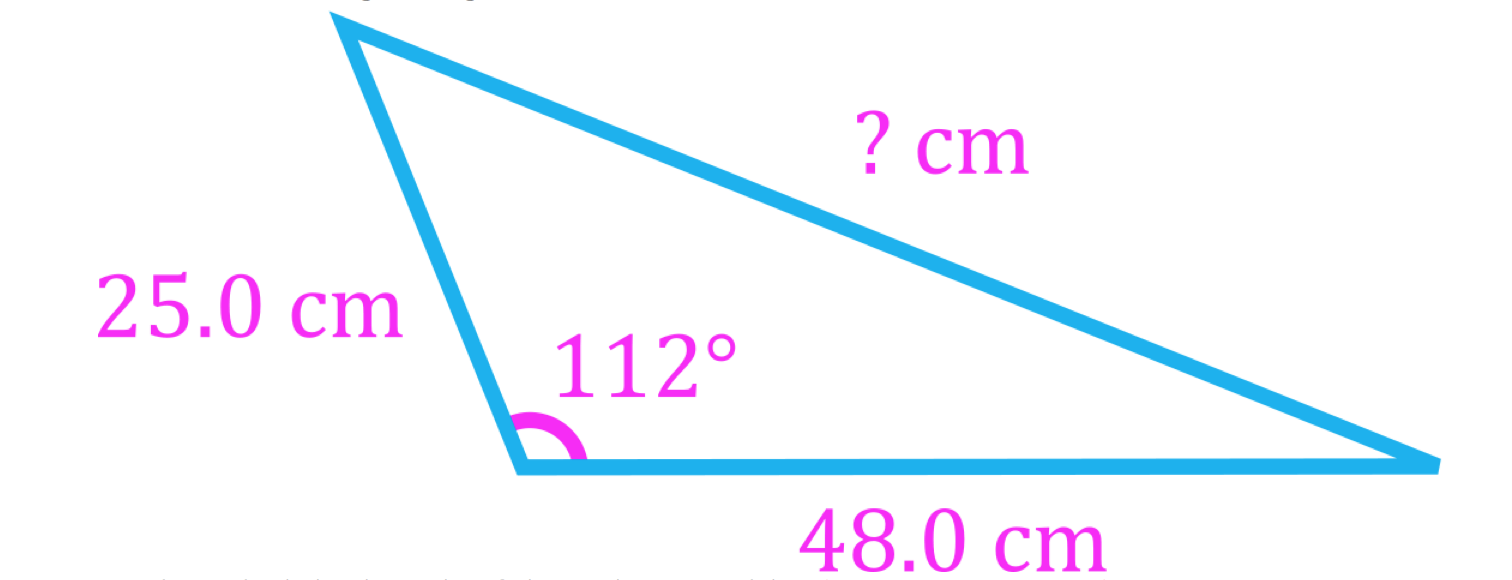
- Find the length of the unknown side.
- Find the angle θ
Step 1: Identify the Type of Triangle
In this problem, we have a triangle with two known sides and an included angle. This type of triangle is known as a side-angle-side (SAS) triangle. When dealing with SAS triangles, the law of cosines is the appropriate method to use because it allows us to find the unknown side when we have two sides and the included angle.
Step 2: Write Down the Law of Cosines
The law of cosines is a generalization of the Pythagorean theorem and is used for any type of triangle. The formula is:
c² = a² + b² - 2ab * cos(C)
Here, c is the side opposite the angle C, and a and b are the other two sides. The angle C is the included angle between sides a and b.
Step 3: Substitute the Known Values
In our triangle, we have:
a = 25 cmb = 48 cmC = 112°
c² = 25² + 48² - 2 * 25 * 48 * cos(112°)
Step 4: Calculate the Unknown Side
First, calculate the squares of the sides:
25² = 625
48² = 2304
Then, calculate the product of the sides and the cosine of the angle:
2 * 25 * 48 * cos(112°)
Use a calculator to find the cosine of 112° and complete the multiplication. Finally, combine all the terms to find c² and then take the square root to find c.
Step 5: Find the Angle θ
Now that we have the length of the unknown side, we can use the sine law to find the angle θ. The sine law states:
(sin A / a) = (sin B / b) = (sin C / c)
We need to find angle θ, which is opposite the side of 48 cm. Set up the sine law equation:
sin(θ) / 48 = sin(112°) / 61.9
Cross-multiply to solve for sin(θ):
sin(θ) = 48 * sin(112°) / 61.9
Use a calculator to find sin(112°) and complete the multiplication and division. Finally, take the inverse sine (arcsin) of the result to find θ.
Step 6: Verify the Solution
After finding the unknown side and angle, it's always a good practice to verify your solution. Check that the sum of the angles in the triangle is 180° and that the calculated side lengths and angles are consistent with the given information.
FAQs
Q1: What is the difference between the law of sines and the law of cosines?
A1: The law of sines relates the sides of a triangle to the sines of its opposite angles, while the law of cosines relates the square of one side to the sum of squares of the other two sides minus their product times the cosine of the included angle. The law of sines is useful when you know two angles and one side, or two sides and an opposite angle. The law of cosines is best when you know three sides or two sides and the included angle.
Q2: When should I use vector components instead of trigonometric laws?
A2: Use vector components when the problem is presented in Cartesian coordinates or when vectors can be easily broken down into x, y, and z components. This method is particularly useful for adding or subtracting vectors, finding resultant vector magnitudes, or resolving forces in mechanics problems. Trigonometric laws are more suitable for problems involving triangles formed by vectors or when angles between vectors are known.
Q3: How can I determine the magnitude of a resultant vector using the law of cosines?
A3: To find the magnitude of a resultant vector using the law of cosines, use the formula: R² = A² + B² - 2AB cos(θ), where R is the magnitude of the resultant vector, A and B are the magnitudes of the two original vectors, and θ is the angle between them. Take the square root of the result to get the magnitude of R.
Q4: What are some real-world applications of two-dimensional vector problems?
A4: Two-dimensional vector problems have numerous applications in physics, engineering, and everyday life. Some examples include:
- Analyzing forces acting on objects in mechanics
- Calculating wind velocity and direction in meteorology
- Determining river flow rates in hydrology
- Planning flight paths in aviation
- Designing electrical circuits in electronics
- Optimizing traffic flow in urban planning
Q5: How can I improve my skills in solving two-dimensional vector problems?
A5: To improve your skills:
1. Practice regularly with a variety of problems
2. Master both component-based and trigonometric methods
3. Draw clear diagrams for each problem
4. Use technology like graphing calculators or software to visualize vectors
5. Study real-world applications to understand the practical importance of vector analysis
6. Join study groups or seek help from instructors for challenging problems
7. Review and analyze your mistakes to learn from them
Prerequisite Topics
Understanding the foundation of vector mathematics is crucial when approaching the topic of solving two-dimensional vector problems. While there are no specific prerequisite topics provided in the given JSON format, it's important to recognize that a solid grasp of fundamental mathematical concepts is essential for success in this area.
To effectively tackle two-dimensional vector problems, students should have a strong understanding of basic algebra and geometry. These foundational skills provide the necessary framework for manipulating vector equations and visualizing spatial relationships. Additionally, familiarity with trigonometry is invaluable, as it plays a significant role in resolving vectors into their components and calculating angles between vectors.
Another key aspect to consider is the concept of coordinate systems. A thorough understanding of the Cartesian coordinate system is vital for representing vectors in two-dimensional space. This knowledge allows students to plot vector positions, determine vector magnitudes, and perform vector addition and subtraction with confidence.
Moreover, a firm grasp of scalar multiplication and vector notation is essential. These concepts form the building blocks for more complex vector operations and help students interpret and solve problems involving force, velocity, and other physical quantities represented by vectors.
While not explicitly listed as prerequisites, familiarity with physics concepts such as force and motion can provide valuable context for applying vector mathematics to real-world scenarios. This interdisciplinary connection enhances students' ability to understand the practical applications of two-dimensional vector problems.
It's also worth noting that proficiency in using graphing calculators or computer software for vector calculations can greatly aid in problem-solving and visualization. While not strictly necessary, these tools can enhance understanding and efficiency when working with complex vector problems.
As students progress in their study of two-dimensional vector problems, they'll find that a solid foundation in these underlying concepts allows for a smoother transition to more advanced topics. The ability to decompose vectors, calculate dot products, and determine vector projections all build upon these fundamental skills.
In conclusion, while specific prerequisites may not be listed, the importance of a strong mathematical foundation cannot be overstated when approaching two-dimensional vector problems. By ensuring a thorough understanding of basic algebra, geometry, trigonometry, and coordinate systems, students will be well-equipped to tackle the challenges presented by vector mathematics and its applications in various fields of study.