TOPIC

Solving two dimensional vector problems

MY PROGRESS

Pug Score

0%

Study Points

+0

Overview

Watch

Read

Next Steps


Get Started

Get unlimited access to all videos, practice problems, and study tools.

Unlimited practice
Full videos

Back to Menu

Topic Progress

Pug Score

0%

Videos Watched

0/0

Read

Not viewed


Study Points

+0

Read

Mastering Two-Dimensional Vector Problems

In this lesson, we will learn:

  • How to solve two dimensional vector problems using the law of sines and the law of cosines

Notes:

  • Often, vector equations in physics problems result in vector triangles which can be solved using trigonometry
  • At least three pieces of information are needed to solve a triangle, which can be three side lengths (SSS), two side lengths and one angle (SSA, SAS), or one side length and two angles (SAA, ASA).
    • Knowing three angles (AAA) does not let you solve a triangle since you will not be able to solve for the side lengths. There is no way to know the size of the triangle without more information.
  • You can always solve a triangle that you know four or more pieces of information about.
  • Vector triangles that do not contain right angles can be solved either by breaking vectors into their components or using the law of sines and the law of cosines, which are trigonometric laws that apply to all triangles

Law of Sines

\(\frac{a}{sinA} = \frac{b}{sinB} = \frac{c}{sinC}\)
a,b,c: length of sides a,b,c
A,B,C: angles opposite sides a, b, c

Law of Cosines

\(c^2 = a^2 + b^2 - 2ab \,cosC \)

Introduction: Solving Two-Dimensional Vector Problems

Welcome to the fascinating world of two-dimensional vector problems! As we embark on this mathematical journey, you'll discover how these concepts play a crucial role in various fields, from physics to engineering. Our introduction video serves as your gateway to understanding these problems, providing a solid foundation for what's to come. By watching this video, you'll gain valuable insights into the nature of two-dimensional vectors and their applications. One of the key aspects we'll explore is solving these problems using two powerful tools: the law of sines and the law of cosines. These fundamental principles will become your trusted companions as you navigate through complex vector scenarios. Learning to apply these laws effectively will not only enhance your problem-solving skills but also deepen your understanding of vector mathematics. So, let's dive in and unravel the mysteries of two-dimensional vector problems together!

Review of Previous Vector Problem-Solving Methods

Let's take a friendly stroll down memory lane and revisit the methods we've learned for tackling 2D vector problems. We'll start with right triangle vector problems and then move on to non-right triangle problems using components. These techniques are essential tools in your vector problem-solving toolkit! First up, right triangle vectors. Remember how handy the Pythagorean theorem was? It allowed us to find the magnitude of a vector when we knew its components. For example, if we had a vector with components 3 units east and 4 units north, we could easily calculate its magnitude as (3² + 4²) = 5 units. This method works like a charm for right triangles, but it has its limitations when dealing with non-right triangles. Enter the trigonometric functions: sine, cosine, and tangent. These became our best friends when working with right triangle vectors. We used sine to find the opposite side length, cosine for the adjacent side, and tangent for the ratio between opposite and adjacent sides. For instance, if we knew a vector had a magnitude of 10 units and made a 30° angle with the x-axis, we could find its x-component using cosine: 10 * cos(30°) 8.66 units. But what about those pesky non-right triangle problems? That's where vector components truly shined! We learned to break down any vector into its horizontal (x) and vertical (y) components. This technique allowed us to tackle more complex problems by converting them into simpler right triangle scenarios. For example, if we had two vectors at odd angles to each other, we could add them by first finding their individual x and y components, then adding those components separately. The beauty of using components is that it works for any 2D vector problem, regardless of the angles involved. It's like having a universal translator for vector languages! However, it's worth noting that while this method is powerful, it can sometimes involve more calculations than direct geometric approaches for simpler problems. Remember, these methods aren't mutually exclusive. Often, the most efficient solution involves a combination of techniques. For instance, you might use components to break down a complex problem, then apply the Pythagorean theorem or trigonometric functions to solve the resulting right triangle scenarios. As we continue our vector journey, keep these tools in your problem-solving arsenal. They'll serve as a solid foundation for tackling more advanced vector concepts and real-world applications. Whether you're calculating forces in physics, analyzing motion in engineering, or even working on computer graphics, these fundamental vector techniques will always be valuable. So, pat yourself on the back for mastering these methods you're well-equipped to handle a wide range of vector challenges!

Introduction to the Law of Sines and Law of Cosines

When dealing with non-right triangle vector problems, the law of sines and the law of cosines provide powerful alternative methods to solve complex scenarios efficiently. These trigonometric laws offer significant advantages over traditional component-based approaches, allowing for faster problem-solving and fewer calculation steps.

The Law of Sines

The law of sines states that for any triangle ABC with sides a, b, and c, and opposite angles A, B, and C:

a/sin(A) = b/sin(B) = c/sin(C)

This formula relates the lengths of the sides of a triangle to the sines of its angles. In vector triangles, this law is particularly useful when we know two angles and one side, or two sides and one angle (as long as the known angle is opposite one of the known sides).

The Law of Cosines

The law of cosines, on the other hand, states that in a triangle ABC:

c² = a² + b² - 2ab cos(C)

This formula extends the Pythagorean theorem to any triangle, not just right triangles. It's especially useful in vector problems when we know all three sides of a triangle or two sides and the included angle.

Applications in Vector Triangles

Vector triangles often arise in physics and engineering problems involving forces, velocities, or displacements. When dealing with non-right triangles, these laws become invaluable tools. For instance:

  • The law of sines can quickly determine unknown angles or side lengths in vector addition problems.
  • The law of cosines is perfect for finding the magnitude of a resultant vector when you know the magnitudes of two vectors and the angle between them.

Advantages Over Component Methods

While component methods are versatile, using the laws of sines and cosines often provides several benefits:

  1. Efficiency: These laws often require fewer steps to solve problems, leading to quicker solutions.
  2. Directness: They allow for direct calculation of desired quantities without the need for intermediate steps like finding x and y components.
  3. Clarity: The relationships between sides and angles are more apparent, providing better insight into the problem's geometry.
  4. Reduced Error: Fewer calculations mean less chance for computational errors.

Illustrating the Laws

To visualize how these laws apply to vector triangles, consider the following scenarios:

  1. Law of Sines Example: Imagine two forces acting at an angle, and you need to find the magnitude of the resultant force. If you know the magnitudes of the two forces and the angle between them, the law of sines can directly give you the magnitude of the resultant.
  2. Law of Cosines Example: In a similar scenario, if you know the magnitudes of all three forces (two original and the resultant) but not the angles, the law of cosines can help you determine the unknown angles without breaking the vectors into components.

Conclusion

The law of sines and the law of cosines are powerful tools in the vector problem-solving toolkit. By understanding and applying these trigonometric laws, you can tackle complex non-right triangle vector problems with greater ease and efficiency. While component methods remain valuable, these laws often provide a more direct path to solution, especially in scenarios involving oblique triangles. Mastering these techniques will significantly enhance your ability to analyze and solve a wide range of vector-related problems in physics, engineering, and beyond.

Applying the Law of Sines in Vector Problems

The law of sines is a powerful tool in trigonometry that can be incredibly useful when solving vector problems. This method allows us to find unknown angles or side lengths in triangles, which is often crucial in vector calculations. Let's dive into how we can apply the law of sines to vector problems, step by step.

First, let's recall the law of sines: for any triangle with sides a, b, and c, and opposite angles A, B, and C, we have:

a / sin(A) = b / sin(B) = c / sin(C)

Now, let's break down the process of applying this to vector problems:

1. Identify the triangle: In vector problems, you'll often have two vectors forming two sides of a triangle. The third side is the resultant vector.

2. Label the sides and angles: Assign letters to the sides (vectors) and their opposite angles.

3. Determine known values: Identify which side lengths (vector magnitudes) and angles you already know.

4. Set up the law of sines equation: Write out the equation using the known and unknown values.

5. Solve for the unknown: Rearrange the equation to isolate the value you're looking for.

Let's work through an example to illustrate this process:

Example: Two forces act on an object. Force A has a magnitude of 50 N and acts at an angle of 30° above the horizontal. Force B has a magnitude of 80 N and acts at an angle of 45° above the horizontal. Find the magnitude and direction of the resultant force.

Step 1: Sketch the triangle formed by the two forces and their resultant.

Step 2: Label the sides: a = 50 N, b = 80 N, c = resultant (unknown). Label the angles: A = 15° (the angle between B and c), B = 75° (the angle between A and c), C = 90° (the angle between A and B).

Step 3: We know two sides (a and b) and all three angles.

Step 4: Set up the law of sines equation: 50 / sin(15°) = 80 / sin(75°) = c / sin(90°)

Step 5: Solve for c: c = 50 * sin(90°) / sin(15°) 193.2 N

To find the direction, we can use the law of sines again: sin(θ) / 50 = sin(90°) / 193.2

Solving for θ: θ 15.1°

Therefore, the resultant force has a magnitude of about 193.2 N and acts at an angle of approximately 15.1° above the horizontal.

The law of sines is most useful in vector problems when you have a combination of known angles and side lengths (vector magnitudes). It's particularly helpful when dealing with non-right triangles, where the Pythagorean theorem can't be directly applied.

However, there are some limitations to be aware of:

1. Ambiguous case: When solving for an angle, you may sometimes get two possible solutions. In these cases, you'll need additional information to determine which solution is correct.

2. Precision: When working with very small angles, even minor measurement errors can lead to significant inaccuracies in the results.

3. Complexity: For problems involving more than two vectors, you may need to break down the problem into multiple triangles, which can become complex.

Despite

Applying the Law of Cosines in Vector Problems

The law of cosines is a powerful tool in trigonometry that can be particularly useful when solving vector problems. This mathematical principle allows us to find unknown sides or angles in a triangle when we have certain information about the other sides and angles. In vector problems, this law becomes especially valuable when dealing with non-right triangles or when we need to find the magnitude of a resultant vector.

To use the law of cosines in vector problems, follow these steps:

  1. Identify the known vector components and angles in your problem.
  2. Draw a diagram representing the vectors as sides of a triangle.
  3. Apply the law of cosines formula: c² = a² + b² - 2ab cos(C), where c is the side opposite the angle C, and a and b are the other two sides.
  4. Solve for the unknown side or angle.

Let's walk through a detailed example to illustrate this process:

Example: Two forces act on an object. Force A has a magnitude of 50 N and Force B has a magnitude of 30 N. The angle between these forces is 60°. Calculate the magnitude of the resultant force.

Step 1: Identify known components
Force A = 50 N
Force B = 30 N
Angle between forces = 60°

Step 2: Draw a diagram
Imagine a triangle where Forces A and B form two sides, and the resultant force is the third side.

Step 3: Apply the law of cosines
Let R be the resultant force (unknown side)
R² = A² + B² - 2AB cos(C)
R² = 50² + 30² - 2(50)(30)cos(60°)

Step 4: Solve for R
R² = 2500 + 900 - 3000(0.5)
R² = 2500 + 900 - 1500
R² = 1900
R = 1900 43.59 N

The law of cosines is particularly useful in vector problems when:

  • Dealing with non-right triangles where the Pythagorean theorem doesn't apply
  • Finding the magnitude of a resultant vector when given two vectors and the angle between them
  • Calculating the angle between two vectors when their magnitudes and the magnitude of their resultant are known
  • Solving problems involving force, velocity, or displacement vectors in physics

Comparing the law of cosines to the law of sines, we find that both are valuable tools in trigonometry, but they serve different purposes. The law of sines is used to find unknown sides or angles in a triangle when we know one side and two angles, or two sides and the angle opposite one of them. It's particularly useful for finding angles or sides in proportion to each other.

On the other hand, the law of cosines is more versatile for vector problems because:

  • It can be used when we know three sides of a triangle to find an angle
  • It's applicable in situations where we have two sides and the included angle
  • It directly gives us the square of the unknown side, which is often the magnitude we're seeking in vector problems

While the law of sines requires us to know at least one angle in our problem, the law of cosines can be applied even when we only know side lengths. This makes it particularly suited for vector addition problems where we often know the magnitudes of vectors and the angle between them, but not necessarily any angles within the resulting triangle.

In conclusion, mastering the law of cosines for vector problem-solving is

Choosing Between Methods: Components vs. Law of Sines/Cosines

When solving vector problems, two primary methods often come into play: using vector components and applying the law of sines or cosines. Understanding when to use each approach is crucial for efficient problem-solving in physics and engineering. This guide will help you navigate the decision-making process and highlight the benefits of mastering both techniques.

Vector components are particularly useful when dealing with problems in Cartesian coordinates or when the vectors are easily broken down into x, y, and z components. This method shines in situations where you need to: 1. Add or subtract vectors 2. Find the magnitude of a resultant vector 3. Determine the direction of a vector in terms of angles from coordinate axes 4. Resolve forces in mechanics problems

For example, when analyzing the motion of a projectile, breaking the velocity vector into horizontal and vertical components allows for easier calculation of the object's position at any given time. Similarly, in electrical engineering, when dealing with circuit analysis, resolving currents or voltages into components can simplify complex network problems.

On the other hand, the law of sines and law of cosines become invaluable when working with problems that involve: 1. Triangles formed by vectors 2. Known angles between vectors 3. Situations where direct component analysis is cumbersome

The law of sines is particularly useful when you know two angles and one side of a triangle, or two sides and the angle opposite one of them. For instance, in navigation problems where you need to find the distance between two points given their bearings from a third point, the law of sines provides a straightforward solution.

The law of cosines excels when you have three sides of a triangle or two sides and the included angle. It's especially handy in problems involving vector addition where you know the magnitudes of two vectors and the angle between them, and you need to find the magnitude of the resultant vector.

To choose the most appropriate method, consider the following guidelines: 1. If the problem provides or easily yields x, y, (and z) components, use the component method. 2. If the problem involves triangles or angles between vectors without clear component information, lean towards the law of sines or cosines. 3. When dealing with force diagrams in physics, especially those not aligned with coordinate axes, the law of sines or cosines might offer a more direct solution. 4. For problems involving vector addition where magnitudes and angles are given, the law of cosines is often the quickest route.

Consider a scenario where you need to find the resultant force of two forces acting on an object. If the forces are given in component form or can be easily resolved into components, the component method is ideal. However, if you're given the magnitudes of the forces and the angle between them, the law of cosines provides a more direct path to the solution.

In surveying and geolocation problems, where distances and angles between points are often known, the law of sines frequently offers elegant solutions. Conversely, in electrical circuit analysis, where currents and voltages are typically expressed in component form, the component method usually prevails.

Mastering both methods offers several advantages: 1. Flexibility in problem-solving approaches 2. Ability to cross-check results using different methods 3. Enhanced understanding of vector relationships 4. Improved efficiency in tackling a wide range of problems

By developing proficiency in both component analysis and trigonometric laws, you'll be well-equipped to handle diverse vector problems across various fields of study. This versatility not only aids in academic pursuits but also prepares you for real-world applications in engineering, physics, and beyond. Remember, the key to effective problem-solving lies in recognizing the most efficient method for each unique situation, and having multiple tools at your disposal ensures you're always prepared.

Practice Problems and Solutions

Ready to put your vector calculation skills to the test? Let's dive into some engaging practice problems that will challenge your understanding of two-dimensional vectors, the law of sines, and the law of cosines. Remember, the key to mastering these concepts is practice, so try to solve each problem on your own before checking the solutions. You've got this!

Problem 1: Finding the Resultant Vector

Two forces act on a particle: F1 = 50 N at 30° north of east, and F2 = 80 N at 60° north of west. Find the magnitude and direction of the resultant force.

Solution:

Let's approach this step-by-step: 1. Convert the angles to standard position: F1 is at 30°, F2 is at 150°. 2. Find the x and y components of each force: F1x = 50 cos(30°) = 43.3 N F1y = 50 sin(30°) = 25 N F2x = 80 cos(150°) = -69.3 N F2y = 80 sin(150°) = 40 N 3. Sum the x and y components: Rx = 43.3 - 69.3 = -26 N Ry = 25 + 40 = 65 N 4. Calculate the magnitude: R = ((-26)² + 65²) = 70.0 N 5. Find the direction: θ = tan¹(65/-26) + 180° = 111.8° The resultant force is 70.0 N at 111.8° from the positive x-axis.

Problem 2: Using the Law of Sines

A triangle ABC has side lengths a = 8 cm and b = 12 cm. The angle opposite side a is 30°. Find the length of side c and the remaining angles.

Solution:

Let's use the law of sines: 1. Find angle B using the law of sines: sin(B) / 8 = sin(30°) / 12 sin(B) = (8 * sin(30°)) / 12 = 0.3333 B = sin¹(0.3333) = 19.5° 2. Calculate angle C: C = 180° - 30° - 19.5° = 130.5° 3. Use the law of sines to find side c: c / sin(30°) = 12 / sin(19.5°) c = (12 * sin(30°)) / sin(19.5°) = 18.7 cm The triangle has side c = 18.7 cm, angle B = 19.5°, and angle C = 130.5°.

Problem 3: Applying the Law of Cosines

Two vectors, u and v, have magnitudes |u| = 5 and |v| = 8. The angle between them is 60°. Find the magnitude of their difference, |u - v|.

Solution:

This problem is perfect for the law of cosines: 1. The formula for the law of cosines is: |u - v|² = |u|² + |v|² - 2|u||v|cos(θ) 2. Plug in the values: |u - v|² = 5² + 8² - 2(5)(8)cos(60°) 3. Simplify: |u - v|² = 25 + 64 - 80(0.5) = 49 4. Take the square root: |u - v| = 49 = 7 The magnitude of the difference

Conclusion and Further Resources

In this article, we've explored two essential approaches to solving vector problems: component-based and trigonometric methods. Understanding both techniques is crucial for success in physics and engineering. The component-based method breaks vectors into their x and y components, allowing for easier calculations and analysis. On the other hand, the trigonometric method utilizes angle measurements and trigonometric functions to solve vector problems. Each approach has its strengths, and mastering both will greatly enhance your problem-solving abilities. To reinforce your understanding, it's vital to practice regularly with a variety of problems. We encourage you to seek out additional resources, such as online tutorials, textbooks, and problem sets. Consider joining study groups or seeking help from instructors to further solidify your knowledge. Remember, proficiency in vector analysis is a valuable skill that will serve you well in your academic and professional pursuits. Keep practicing and exploring these concepts to build a strong foundation in vector mathematics.

Example:

Use the law of cosines to solve triangles For the following triangle:
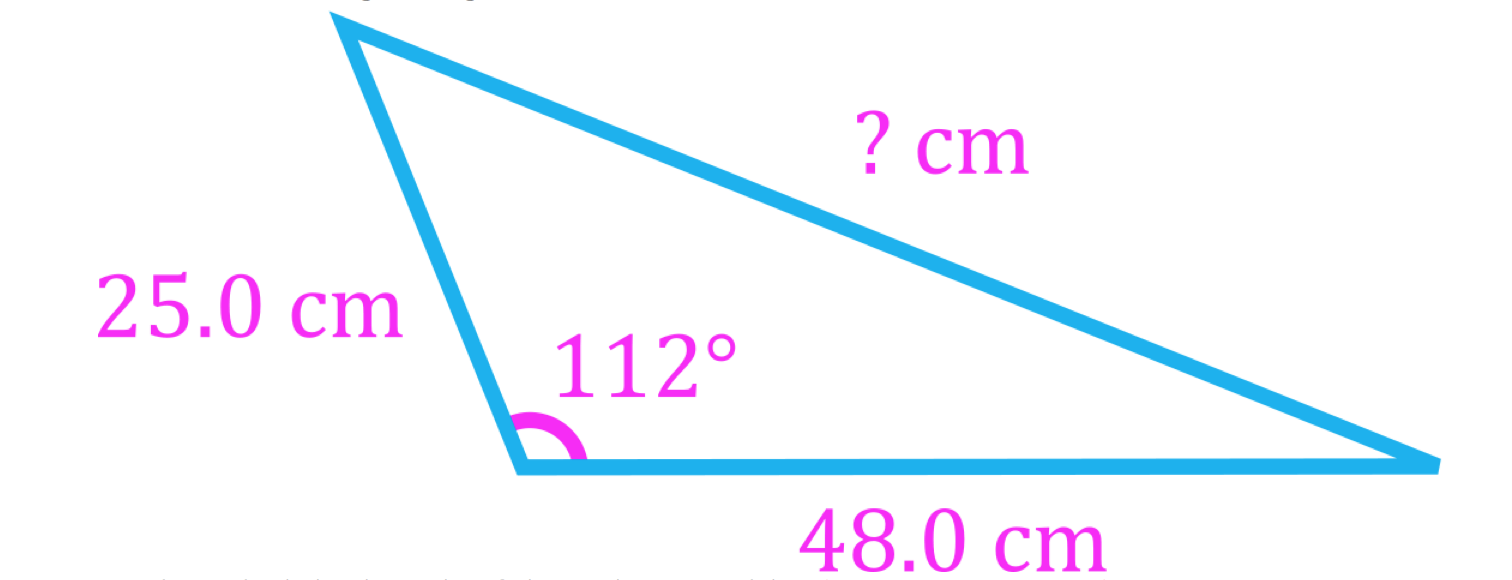
triangle to solve

  1. Find the length of the unknown side.
  2. Find the angle θ

Step 1: Identify the Type of Triangle

In this problem, we have a triangle with two known sides and an included angle. This type of triangle is known as a side-angle-side (SAS) triangle. When dealing with SAS triangles, the law of cosines is the appropriate method to use because it allows us to find the unknown side when we have two sides and the included angle.

Step 2: Write Down the Law of Cosines

The law of cosines is a generalization of the Pythagorean theorem and is used for any type of triangle. The formula is:

c² = a² + b² - 2ab * cos(C)

Here, c is the side opposite the angle C, and a and b are the other two sides. The angle C is the included angle between sides a and b.

Step 3: Substitute the Known Values

In our triangle, we have:

  • a = 25 cm
  • b = 48 cm
  • C = 112°
Substitute these values into the law of cosines formula:

c² = 25² + 48² - 2 * 25 * 48 * cos(112°)

Step 4: Calculate the Unknown Side

First, calculate the squares of the sides:

25² = 625
48² = 2304

Then, calculate the product of the sides and the cosine of the angle:

2 * 25 * 48 * cos(112°)

Use a calculator to find the cosine of 112° and complete the multiplication. Finally, combine all the terms to find and then take the square root to find c.

Step 5: Find the Angle θ

Now that we have the length of the unknown side, we can use the sine law to find the angle θ. The sine law states:

(sin A / a) = (sin B / b) = (sin C / c)

We need to find angle θ, which is opposite the side of 48 cm. Set up the sine law equation:

sin(θ) / 48 = sin(112°) / 61.9

Cross-multiply to solve for sin(θ):

sin(θ) = 48 * sin(112°) / 61.9

Use a calculator to find sin(112°) and complete the multiplication and division. Finally, take the inverse sine (arcsin) of the result to find θ.

Step 6: Verify the Solution

After finding the unknown side and angle, it's always a good practice to verify your solution. Check that the sum of the angles in the triangle is 180° and that the calculated side lengths and angles are consistent with the given information.

FAQs

Q1: What is the difference between the law of sines and the law of cosines?
A1: The law of sines relates the sides of a triangle to the sines of its opposite angles, while the law of cosines relates the square of one side to the sum of squares of the other two sides minus their product times the cosine of the included angle. The law of sines is useful when you know two angles and one side, or two sides and an opposite angle. The law of cosines is best when you know three sides or two sides and the included angle.

Q2: When should I use vector components instead of trigonometric laws?
A2: Use vector components when the problem is presented in Cartesian coordinates or when vectors can be easily broken down into x, y, and z components. This method is particularly useful for adding or subtracting vectors, finding resultant vector magnitudes, or resolving forces in mechanics problems. Trigonometric laws are more suitable for problems involving triangles formed by vectors or when angles between vectors are known.

Q3: How can I determine the magnitude of a resultant vector using the law of cosines?
A3: To find the magnitude of a resultant vector using the law of cosines, use the formula: R² = A² + B² - 2AB cos(θ), where R is the magnitude of the resultant vector, A and B are the magnitudes of the two original vectors, and θ is the angle between them. Take the square root of the result to get the magnitude of R.

Q4: What are some real-world applications of two-dimensional vector problems?
A4: Two-dimensional vector problems have numerous applications in physics, engineering, and everyday life. Some examples include: - Analyzing forces acting on objects in mechanics - Calculating wind velocity and direction in meteorology - Determining river flow rates in hydrology - Planning flight paths in aviation - Designing electrical circuits in electronics - Optimizing traffic flow in urban planning

Q5: How can I improve my skills in solving two-dimensional vector problems?
A5: To improve your skills: 1. Practice regularly with a variety of problems 2. Master both component-based and trigonometric methods 3. Draw clear diagrams for each problem 4. Use technology like graphing calculators or software to visualize vectors 5. Study real-world applications to understand the practical importance of vector analysis 6. Join study groups or seek help from instructors for challenging problems 7. Review and analyze your mistakes to learn from them

Prerequisite Topics

Understanding the foundation of vector mathematics is crucial when approaching the topic of solving two-dimensional vector problems. While there are no specific prerequisite topics provided in the given JSON format, it's important to recognize that a solid grasp of fundamental mathematical concepts is essential for success in this area.

To effectively tackle two-dimensional vector problems, students should have a strong understanding of basic algebra and geometry. These foundational skills provide the necessary framework for manipulating vector equations and visualizing spatial relationships. Additionally, familiarity with trigonometry is invaluable, as it plays a significant role in resolving vectors into their components and calculating angles between vectors.

Another key aspect to consider is the concept of coordinate systems. A thorough understanding of the Cartesian coordinate system is vital for representing vectors in two-dimensional space. This knowledge allows students to plot vector positions, determine vector magnitudes, and perform vector addition and subtraction with confidence.

Moreover, a firm grasp of scalar multiplication and vector notation is essential. These concepts form the building blocks for more complex vector operations and help students interpret and solve problems involving force, velocity, and other physical quantities represented by vectors.

While not explicitly listed as prerequisites, familiarity with physics concepts such as force and motion can provide valuable context for applying vector mathematics to real-world scenarios. This interdisciplinary connection enhances students' ability to understand the practical applications of two-dimensional vector problems.

It's also worth noting that proficiency in using graphing calculators or computer software for vector calculations can greatly aid in problem-solving and visualization. While not strictly necessary, these tools can enhance understanding and efficiency when working with complex vector problems.

As students progress in their study of two-dimensional vector problems, they'll find that a solid foundation in these underlying concepts allows for a smoother transition to more advanced topics. The ability to decompose vectors, calculate dot products, and determine vector projections all build upon these fundamental skills.

In conclusion, while specific prerequisites may not be listed, the importance of a strong mathematical foundation cannot be overstated when approaching two-dimensional vector problems. By ensuring a thorough understanding of basic algebra, geometry, trigonometry, and coordinate systems, students will be well-equipped to tackle the challenges presented by vector mathematics and its applications in various fields of study.