TOPIC
Mineral Properties, Physical and chemical propertiesMY PROGRESS
Pug Score
0%
Getting Started
"Let's build your foundation!"
Best Streak
0 in a row
Study Points
+0
Overview
Practice
Read
Quiz
Next Steps
Get Started
Get unlimited access to all videos, practice problems, and study tools.
BACK TO MENU
Topic Progress
Pug Score
0%
Getting Started
"Let's build your foundation!"
Best Practice
No score
Read
Not viewed
Best Quiz
No attempts
Best Streak
0 in a row
Study Points
+0
Overview
Practice
Read
Quiz
Next Steps
Read
Discover Mineral Properties: Physical and Chemical Identification
You will learn how to identify minerals using their physical properties like hardness, luster, streak, and cleavage and their chemical properties, such as how they react with acid.
What Is a Mineral?
A mineral is a naturally occurring, solid, inorganic substance with a definite chemical composition and a specific crystal structure. That means minerals form in nature not in a factory and they are never made from living things. You can explore how minerals connect to Rock Types: Igneous, Sedimentary, and Metamorphic since rocks are mixtures of one or more minerals.
To be classified as a mineral, a substance must meet five criteria: it must be naturally occurring, solid, inorganic, have a definite chemical composition, and have a crystal structure. Man-made substances, liquids, and materials from living organisms do not qualify as minerals.
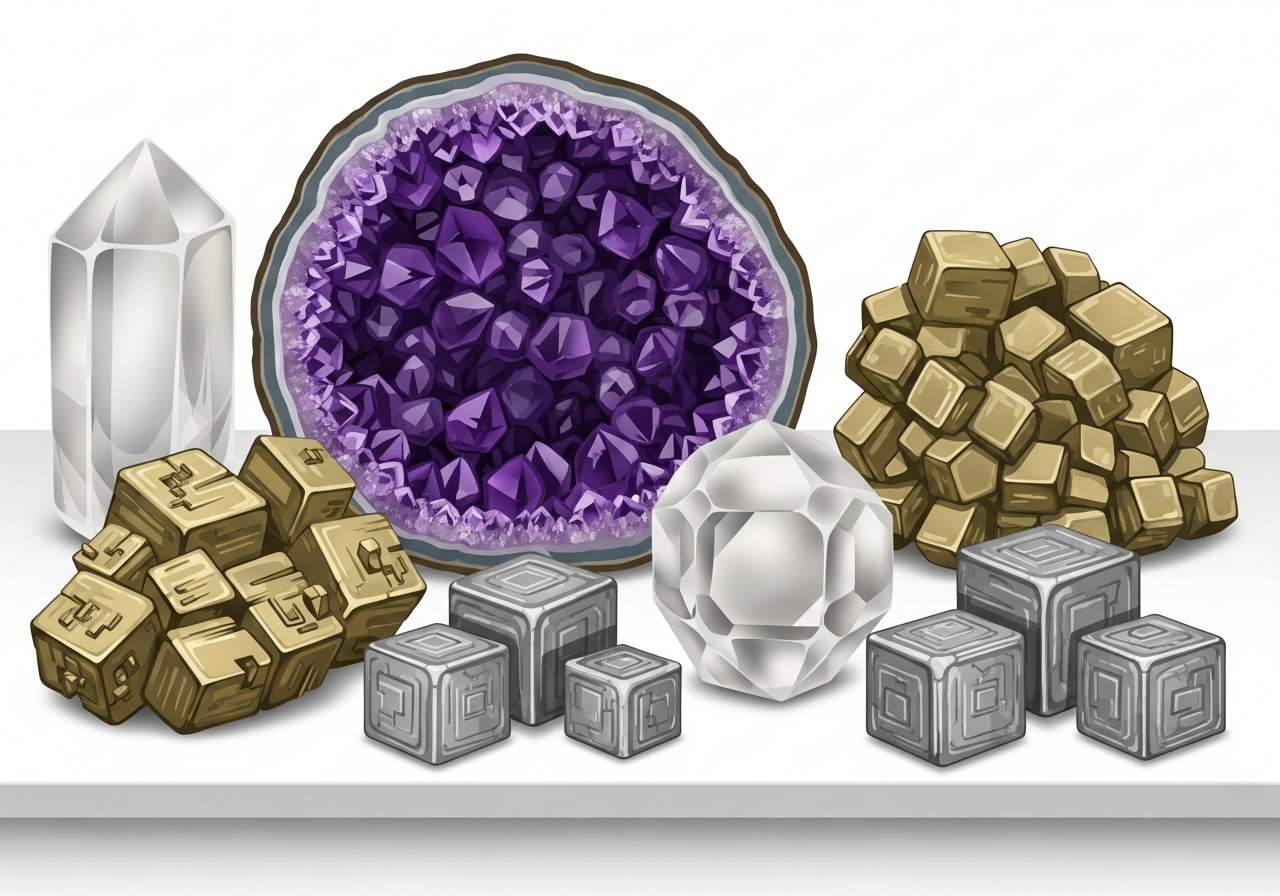
Physical Properties of Minerals
Physical properties are characteristics you can observe or measure without changing the mineral's chemical makeup. These properties help you identify minerals in the field and in the lab.
Luster
Luster describes how a mineral's surface reflects light. If a mineral shines like polished metal, it has metallic luster (for example, pyrite and galena). If it looks like glass, it has vitreous (glassy) luster (for example, quartz). Other types include waxy, pearly, and dull luster.
Hardness and the Mohs Scale
Hardness measures a mineral's ability to resist being scratched. You use the Mohs hardness scale, which ranks minerals from 1 (softest) to 10 (hardest). Talc is the softest at 1, and diamond is the hardest at 10. A copper penny has a hardness of about 3.5, so if a penny scratches a mineral, that mineral is softer than 3.5.
Streak
Streak is the color of the powder a mineral leaves when you rub it against an unglazed porcelain streak plate. Streak is more reliable than surface color because the same mineral always produces the same streak color, even when its surface color varies. For example, pyrite looks gold on the surface but leaves a greenish-black streak, while real gold leaves a golden-yellow streak making streak the best way to tell them apart.
Cleavage and Fracture
Cleavage is the tendency of a mineral to break along smooth, flat planes due to weak atomic bonds. Mica splits into thin flat sheets a perfect example of cleavage. Fracture is when a mineral breaks with rough, uneven, or curved surfaces instead of flat planes. Quartz is a well-known mineral that shows fracture rather than cleavage.
Crystal Form, Color, and Density
Crystal form is the geometric shape that a mineral naturally grows into, such as the cubic shape of halite (table salt). Color is the easiest property to observe but the least reliable, because impurities can make the same mineral appear in many different colors. Density (also called specific gravity) measures how much mass is packed into a given volume gold feels much heavier than a similarly sized piece of quartz because gold has a much higher density.
Chemical Properties of Minerals
Chemical properties describe how a mineral reacts when it interacts with another substance. Unlike physical properties, testing a chemical property changes the mineral's chemical composition.
The most common chemical test is the acid test. When you apply hydrochloric acid to calcite, it fizzes and releases carbon dioxide gas this is a chemical reaction. Solubility is another chemical property: halite (table salt) dissolves easily in water, which changes its chemical bonds. These reactions help scientists identify minerals that look similar on the outside.
Key Terms & Definitions
Mineral: A naturally occurring, solid, inorganic substance with a definite chemical composition and crystal structure. You can think of it as a pure building block found in rocks.
Luster: The way a mineral's surface reflects light. You describe luster as metallic (shiny like metal) or non-metallic (glassy, waxy, dull, or pearly).
Hardness: A mineral's ability to resist being scratched. You measure hardness using the Mohs hardness scale, which goes from 1 (softest) to 10 (hardest).
Mohs Hardness Scale: A ranking system from 1 to 10 that you use to compare the scratch resistance of minerals. Diamond (10) is the hardest; talc (1) is the softest.
Streak: The color of the powder a mineral leaves on an unglazed porcelain streak plate. Streak is more reliable than surface color for identifying minerals.
Cleavage: The tendency of a mineral to break along smooth, flat planes in specific directions. Mica is a great example it splits into thin, flat sheets.
Fracture: When a mineral breaks with rough, uneven, or curved surfaces instead of smooth flat planes. Quartz shows fracture rather than cleavage.
Crystal Form: The geometric shape that a mineral naturally grows into based on its internal atomic arrangement. Halite grows into cube-shaped crystals.
Density: The amount of mass in a given volume of a mineral. Each mineral has a unique, consistent density that helps you identify it.
Specific Gravity: A comparison of a mineral's weight to the weight of an equal volume of water. A high specific gravity means the mineral feels heavy for its size, like gold.
Color: The visible hue on the outer surface of a mineral. Color is the easiest property to observe but the least reliable because impurities can change a mineral's color.
Metallic Luster: A type of luster where the mineral's surface shines and reflects light like a polished metal object, such as pyrite or galena.
Vitreous (Glassy) Luster: A type of luster where the mineral's surface looks like glass, such as quartz.
Acid Test: A chemical test where you apply hydrochloric acid to a mineral to see if it reacts. Calcite fizzes and releases carbon dioxide gas when acid is applied.
Inorganic: Not made by or from living organisms. Minerals must be inorganic they cannot come from once-living plants or animals.
Fluorescence: A special property where some minerals, like fluorite and calcite, glow with bright colors when exposed to ultraviolet (UV) light in darkness.
Physical Property: A characteristic you can observe or measure without changing the mineral's chemical makeup, such as color, hardness, luster, streak, and cleavage.
Chemical Property: A characteristic that describes how a mineral reacts with another substance, such as fizzing in acid or dissolving in water, which changes the mineral's composition.
How You Can Practice Identifying Minerals
You can practice identifying minerals by testing their properties step by step. Start by observing color and luster, then test hardness using objects of known hardness (fingernail, copper penny, steel nail). Next, rub the mineral on a streak plate to find its streak color, and observe how it breaks to determine cleavage or fracture.
This connects to your earlier learning about Physical Properties: Mass, Volume, and Density and Chemical Properties: Reactivity, pH, and Combustibility, which gave you the foundation for understanding how properties are used to classify matter. You also use skills from Data Collection: Quantitative and Qualitative Data when you record your mineral observations.
Building on What You Already Know
Before studying mineral properties, you explored several important foundational topics. Your understanding of Particle Theory: Arrangement and Movement of Particles helps you understand why minerals have crystal structures. Your knowledge of Internal Structure: Layers of the Earth and Surface Features: Mountains, Valleys, and Oceans shows you where minerals form and are found.
You also draw on Analysis Methods: Patterns, Trends, and Relationships when you compare mineral properties, and on Materials Science: Properties and Applications to understand how mineral properties determine their uses.
Related Topics & Connections
Mineral properties connect to many other important science topics that you will explore. Understanding minerals is a key part of the bigger picture of Earth science and materials science.
You will see how minerals fit into the Rock Cycle: Formation and Transformation minerals are the building blocks of rocks that constantly change form over time. You already explored Rock Types: Igneous, Sedimentary, and Metamorphic, which are all made of different combinations of minerals.
The physical and chemical properties you learn here connect directly to Types of Changes: Physical vs. Chemical Changes and Reactions: Signs of Chemical Reactions, since the acid test on calcite is a real chemical reaction. You can also connect mineral solubility to Solution Properties: Concentration and Solubility and Mixtures: Heterogeneous and Homogeneous.
Minerals are also important natural resources. You will explore this further in Natural Resources: Renewable and Non-Renewable and Resource Management: Sustainable Use and Conservation. Precise measurement of mineral properties connects to Data Collection: Precision and Accuracy in Measurements, and choosing minerals for specific uses connects to Material Selection: Properties and Applications.
This topic prepares you for advanced Earth science concepts including Earth's Structure: Internal Layers, Geological Events: Earthquakes and Volcanoes, Plate Tectonics: Continental Drift Theory, and Introduction to Mineral Resources: Formation and Extraction. Your understanding of mineral properties also supports future learning in States of Matter: Kinetic Molecular Theory and Phase Changes: Energy in Transitions.