7th Grade Math Help — Step-by-Step Video Lessons & Practice
Help your child understand every 7th grade math topic and build real confidence, one lesson at a time.

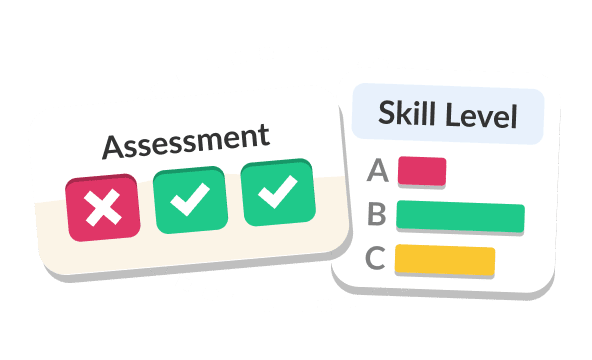
Find the Gaps Fast
A quick diagnostic pinpoints exactly where your child needs support — no guessing, no wasted time. Focus on what matters most from day one.
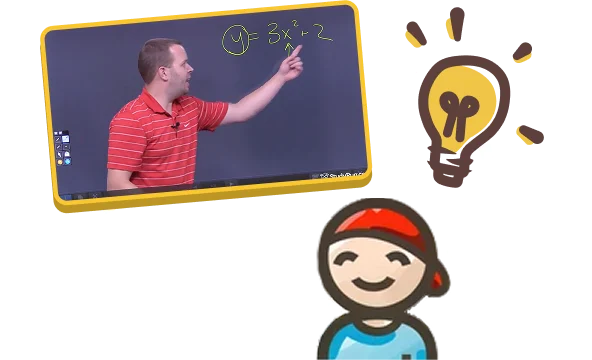
Step-by-Step Video Lessons
Friendly certified teachers explain every 7th grade math concept clearly, showing the method — not just the answer — so your child can solve similar problems independently.

Matches Their Classroom
Lessons align to your state's math standards, so what your child practices on StudyPug directly supports what they're learning in school.
Try It Now
Test your knowledge
Our approach aligns with the evidence
Exam Scores
Better Recall
Less Anxiety
7th Grade Math Topics
1. Numbers and Relations
2. Number Theory
3. Adding and Subtracting Integers
4. Multiplying and Dividing Integers
5. Operations with Decimal Numbers
6. Coordinates, Quadrants, and Transformations
7. Geometry and Measurement
8. Measuring Systems
9. Adding and Subtracting Fractions
10. Multiplying and Dividing Fractions
11. Fractions, Decimals, and Percents
12. Ratios, Rates, and Proportions
13. Pythagorean Theorem
14. Powers and Exponents
15. Introduction to 3D Objects
16. Volume
18. Patterns and Solving Equations
19. Introduction to Probability
Discover Our Learning Areas
Explore key subjects and start learning with interactive content.













What Is 7th Grade Math?
7th grade math is the bridge between elementary arithmetic and the abstract thinking required in high school mathematics. At this stage, students move from working with whole numbers and simple fractions into a world of rational numbers, proportional reasoning, and algebraic expressions. For many children — and parents — it's the year math starts to feel genuinely challenging. Understanding what the curriculum covers and how to support your child through it can make all the difference.
What Topics Does 7th Grade Math Cover?
The 7th grade math curriculum in the US is organized around several interconnected areas. Most states align to Common Core State Standards or their own equivalent frameworks, so the core topics are consistent across the country:
- Ratios and Proportional Relationships: Understanding unit rates, constant of proportionality, and connecting tables, graphs, and equations.
- The Number System: Operations with rational numbers — adding, subtracting, multiplying, and dividing fractions, decimals, and integers (positive and negative numbers).
- Expressions and Equations: Writing and solving linear equations and inequalities with one variable; applying properties of operations.
- Geometry: Area and circumference of circles, area of composite shapes, surface area and volume of 3D solids.
- Statistics and Probability: Sampling, data distributions, comparing populations, and basic probability concepts including compound events.
Each topic builds directly on 6th grade work and feeds into 8th grade math or Pre-Algebra, so a strong 7th grade foundation is essential for long-term success.
Why Is 7th Grade Math a Turning Point — and Where Do Students Get Stuck?
Parents often describe 7th grade as the year math "suddenly got hard." That's not a coincidence. The shift from concrete calculation to abstract reasoning happens quickly. Here are the most common struggle points:
- Negative numbers: Working with integers across all four operations confuses many students who have only dealt with positive values before.
- Proportional relationships: Recognizing when a situation is proportional, writing the equation, and reading the graph all at once is a lot to manage simultaneously.
- Multi-step equations: Keeping track of operations across multiple steps — especially when fractions or negatives are involved — is where many children lose confidence.
- Connecting representations: Moving between tables, graphs, equations, and verbal descriptions of the same relationship is a genuinely new skill that requires lots of practice.
The good news is that targeted, consistent practice — especially with clear explanations of the method — dramatically reduces these stumbling blocks. Short daily sessions focused on the right topics are far more effective than long, unfocused study time.
How Is 7th Grade Math Assessed in the US?
Assessment in 7th grade math varies by state, but most students face a combination of regular classroom tests, mid-year and end-of-year district assessments, and state standardized tests. States like Texas administer the STAAR (State of Texas Assessments of Academic Readiness), while New York uses the New York State Math Test. Other states have their own assessments aligned to their grade-level standards. In addition to state tests, many schools use benchmark assessments throughout the year to track progress. Knowing which test your child will take — and which standards it covers — helps you focus practice where it counts most.
Why StudyPug for 7th Grade Math Help?
StudyPug is built around the way students actually learn math — not just memorizing steps, but understanding the concepts well enough to handle any variation of a problem. Here's what makes it different:
Diagnostic assessment that finds the real gaps. Before your child spends a single minute practicing, a quick diagnostic identifies precisely where they need support. No guessing, no wasted effort — just a clear, focused plan.
Certified-teacher video lessons that teach the method. Every lesson is taught by a certified teacher who explains not just what to do, but why it works. Your child learns the reasoning behind proportional relationships, integer operations, and equation solving — which means they can tackle similar problems on their own, not just copy a memorized procedure.
Adaptive practice that grows with your child. Practice questions adjust in difficulty based on how your child is performing. If they're finding integer operations straightforward, the system moves them forward. If multi-step equations need more work, it provides more targeted practice at that level — building genuine confidence rather than frustration.
A Family Plan built for real families. StudyPug's Family Plan covers up to 5 children under one subscription — all grades, all subjects — so whether you have a 7th grader working on math and a younger child just starting out, everyone is supported at one price.
Parent dashboard for real visibility. The parent dashboard shows you each child's progress clearly — which topics they've worked on, where improvement is happening, and where they may need extra attention. You don't need to wait for a report card to know how your child is doing.
What Your Child Will Learn: 7th Grade Math Curriculum Coverage
StudyPug's 7th grade math content maps directly to US state standards. Lessons are organized around the core curriculum areas your child's school is already following. Key topic areas include:
- Ratios, rates, and proportional reasoning
- Rational number operations (integers, fractions, decimals)
- Algebraic expressions, equations, and inequalities
- Geometric measurement — circles, composite figures, surface area, volume
- Statistics, data analysis, and probability
For state-specific curriculum details, you can explore the Texas 7th grade math curriculum and the NYS 7th grade math curriculum to see exactly how StudyPug's lessons align to what your child is being taught in school.
How to Use StudyPug to Support Your 7th Grader
Getting started is straightforward. Here's a simple approach that works well for most families:
Step 1 — Run the diagnostic. Let your child complete the short diagnostic assessment. It takes just a few minutes and immediately surfaces the topics that need the most attention. This is the single most effective thing you can do before any practice begins.
Step 2 — Watch, then practice. For any topic flagged by the diagnostic, have your child watch the certified-teacher video lesson first. These are short and focused — typically 5 to 10 minutes — and teach the concept step by step. Then move into the adaptive practice questions while the lesson is fresh.
Step 3 — Build a daily habit. Consistent short sessions — 20 to 30 minutes a day — outperform occasional marathon study sessions. Use the parent dashboard to check in on progress each week and adjust focus as new units start at school.
Step 4 — Prepare for tests. Before unit tests or state assessments, use StudyPug's practice tests based on real exam formats to build your child's confidence and identify any remaining gaps. The more familiar your child is with the question types and format, the calmer and better prepared they'll feel on test day.
Free practice content is available to start right now — no sign-up required. The full plan comes with a 30-day money-back guarantee, so you can explore everything StudyPug offers with complete peace of mind.
7th Grade Math FAQ
Unsure how StudyPug works? Need help with setting up? Check our frequently asked questions or contact us for help.
What does my child learn in 7th grade math, and what topics does it cover?
7th grade math builds on foundational skills to introduce more abstract thinking. Key topics include ratios and proportional relationships, operations with rational numbers (fractions, decimals, integers), expressions and equations, inequalities, geometry (area, surface area, and volume), and basic statistics and probability. Most US curricula align to Common Core State Standards or equivalent state standards at this grade level, preparing students for pre-algebra or algebra in 8th grade.
Is 7th grade math hard, and where do children commonly struggle?
7th grade math is a significant step up for many students. The biggest stumbling blocks are working with negative numbers and integer operations, understanding proportional relationships, and solving multi-step equations. Fractions combined with algebra-style thinking trips up many kids who felt confident in elementary math. The abstract nature of expressions and inequalities can also be a challenge. Consistent practice with clear explanations — especially for the 'why' behind each step — makes a real difference at this stage.
What should my child know before 7th grade math, and what comes next?
Solid 6th grade foundations matter: fraction and decimal operations, ratios and rates, basic expressions and equations, and understanding of positive and negative numbers. If your child has gaps in any of those areas, addressing them early in 7th grade will save a lot of frustration. After 7th grade, students typically move into 8th grade math or Pre-Algebra, then Algebra 1 — so the concepts introduced now (equations, proportional reasoning, geometry) are the direct building blocks for high school math.
How does StudyPug 7th grade math map to what they learn at school?
StudyPug's 7th grade math content is built around Common Core State Standards and state-level standards used across the US. Lessons cover the same topics your child's teacher is working through in class — proportional relationships, rational number operations, geometry, and statistics — in the same sequence. Whether your child's school follows the Texas TEKS, New York Next Generation Standards, California frameworks, or another state's standards, you'll find matching lessons and practice problems for every unit.
What is one of the trickiest 7th grade math concepts, and how is it taught?
Proportional relationships is one of the most important and most misunderstood topics in 7th grade math. Students need to recognize proportional vs. non-proportional situations, work with unit rates, and connect tables, graphs, and equations — all at once. StudyPug certified teachers break this down in short video lessons that show the method step by step, starting with simple ratio tables before progressing to graphing and equation forms. Practice questions then adapt to your child's level, reinforcing the concept until it sticks.
How much math practice should my child do in 7th grade?
Most education guidelines suggest 20–30 minutes of focused math practice per day outside school is ideal for 7th graders. The key is consistency and quality over quantity — targeted practice on the specific topics your child is currently covering is far more effective than marathon sessions. StudyPug's adaptive practice adjusts difficulty to your child's level, so even short daily sessions build meaningful skills. Using the diagnostic to identify weak spots first means every practice session counts.