Chapter 12.1

Ohm's Law: The Foundation of Electrical Circuit Analysis

Unlock the power of Ohm's Law to understand and manipulate electrical circuits. Learn how voltage, current, and resistance interact, and apply this knowledge to real-world electrical systems and devices.


What You'll Learn

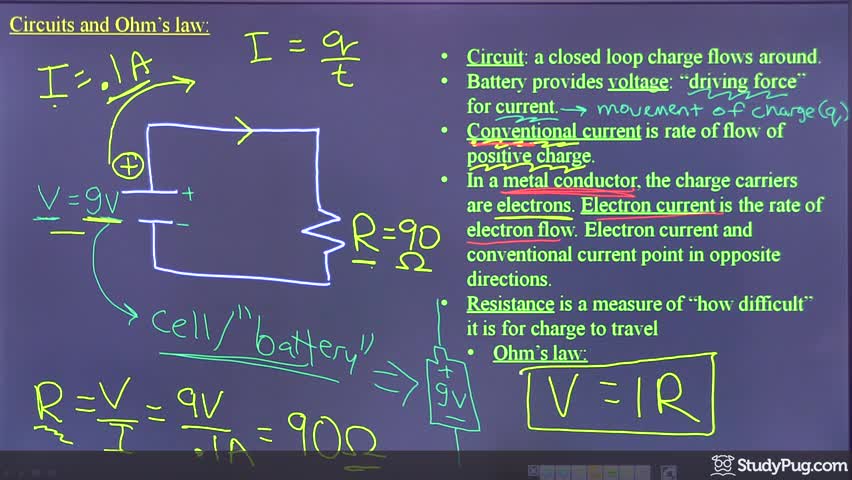
Apply Ohm's Law to relate voltage, current, and resistance in electric circuits
Calculate current by dividing voltage by resistance (I = V/R)
Determine resistance using voltage and current measurements (R = V/I)
Convert between units of current: amps and milliamps
Calculate total charge flow using the definition of current (Q = I × t)
Convert between conventional current and electron flow in conductors

What You'll Practice

1

Finding current in circuits with given voltage and resistance

2

Calculating charge flow over a specific time period

3

Converting coulombs of charge to number of electrons

4

Rearranging Ohm's Law to solve for different variables

Why This Matters

Ohm's Law is fundamental to understanding electricity in every device you use daily. Whether you're designing circuits, troubleshooting electronics, or studying electrical engineering, this relationship between voltage, current, and resistance is essential for analyzing how electricity flows and powers everything from smartphones to power grids.

This Unit Includes

2 Video lessons
Learning resources

Skills

Ohm's Law
Voltage
Current
Resistance
Electric Circuits
Unit Conversion
Charge Flow
Pug instructor