Topic
My Progress
Pug Score
0%
Study Points
+0
Overview
Watch
Read
Next Steps
Overview
Watch
Read
Next Steps
Watch
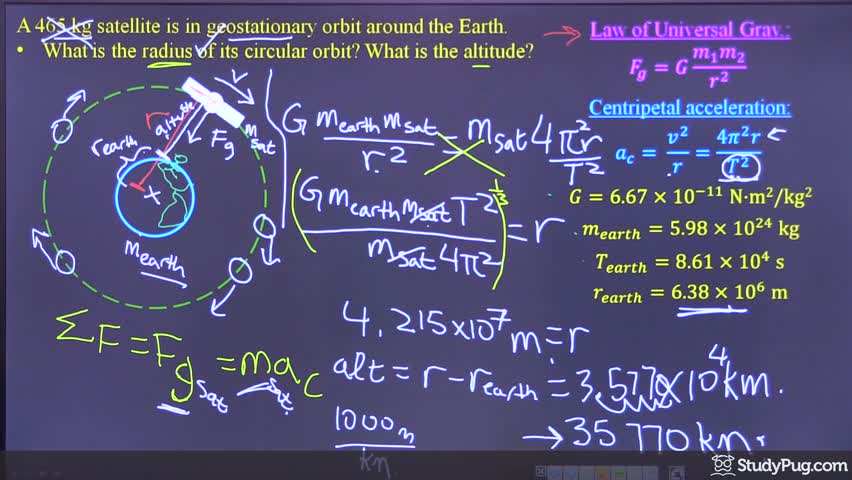
Finding the orbital radius and altitude of a geostationary satellite
📝 My Notes
Auto-saves the current timestamp
Finding the orbital radius and altitude of a geostationary satellite
20:22
About this lesson
A 465 kg satellite is in geostationary orbit around the Earth.
Key Moments
No key moments available.
Video 1 of 10
Finding the orbital radius and altitude of a geostationary satellite
20 min
• Selected
Calculating geostationary satellite speed and why only one orbit works
12 min
Calculating gravitational potential energy on Earth and in orbit
4 min
Why gravitational potential energy is negative
9 min
Calculating total mechanical energy of a satellite in orbit
4 min
Proving the relationship between kinetic and potential energy in circular orbit
15 min
Calculating work to launch a satellite into geostationary orbit
8 min
Finding the launch speed of a satellite using energy methods
9 min
Calculating the extra energy needed for a satellite to escape Earth's gravity
15 min
Calculating escape velocity from Earth's surface and proving it is mass-independent
12 min