Ontario

Join 50,000+ Ontario students mastering MPM2D with expert video lessons and unlimited practice
Why MPM2D Students Choose StudyPug
Three ways you get help — even when you’re stuck

Search with Photo
Snap a photo of any problem and get the exact lesson

Expert Video Teaching
Certified teachers explain every concept with clear examples

Unlimited Practice
Thousands of practice questions with step-by-step solutions
How StudyPug Works for You
1

Pick Your Course
Choose MPM2D and see every topic from your class
2

Get Unstuck
Upload homework problems or browse curriculum-aligned lessons.
3

Practice & Master
Work through similar problems until concepts stick.
4

See Results
Track exactly what you've mastered.
Find the right Ontario Grade 10 course
Master Principles of Mathematics Grade 10 (MPM2D) | StudyPugHelp
OE_ID | Expectations | StudyPug Topic |
|---|---|---|
ON.OE.10P.1.1 | 1.1 Investigating the Basic Properties of Quadratic Relations: Collect data that can be represented as a quadratic relation, from experiments using appropriate equipment and technology, or from secondary sources; graph the data and draw a curve of best fit, if appropriate, with or without the use of technology; determine, through investigation with and without the use of technology, that a quadratic relation of the form y = ax^2 + bx + c (a ? 0) can be graphically represented as a parabola, and that the table of values yields a constant second difference; identify the key features of a graph of a parabola (i.e., the equation of the axis of symmetry, the coordinates of the vertex, the y-intercept, the zeros, and the maximum or minimum value), and use the appropriate terminology to describe them; compare, through investigation using technology, the features of the graph of y = x^2 and the graph of y = 2^x, and determine the meaning of a negative exponent and of zero as an exponent |
ON.OE.10P.1.2 | 2.1 Relating the Graph of y = x^2 and Its Transformations: Identify, through investigation using technology, the effect on the graph of y = x^2 of transformations (i.e., translations, reflections in the x-axis, vertical stretches or compressions) by considering separately each parameter a, h, and k; explain the roles of a, h, and k in y = a(x ? h)^2 + k, using the appropriate terminology to describe the transformations, and identify the vertex and the equation of the axis of symmetry; sketch, by hand, the graph of y = a(x ? h)^2 + k by applying transformations to the graph of y = x^2; determine the equation, in the form y = a(x ? h)^2 + k, of a given graph of a parabola |
ON.OE.10P.1.3 | 3.1 Solving Quadratic Equations: Expand and simplify second-degree polynomial expressions; factor polynomial expressions involving common factors, trinomials, and differences of squares; determine, through investigation, and describe the connection between the factors of a quadratic expression and the x-intercepts of the graph of the corresponding quadratic relation; interpret real and non-real roots of quadratic equations, through investigation using graphing technology, and relate the roots to the x-intercepts of the corresponding relations; express y = ax^2 + bx + c in the form y = a(x ? h)^2 + k by completing the square in situations involving no fractions; sketch or graph a quadratic relation whose equation is given in the form y = ax^2 + bx + c, using a variety of methods; explore the algebraic development of the quadratic formula; solve quadratic equations that have real roots, using a variety of methods |
ON.OE.10P.2.1 | 1.1 Using Linear Systems to Solve Problems: Solve systems of two linear equations involving two variables, using the algebraic method of substitution or elimination; solve problems that arise from realistic situations described in words or represented by linear systems of two equations involving two variables, by choosing an appropriate algebraic or graphical method |
ON.OE.10P.2.2 | 2.1 Solving Problems Involving Properties of Line Segments: Develop the formula for the midpoint of a line segment, and use this formula to solve problems; develop the formula for the length of a line segment, and use this formula to solve problems; develop the equation for a circle with centre (0, 0) and radius r, by applying the formula for the length of a line segment; determine the radius of a circle with centre (0, 0), given its equation; write the equation of a circle with centre (0, 0), given the radius; and sketch the circle, given the equation in the form x^2 + y^2 = r^2; solve problems involving the slope, length, and midpoint of a line segment |
ON.OE.10P.2.3 | 3.1 Using Analytic Geometry to Verify Geometric Properties: Determine, through investigation, some characteristics and properties of geometric figures; verify, using algebraic techniques and analytic geometry, some characteristics of geometric figures; plan and implement a multi-step strategy that uses analytic geometry and algebraic techniques to verify a geometric property |
ON.OE.10P.3.1 | 1.1 Investigating Similarity and Solving Problems Involving Similar Triangles: Verify, through investigation, the properties of similar triangles; describe and compare the concepts of similarity and congruence; solve problems involving similar triangles in realistic situations |
ON.OE.10P.3.2 | 2.1 Solving Problems Involving the Trigonometry of Right Triangles: Determine, through investigation, the relationship between the ratio of two sides in a right triangle and the ratio of the two corresponding sides in a similar right triangle, and define the sine, cosine, and tangent ratios; determine the measures of the sides and angles in right triangles, using the primary trigonometric ratios and the Pythagorean theorem; solve problems involving the measures of sides and angles in right triangles in real-life applications |
ON.OE.10P.3.3 | 3.1 Solving Problems Involving the Trigonometry of Acute Triangles: Explore the development of the sine law within acute triangles; explore the development of the cosine law within acute triangles; determine the measures of sides and angles in acute triangles, using the sine law and the cosine law; solve problems involving the measures of sides and angles in acute triangles |
Complete MPM2D Coverage
Topics
63
Video Lessons
363
Practice Questions
567
Step-by-Step Solutions
All
Why Ontario MPM2D Students Love StudyPug
Built specifically for Ontario high school success
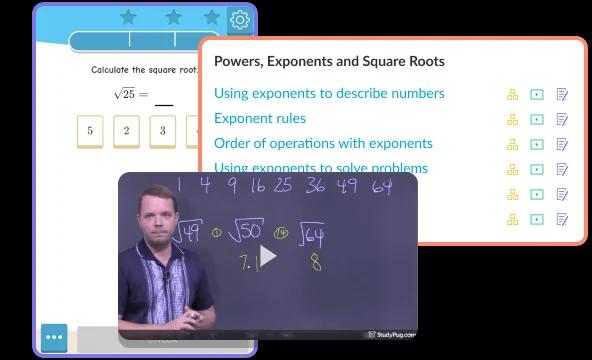
Ontario Curriculum Aligned
Every lesson matches Ontario MPM2D standards—what you learn in class, we teach

EQAO Preparation
Practice with Ontario graduation numeracy assessment questions—be ready for exam day
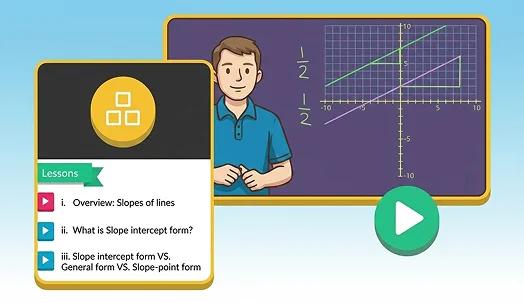
Ontario Certified Teachers
Learn from expert Ontario teachers who know exactly what you need for MPM2D

Learn Anywhere
Desktop, tablet, or phone—your MPM2D lessons sync across all devices
Frequently Asked Questions
Everything you need to know about mastering MPM2D with StudyPug
What does MPM2D coverage include?
StudyPug covers all three MPM2D strands: Quadratic Relations (including graphing, factoring, and solving equations), Analytic Geometry (linear systems, distance, midpoint, and geometric properties), and Trigonometry (similar triangles, right triangle trig, and sine and cosine laws). You'll find 69 topics, 363 video lessons, and 592 practice questions—everything you need to master the Ontario Grade 10 Academic math curriculum.
How does photo search work?
Just snap a photo of any problem from your homework or textbook using your phone. Our AI instantly identifies the topic and takes you to the exact video lesson that explains how to solve it. No more searching through hundreds of videos—you get the help you need in seconds. It works with equations, graphs, word problems, and diagrams from your MPM2D coursework.
How many practice problems are available for MPM2D?
StudyPug offers 592 practice questions specifically for MPM2D, covering quadratic relations, analytic geometry, and trigonometry. Every question includes step-by-step solutions so you can see exactly where you went wrong. Questions are organized by topic, so you can focus on your weak areas. Plus, you can retake quizzes as many times as you need until you master each concept.
What if I'm falling behind in MPM2D?
StudyPug is perfect for catching up. Start with our diagnostic tools to identify exactly which topics you're struggling with—whether it's factoring trinomials, solving linear systems, or applying the sine law. Then work through those specific video lessons and practice questions at your own pace. Students who use StudyPug consistently see grade improvements within weeks because they can focus on what they actually need to learn.
Does StudyPug help with MPM2D exams and tests?
Absolutely. StudyPug prepares you for unit tests, final exams, and EQAO assessments. Our practice questions mirror the style and difficulty of Ontario MPM2D assessments. You can create custom quizzes focused on your upcoming test topics, review step-by-step solutions for every problem type, and track your progress to ensure you're ready. Many students use StudyPug specifically during exam prep and see significant score improvements.
How much does StudyPug cost?
StudyPug offers flexible subscription plans starting at just $12.49/month with our annual plan. That's less than the cost of a single tutoring session, but you get unlimited access to every MPM2D lesson, practice question, and feature. We also offer monthly plans if you prefer more flexibility. All plans include a free trial so you can try everything risk-free before committing. Cancel anytime—no hidden fees.
Smart Study Tools for Real Results
Personalized features that help you stay motivated and make progress
Adaptive Practice
Questions adapt to your level
Stay Motivated
Badges and streaks keep you practising daily
Quiz Mastery
Retake quizzes until you truly get it
Progress Tracking
See exactly where you need more practice