TOPIC

Natural Selection, Selection pressures

MY PROGRESS

Pug Score

0%

Best Streak

0 in a row

Study Points

+0

Overview

Practice

Read

Quiz

Next Steps


Get Started

Get unlimited access to all videos, practice problems, and study tools.

Unlimited practice
Full videos

Back to Menu

Topic Progress

Pug Score

0%

Best Practice

No score

Read

Not viewed

Best Quiz

No attempts


Best Streak

0 in a row

Study Points

+0

Read

Natural Selection & Selection Pressures: How Environments Shape Populations

Natural selection is the process by which environmental selection pressures favour individuals with advantageous heritable traits, causing those traits to become more common in a population over successive generations.

What Is Natural Selection?

Natural selection is a core mechanism of evolution in which individuals with heritable traits better suited to their environment survive longer and reproduce more successfully than others. This process, first described by Charles Darwin, does not involve conscious choice it is driven entirely by environmental conditions acting on existing variation within a population.

For natural selection to occur, four conditions must be met: heritable variation must exist among individuals, individuals must differ in their ability to survive and reproduce, those differences must be linked to heritable traits, and the population must be subject to environmental pressures. Understanding these conditions connects directly to prerequisite knowledge of Genetic Variation, Sources of Diversity, and Cell Reproduction and DNA Structure and the Molecular Basis of Heredity.

Selection Pressures: Biotic and Abiotic Factors

A selection pressure is any environmental factor that influences the survival and reproductive success of individuals in a population. Selection pressures determine which traits are advantageous in a given environment and therefore which individuals are most likely to pass their genes to the next generation.

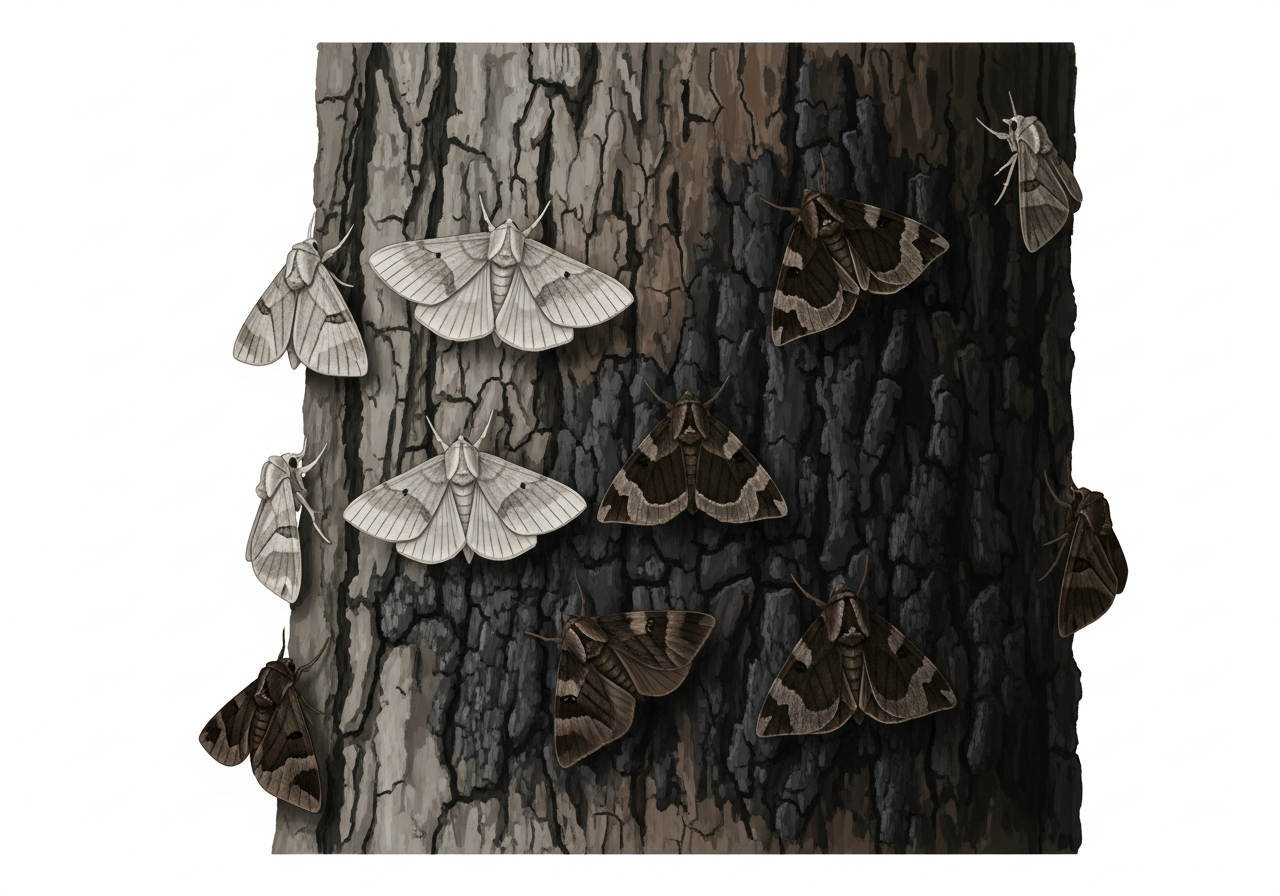
Biotic selection pressures arise from interactions with other living organisms. Examples include predation (e.g., birds eating more visible moths), competition for food or territory, disease, and parasitism. Abiotic selection pressures come from non-living physical or chemical factors such as temperature, rainfall, salinity, pH, and light availability. In a drought, for instance, water availability acts as an abiotic pressure favouring plants with deeper root systems.

Multiple selection pressures can act simultaneously on a population for example, a deer population facing both wolf predation and drought-reduced food supply must possess traits that address both challenges at once.

Types of Natural Selection

Directional selection occurs when one extreme phenotype is favoured, shifting the population's average trait over time. The classic peppered moth example illustrates this: industrial pollution darkened tree bark, making dark moths better camouflaged from bird predators, so dark moths increased in frequency while pale moths declined.

Stabilising selection removes individuals at both extremes of a trait distribution, favouring the intermediate phenotype. Human birth weight is a well-documented example very low and very high birth weight infants face higher mortality, so intermediate birth weight is consistently favoured across generations.

Disruptive selection favours both extremes of a trait distribution simultaneously, potentially splitting a population into two distinct groups. This type of selection is closely connected to the related topic of Speciation and Species Formation.

Biological Fitness and Differential Reproductive Success

In evolutionary biology, biological fitness refers specifically to an organism's ability to survive and reproduce successfully in its current environment not physical strength or speed. A small, camouflaged insect may be far more "fit" than a large, visible one in a predator-rich habitat.

Differential reproductive success is the mechanism through which natural selection operates: individuals with advantageous traits leave more offspring, gradually increasing the frequency of those traits in the population. The phrase "survival of the fittest" reflects this concept "fittest" means best adapted to the current environment, not strongest or largest.

Fitness is always environment-dependent. A trait that is highly advantageous in one environment may become harmful if conditions change, as explored in the related topic of Genetic Drift and Population Changes.

The Role of Mutations and Heritable Variation

Mutations are random changes in DNA that introduce new heritable variations into a population. They are the raw material upon which selection pressures act not the selection pressure itself. Antibiotic resistance in bacteria demonstrates this clearly: resistant bacteria already possessed random mutations before antibiotic exposure; the antibiotic acted as the selection pressure that eliminated non-resistant individuals.

This concept builds directly on the related topic of Mutations, Types and Effects and the prerequisite topic of Gene Expression and Protein Synthesis. Without heritable variation, all individuals would be equally affected by selection pressures and no differential survival would occur.

Sexual reproduction also plays a critical role by generating new combinations of alleles through crossing over and random fertilisation, as covered in the prerequisite topic of Meiosis and Gamete Formation.

Key Terms & Definitions

Natural Selection: The process by which individuals with heritable traits better suited to their environment survive and reproduce more successfully, causing those traits to increase in frequency over generations.

Selection Pressure: Any environmental factor living or non-living that influences the survival and reproductive success of individuals in a population, thereby driving natural selection.

Biotic Selection Pressure: A selection pressure arising from interactions with other living organisms, such as predation, competition, disease, or parasitism.

Abiotic Selection Pressure: A selection pressure arising from non-living physical or chemical environmental factors, such as temperature, rainfall, salinity, or light availability.

Biological Fitness: An organism's ability to survive and reproduce successfully in its current environment; measured by reproductive success, not physical strength or size.

Differential Reproductive Success: The variation in reproductive output among individuals in a population, driven by differences in heritable traits; the core mechanism through which natural selection operates.

Heritable Variation: Differences in traits among individuals in a population that have a genetic basis and can be passed from parents to offspring through reproduction.

Adaptation: A heritable trait that has been shaped by natural selection because it improves an organism's survival or reproductive success in its environment.

Selective Advantage: The short-term edge one trait variant provides over another in a given environment, making individuals with that variant more likely to survive and reproduce.

Directional Selection: A type of natural selection in which one extreme phenotype is favoured, causing the population's average trait value to shift in that direction over time.

Stabilising Selection: A type of natural selection that removes individuals at both extremes of a trait distribution, favouring the intermediate phenotype and keeping the population mean stable.

Disruptive Selection: A type of natural selection that favours both extremes of a trait distribution simultaneously, potentially leading to two distinct phenotypic groups within a population.

Sexual Selection: A form of natural selection in which certain traits are favoured because they increase an individual's success in attracting or competing for mates, rather than through direct survival advantage.

Artificial Selection: The intentional human-directed process of selecting which individuals reproduce based on desired traits, producing rapid population change; contrasts with natural selection where the environment drives selection.

Population Bottleneck: A sharp reduction in population size caused by an environmental event or selection pressure, which dramatically reduces genetic variation and can radically change which traits survive in the remaining gene pool.

Survival of the Fittest: A phrase summarising natural selection, meaning that organisms best adapted to their current environment are most likely to survive and reproduce "fittest" refers to environmental suitability, not physical dominance.

Applying Natural Selection Concepts

Learners can strengthen their understanding by analysing real-world case studies such as antibiotic resistance in bacteria, the peppered moth in industrial England, and Darwin's finches during drought conditions. In each case, students should identify the specific selection pressure, the heritable variation present, and the resulting change in trait frequency.

Connecting these examples to the related topic of Evolutionary Evidence and Multiple Lines of Evidence helps students appreciate how natural selection is supported by fossil records, comparative anatomy, and molecular biology. The broader implications of selection pressures also connect to Biodiversity and Species Relationships and Conservation and Protection Methods.
Prerequisite Knowledge & Learning Connections

A solid understanding of natural selection requires foundational knowledge from several prerequisite topics. Mitosis, Process and Stages and the Cell Cycle, Growth and Regulation establish how cells divide and populations grow. Mendelian Genetics and Basic Inheritance Patterns and Modern Genetics and Complex Inheritance explain how traits are transmitted between generations essential for understanding heritability.

The molecular basis of variation is covered in DNA Structure and the Molecular Basis of Heredity and Gene Expression, Transcription and Translation. These topics connect to the related concepts of Molecular Structure, DNA Components and Organisation and Genetic Patterns and Complex Inheritance Models, which together explain why heritable variation exists in populations.

Natural selection also connects to broader ecological and systems-level thinking through System Dynamics and Complex Interactions, reinforcing that evolutionary change does not occur in isolation but as part of interconnected biological systems.

Related Topics & Connections

Natural selection is one of several mechanisms driving evolutionary change. The related topic of Genetic Drift and Population Changes explores how random events rather than selection pressures can alter allele frequencies, particularly in small populations. Together, natural selection and genetic drift explain much of the evolutionary change observed in nature.

When selection pressures act differently on geographically isolated populations, the result can be Speciation and Species Formation the emergence of entirely new species over time. The evidence supporting these processes is examined in Evolutionary Evidence and Multiple Lines of Evidence, which draws on fossil records, biogeography, and molecular data.

At the molecular level, the raw material for selection comes from Mutations, Types and Effects and is expressed through Gene Expression, Transcription and Translation. The inheritance of selected traits follows the patterns described in Genetic Patterns and Complex Inheritance Models and is grounded in Molecular Structure, DNA Components and Organisation.

The outcomes of natural selection over deep time are reflected in Biodiversity and Species Relationships, while the practical application of understanding selection pressures informs Conservation and Protection Methods. Finally, System Dynamics and Complex Interactions provides the ecological framework within which selection pressures operate.