TOPIC

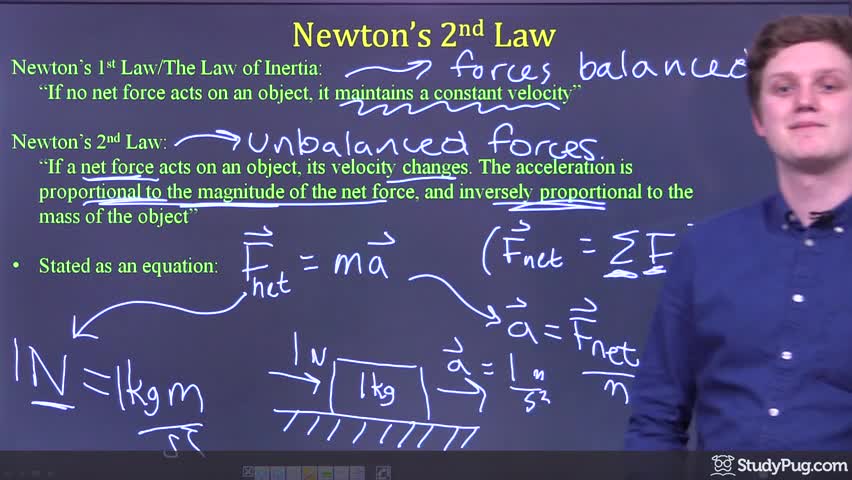
Newton's second law of motion

MY PROGRESS

Pug Score

0%

Getting Started

"Let's build your foundation!"

Activity Points

+0

Overview

Watch

Read

Next Steps


Get Started

Get unlimited access to all videos, practice problems, and study tools.

Unlimited practice
Full videos

BACK TO MENU

Topic Progress

Pug Score

0%

Getting Started

"Let's build your foundation!"

Videos Watched

0/0

Read

Not viewed


Activity Points

+0

Chapter 3.2

Newton's Second Law of Motion: Understanding F=ma

Dive into the fundamental principle of F=ma. Learn how force, mass, and acceleration interact, and apply this knowledge to real-world scenarios. Master problem-solving skills in classical mechanics.


What You'll Learn

Understand that Newton's second law describes motion when forces are unbalanced
Apply the formula F = ma to relate net force, mass, and acceleration
Calculate how changing force or mass affects an object's acceleration
Recognize that net force equals the sum of all forces acting on an object
Use kinematics equations to find unknown accelerations in force problems

What You'll Practice

1

Calculating net force given mass and acceleration

2

Finding acceleration using kinematics then applying F = ma

3

Solving for individual forces like gravity and air resistance

4

Working with multiple forces to determine net force and motion

Why This Matters

Newton's second law is fundamental to understanding how forces create motion in everything from cars to falling objects. You'll use F = ma throughout physics and engineering to predict accelerations, design safe vehicles, analyze sports motion, and solve real-world problems involving force and movement.

This Unit Includes

4 Video lessons
Learning resources

Skills

Newton's Second Law
Net Force
Force and Acceleration
Kinematics
Vector Addition
Problem Solving
Units and Conversions
Pug instructor
Failed to load modal content