Year 4 Maths Help — Step-by-Step Video Lessons & Practice
Help your child understand every topic and build confidence, one lesson at a time
Step-by-Step Video Lessons
Watch it solved then do it yourself.
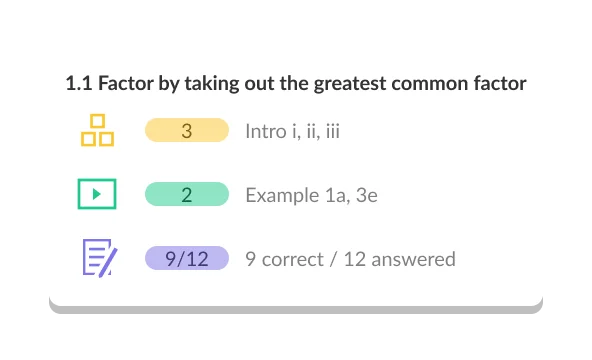
Practice Until Perfect
Keep practicing until you truly get it.
Real Exam Practice
Practice real national exam questions here.
Try It Now
Test your knowledge
Our approach aligns with the evidence
Exam Scores
Better Recall
Less Anxiety
Year 4 Maths Topics
1. Fractions
2. Introduction to Decimals
3. Adding and Subtracting Numbers
4. Multiplying and Dividing Numbers
5. Place Value
6. Patterns
7. Angles and Lines
8. 2D Shapes and Planes
9. 3D Shapes
10. Perimeter and Area
12. Time
13. Organizing Data
14 Chapters · 76 Topics · 1224 Videos

Ready to practice Year 4 Maths?
Try practice questions on every Year 4 Maths topic — with instant feedback and step-by-step video solutions when you get stuck.
Discover Our Learning Areas
Explore key subjects and start learning with interactive content.






What is Year 4 Maths?
Year 4 maths is the fourth year of primary mathematics in England, Wales, and Northern Ireland under the National Curriculum. Children aged 8–9 develop fluency in arithmetic, deepen their understanding of fractions and decimals, and build the reasoning skills they will rely on throughout Key Stage 2 and beyond. By the end of Year 4, every pupil is expected to recall all multiplication tables up to 12×12, a milestone assessed through the statutory Year 4 Multiplication Tables Check (MTC). StudyPug's Year 4 maths programme covers every National Curriculum objective through certified-teacher video lessons and adaptive practice — helping your child keep pace with the classroom and grow in confidence.
What topics are covered in Year 4 maths?
Year 4 maths spans five broad areas of the National Curriculum. Number and place value extends to four-digit numbers (up to 10,000), including ordering, rounding to the nearest 10, 100, and 1,000, and recognising negative numbers. Addition, subtraction, multiplication, and division introduces formal written methods — column addition and subtraction, short multiplication, and short division — alongside times tables fluency up to 12×12. Fractions and decimals covers equivalent fractions, comparing and ordering fractions, and recognising decimal equivalents of common fractions. Measurement includes area and perimeter of rectilinear shapes, converting between units, and reading scales precisely. Geometry explores properties of 2D and 3D shapes, symmetry, acute and obtuse angles, and coordinates in the first quadrant. Together these strands give children a broad and well-rounded Year 4 maths toolkit.
Why do children find Year 4 maths challenging?
Year 4 marks the point where maths becomes noticeably more abstract and procedural. Times tables — particularly the 6, 7, 8, 9, and 12 times tables — require consistent practice to become automatic, and gaps here create knock-on difficulties with multiplication, division, and fractions. Fraction equivalence and comparing fractions with unlike denominators puzzle many children because the rules feel arbitrary without a visual model to anchor understanding. Decimals to two decimal places, formal written division, and interpreting coordinates also appear for the first time in Year 4, adding fresh challenge. The good news is that all of these topics respond well to clear, methodical teaching and regular practice — which is exactly what StudyPug delivers.
Why StudyPug for Year 4 maths?
StudyPug is built around the way children actually learn maths — not just what the right answer is, but why and how to get there. Every Year 4 maths lesson is recorded by a certified teacher who explains each concept step by step, using clear visual models and worked examples. This means your child learns the method, not just a memorised procedure, so they can tackle unfamiliar problems with confidence.
Before your child watches a single video, StudyPug's diagnostic assessment identifies exactly which Year 4 maths topics need attention — and which ones your child already has under control. Instead of working through every topic from scratch, they focus where it matters most. From there, adaptive practice questions adjust automatically to your child's current level, gradually increasing in difficulty as their skills grow. This keeps practice productive and builds real confidence rather than frustration.
For parents, the Parent Dashboard gives a clear topic-by-topic view of each child's progress — useful both for encouraging your child and for spotting where a little extra support would help before a class test or the Year 4 MTC. If you have more than one child, the Family Plan covers up to five children across all subjects and all year groups for one price, making StudyPug outstanding value for families.
All content is aligned to the National Curriculum for England, so every lesson your child watches on StudyPug reinforces exactly what they are learning at school. And because free practice content is available to explore right away, there is no barrier to getting started.
What your child will learn in Year 4 maths
StudyPug's Year 4 maths curriculum covers every key objective your child will encounter at school. Core areas include:
- Multiplication tables up to 12×12 — fluency practice and recall strategies for the MTC
- Four-digit place value — reading, writing, ordering, and rounding numbers up to 10,000
- Formal written methods — column addition and subtraction, short multiplication, short division
- Fractions and equivalence — comparing fractions, finding fractions of amounts, decimal equivalents
- Decimals — tenths and hundredths, comparing and ordering decimal numbers
- Measurement — area and perimeter, converting units of length, mass, and capacity
- Geometry — properties of 2D and 3D shapes, angles, symmetry, and coordinates
Because no validated topic-level URLs are available in the current link map for this page, topic links are not included here. Your child can browse all Year 4 maths topics directly from the topic list above.
How to use StudyPug for Year 4 maths support
Getting started with StudyPug takes just a few minutes. Once you create an account, the diagnostic assessment guides your child to the Year 4 maths topics that need the most attention. From there, a typical study session might look like this: your child watches a short certified-teacher video on the topic — usually five to ten minutes — then completes an adaptive practice set that reinforces the method just taught. Instant feedback means they know straight away whether they have understood correctly, and if not, they can rewatch the relevant section before moving on.
For best results in Year 4, short daily sessions of 15–20 minutes are far more effective than longer weekly catch-up sessions. Consistency builds the automatic recall that times tables and arithmetic fluency require. The Parent Dashboard lets you check in on progress at any time without needing to quiz your child directly — a low-pressure way to stay involved and celebrate improvements together.
StudyPug works on any device — desktop, tablet, or mobile — so your child can practise Year 4 maths at home, on the way to school, or whenever a spare 15 minutes appears. All plans include a 30-day money-back guarantee, so you can start with complete confidence.
Year 4 Maths FAQ
Unsure how StudyPug works? Need help with setting up? Check our frequently asked questions or contact us for help.
What does my child learn in Year 4 maths, and what topics does it cover?
In Year 4 maths, children build on prior knowledge across five key areas: number and place value (up to 10,000), the four operations including formal written methods, fractions and decimals, measurement (area, perimeter, money, time), and geometry (properties of 2D and 3D shapes, coordinates, and angles). The National Curriculum also expects Year 4 pupils to know all multiplication tables up to 12×12 by the end of the year. These topics form the foundation for Year 5 maths and beyond.
Is Year 4 maths hard, and where do children commonly struggle?
Year 4 maths introduces a notable step up in difficulty. The most common struggle points are multiplication tables fluency (especially 6, 7, 8, 9, and 12), understanding fractions — particularly finding fractions of amounts and equivalence — and working with decimals to one and two decimal places. Long multiplication and formal written methods for addition and subtraction also challenge many pupils. Understanding place value with larger four-digit numbers can cause confusion when regrouping. Identifying these gaps early and practising them consistently makes a big difference to your child's progress.
What should my child know before Year 4 maths, and what comes next?
Before Year 4 maths, children should be secure in Year 3 skills: three-digit place value, times tables for 2, 3, 4, 5, 8, and 10, simple fractions (halves, thirds, quarters), telling the time to the minute, and basic column addition and subtraction. Gaps in these areas will slow progress in Year 4. After Year 4, children move into Year 5 maths, where they work with numbers up to 1,000,000, learn long multiplication and division, explore fractions further, and begin calculating with percentages and negative numbers.
How does StudyPug Year 4 maths map to what my child learns at school?
StudyPug's Year 4 maths content is built around the England National Curriculum — the same programme of study your child's teacher follows in the classroom. Every lesson covers a curriculum objective, from multiplication tables and written methods to fractions, decimals, perimeter, and shape. This means the videos and practice questions your child uses on StudyPug directly reinforce what they are learning at school, helping them feel prepared for lessons, tests, and the Year 4 Multiplication Tables Check (MTC).
What is one of the trickiest Year 4 maths concepts, and how is it taught?
Fractions — especially understanding equivalence and comparing fractions with different denominators — is one of the trickiest Year 4 maths concepts. Many children confuse the numerator and denominator or struggle to see why 2/4 equals 1/2. On StudyPug, certified teachers teach this concept using visual models such as fraction bars and number lines, showing the method step by step before moving to abstract notation. Children see why equivalent fractions are equal, not just what the rule is, so they can apply the same reasoning to new problems independently.
How much maths practice should my child do in Year 4?
For Year 4, education guidance and teacher recommendations generally suggest 15–20 minutes of focused maths practice per day outside school — short, regular sessions are more effective than long, infrequent ones. Priority areas include daily times tables practice (building to 12×12 by end of year), weekly work on fractions and decimals, and regular arithmetic drills for the four operations. StudyPug's adaptive practice automatically adjusts question difficulty to your child's current level, keeping sessions productive and building confidence without overwhelming them.





Written by the StudyPug Team
Last updated June 5, 2026
3 M+
students
★★★★★
4.8 average
K–12
all grades