Texas
TexasTexas 6th Grade Math
Watch ratio and rate videos, practice with hundreds of step-by-step problems

My daughter went from a 72 to an 89 in just two months. The step-by-step videos made ratios finally click for her.
Maria G.

Why Choose StudyPug for 6th Grade
Trusted platform that builds strong math foundations
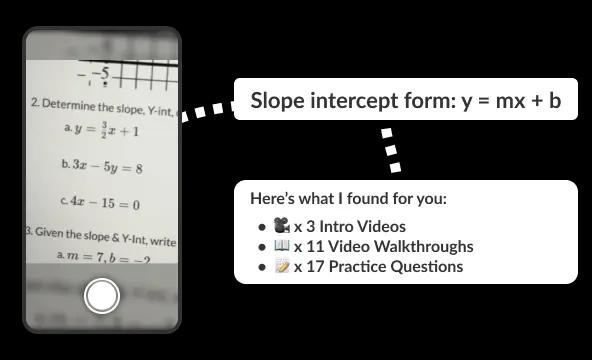
Search with Photo
Snap a photo of any problem and get the exact lesson you need
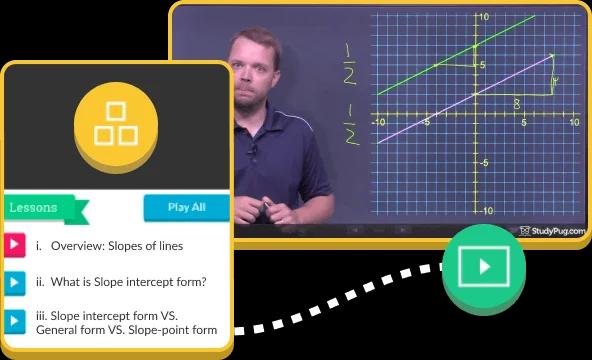
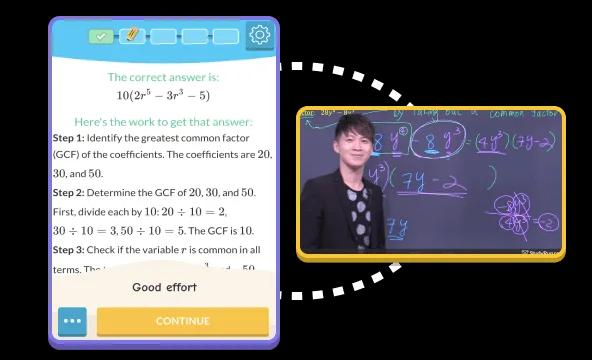
Expert Video Teaching
Certified teachers explain every concept with clear examples
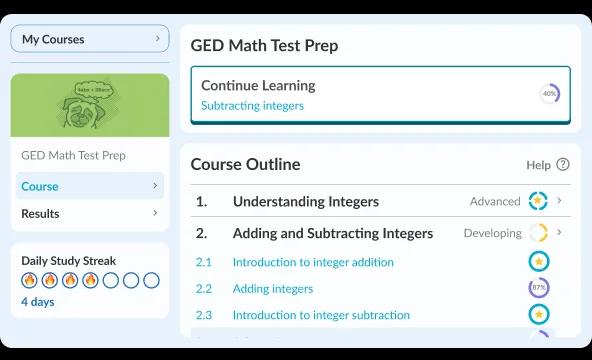
Track Progress
See exactly what they've mastered and what needs more work
How Texas Students Use StudyPug
1

Select Grade Level
Choose your Texas grade (K-12) and current math topics.
2

Get Unstuck
Upload homework problems or browse curriculum-aligned lessons.
3

Practice & Master
Work through similar problems until concepts stick.
4

See Results
Track progress and watch grades improve week by week.
Texas 6th Grade Math Help | Build Strong SkillsHelp
ID | Strand & Expectation | StudyPug Topic |
|---|---|---|
TX.6.2.A | Classify whole numbers, integers, and rational numbers using a visual representation |
TX.6.2.B | Identify a number, its opposite, and its absolute value |
TX.6.2.E | Extend representations for division to include fraction notation such as a/b represents the same number as a ÷ b where b ≠ 0 |
TX.6.3.A | Recognize that dividing by a rational number and multiplying by its reciprocal result in equivalent values |
TX.6.3.B | Determine, with and without computation, whether a quantity is increased or decreased when multiplied by a fraction |
TX.6.3.C | Represent integer operations with concrete models and connect the actions with the models to standardized algorithms |
TX.6.3.D | Add, subtract, multiply, and divide integers fluently |
TX.6.3.E | Multiply and divide positive rational numbers fluently |
TX.6.4.A | Compare two rules verbally, numerically, graphically, and symbolically in the form of y = ax or y = x + a |
TX.6.4.B | Apply qualitative and quantitative reasoning to solve prediction and comparison of real-world problems involving ratios and rates |
TX.6.4.D | Give examples of rates as the comparison by division of two quantities having different attributes |
TX.6.4.E | Represent ratios and percents with concrete models, fractions, and decimals |
TX.6.4.F | Represent benchmark fractions and percents such as 1%, 10%, 25%, 33 1/3%, and multiples of these values |
TX.6.4.H | Convert units within a measurement system, including the use of proportions and unit rates |
TX.6.5.A | Represent mathematical and real-world problems involving ratios and rates using scale factors, tables, graphs, and proportions |
TX.6.5.B | Solve real-world problems to find the whole given a part and the percent, to find the part given the whole and the percent, and to find the percent given the part and the whole |
TX.6.6.A | Identify independent and dependent quantities from tables and graphs |
TX.6.7.A | Generate equivalent numerical expressions using order of operations, including whole number exponents and prime factorization |
TX.6.7.B | Distinguish between expressions and equations verbally, numerically, and algebraically |
TX.6.7.C | Determine if two expressions are equivalent using concrete models, pictorial models, and algebraic representations |
TX.6.8.A | Extend previous knowledge of triangles and their properties to include the sum of angles of a triangle |
TX.6.8.B | Model area formulas for parallelograms, trapezoids, and triangles by decomposing and rearranging parts of these shapes |
TX.6.8.C | Write equations that represent problems related to the area of rectangles, parallelograms, trapezoids, and triangles and volume of right rectangular prisms |
TX.6.9.A | Write one-variable, one-step equations and inequalities to represent constraints or conditions within problems |
TX.6.9.B | Represent solutions for one-variable, one-step equations and inequalities on number lines |
TX.6.10.A | Model and solve one-variable, one-step equations and inequalities that represent problems, including geometric concepts |
TX.6.11 | Graph points in all four quadrants using ordered pairs of rational numbers |
TX.6.12.A | Represent numeric data graphically, including dot plots, stem-and-leaf plots, histograms, and box plots |
TX.6.12.B | Use the graphical representation of numeric data to describe the center, spread, and shape of the data distribution |
TX.6.12.D | Summarize categorical data with numerical and graphical summaries, including the mode, the percent of values in each category (relative frequency table), and the percent bar graph |
TX.6.14.A | Compare the features and costs of a checking account and a debit card offered by different local financial institutions |
TX.6.14.G | Explain various methods to pay for college, including through savings, grants, scholarships, student loans, and work-study |
Complete Texas 6th Grade Math Coverage
6th Grade Math Lessons
72
Video Explanations
734
Practice Problems
367
Texas TEKS Standards
100% Aligned


Success Stories
He can now do his homework independently. No more calling me every five minutes for help with fractions!
Jennifer L.
Her STAAR practice scores improved 15 points in three weeks. The diagnostic quiz showed us exactly what to focus on.
David T.
Read More
Common Questions About 6th Grade Math
Everything you need to know about helping your child succeed
How is StudyPug aligned with Texas TEKS standards?
Every lesson covers specific Texas TEKS standards for 6th grade math. Our curriculum includes all required topics from ratios and rates to integer operations and algebraic expressions.
Will this help prepare my child for the STAAR test?
Yes, our practice problems match STAAR format and difficulty. Students work through questions covering all tested concepts including ratios, percents, expressions, equations, and data analysis.
What 6th grade math topics does StudyPug cover?
We cover all Texas 6th grade standards: ratios and rates, integer operations, expressions and equations, geometry and measurement, data analysis, and financial literacy concepts.
How do the video lessons work for 6th grade?
Certified teachers explain each concept step-by-step with visual examples. Students can pause, rewind, and rewatch any lesson until they fully understand the material.
Can my child use this for homework help?
Absolutely. Students can search for specific topics or snap a photo of their homework problem to find the matching lesson and step-by-step solution instantly.
Practice Smart, See Real Progress
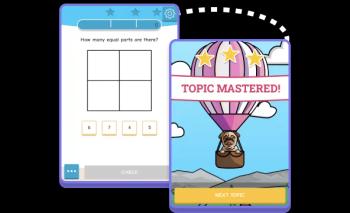
Unlimited Targeted Practice
10,000+ questions adjust to your exact skill level. Never run out of problems that challenge you.
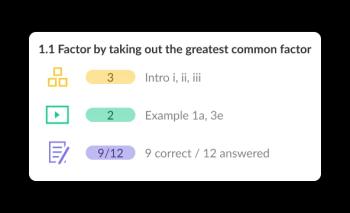
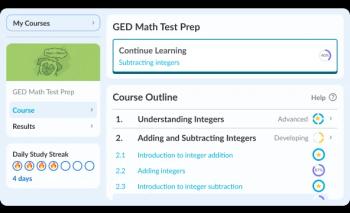
Visual Progress Tracking
See mastery percentage for every topic. Parents get weekly progress emails automatically.
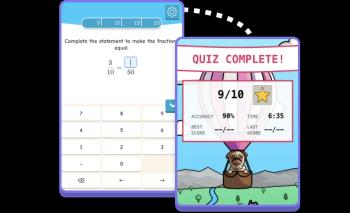
Achievement System
Earn badges for consistency and improvement. Build learning streaks that motivate daily practice
Detailed Analytics
Time spent, problems solved, concepts mastered. Identify exactly where more practice is needed.