Grade 7 Math Help — Step-by-Step Video Lessons & Practice
Help your child understand every grade 7 math topic and build real confidence, one lesson at a time.
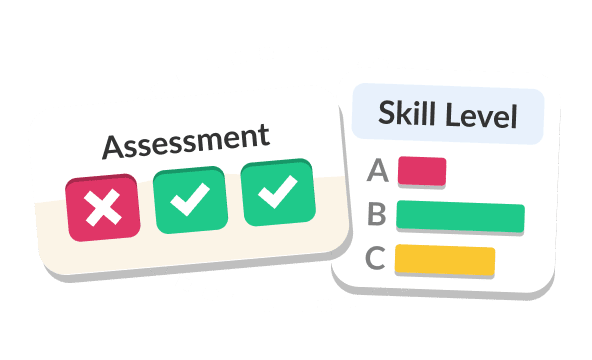
Diagnostic Finds Gaps
Know exactly where your child needs help.
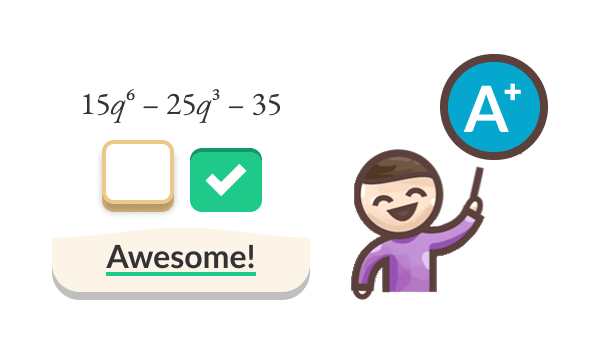
Step-by-Step Videos
Real teaching so your child solves alone.

Curriculum Aligned
Matches your child's provincial curriculum.
Try It Now
Test your knowledge
Our approach aligns with the evidence
Exam Scores
Better Recall
Less Anxiety
Grade 7 Math Topics
1. Numbers and Relations
2. Number Theory
3. Adding and Subtracting Integers
4. Multiplying and Dividing Integers
5. Operations with Decimal Numbers
6. Coordinates, Quadrants, and Transformations
7. Geometry and Measurement
8. Measuring Systems
9. Adding and Subtracting Fractions
10. Multiplying and Dividing Fractions
11. Fractions, Decimals, and Percents
12. Ratios, Rates, and Proportions
13. Pythagorean Theorem
14. Powers and Exponents
15. Introduction to 3D Objects
16. Volume
17. Circles
18. Patterns and Solving Equations
19. Introduction to Probability
21. Data and Graphs
21 Chapters · 100 Topics · 911 Videos

Ready to practice Grade 7 Math?
Try practice questions on every Grade 7 Math topic — with instant feedback and step-by-step video solutions when you get stuck.
Discover Our Learning Areas
Explore key subjects and start learning with interactive content.










What Is Grade 7 Math?
Grade 7 math is the bridge between elementary arithmetic and the abstract thinking required in high school. At this level, your child moves from working purely with whole numbers into a world of negative integers, algebraic variables, and proportional relationships. It is the year many students first feel that math has become genuinely hard — and the year when targeted support makes the biggest difference. Grade 7 math in Canada covers the same core areas across provinces: number sense, algebra, geometry, data management, and probability, all mapped to each province's program of study.
What Topics Are Covered in Grade 7 Math?
Grade 7 math covers a wide range of interconnected topics. Understanding what's on the curriculum helps you spot where your child needs extra practice.
Number sense and operations — integers (positive and negative), fractions, decimals, and percentages. Your child learns to add, subtract, multiply, and divide across all these number types and to move fluidly between them.
Ratios, rates, and proportional reasoning — comparing quantities, solving proportion problems, and applying percent to real-world situations like discounts, taxes, and tips.
Algebra — writing and evaluating algebraic expressions, solving one-step and two-step equations, and understanding what a variable represents.
Geometry — calculating area and perimeter of composite shapes, working with angles (complementary, supplementary, opposite), and an introduction to transformations.
Data and probability — collecting, organising, and interpreting data using graphs and tables; calculating simple theoretical and experimental probability.
These topics build on Grade 6 foundations and lead directly into Grade 8 math, where your child will encounter the Pythagorean theorem, linear relations, and more advanced algebra.
Why Is Grade 7 Math a Common Turning Point?
Grade 7 is the year parents most often notice their child starting to disengage from math. The shift to abstract thinking is real, and it catches many students off guard. Three topics account for the majority of Grade 7 math struggles:
Integers — subtracting a negative number, or multiplying two negatives, feels counterintuitive until the underlying logic is explained clearly. Many textbooks skip straight to the rule without building the concept.
Fractions and their connections to decimals and percentages — students who learned fraction rules by rote in Grade 5 and 6 hit a wall when they need to apply those ideas flexibly in mixed problems.
Algebra — the jump from "find the answer" arithmetic to "write an expression for any value" is a significant conceptual leap. Students who don't understand what a variable actually means struggle throughout the rest of the year.
Identifying which of these areas your child is finding difficult — rather than concluding they are "bad at math" — is the first step to turning things around.
Why StudyPug for Grade 7 Math?
StudyPug is built around the idea that every child learns differently and at their own pace, and that the best support replicates good one-on-one teaching rather than just giving answers.
The process starts with a diagnostic assessment — a short, structured quiz that identifies exactly where your child has gaps. You don't need to work out what they're missing by watching them struggle with homework. The diagnostic does that work for you, so the first lesson your child watches is already targeted at the right place.
From there, certified-teacher video lessons explain each concept step by step. These are not AI-generated explanations — they are recorded by qualified teachers who understand where Grade 7 students get stuck and how to explain the reasoning, not just the procedure. Your child can pause, rewind, and rewatch as many times as needed. That alone removes one of the biggest frustrations of homework: not being able to ask the teacher again.
Adaptive practice follows every lesson. Questions adjust to your child's current level — easier when they need to build confidence, harder as they improve. This means your child is always practising at the edge of their ability, which is where learning actually happens, rather than doing problems that are too easy to be useful or too hard to be encouraging.
For parents, the Parent Dashboard shows each child's progress at a glance. If you have more than one child, the Family Plan covers up to five children at all grade levels under a single subscription — so you're not paying separately for each child's support.
StudyPug also offers free daily practice content, so your child can get started and build a habit before you commit. And if the subscription isn't the right fit within the first 30 days, the 30-day money-back guarantee means you receive a full refund — no questions asked.
What Your Child Will Learn: Grade 7 Math Curriculum Coverage
StudyPug's Grade 7 math content is aligned to Canadian provincial curricula. Whether your child follows the Ontario curriculum or the BC program of study, every lesson maps to what their teacher is covering in class. You can explore the full topic-by-topic breakdown for your province:
- Grade 7 math Ontario curriculum — the complete topic list aligned to the Ontario Mathematics curriculum expectations for Grade 7.
- Grade 7 math curriculum BC — the full scope aligned to the BC Ministry of Education numeracy curricular competencies for Grade 7.
Alberta and other provincial alignments are also covered within the StudyPug topic library. The curriculum coverage spans all major strands: number, algebra, geometry, and data — so no topic your child encounters at school is left without a corresponding video lesson and practice set.
How to Use StudyPug for Grade 7 Math
Getting the most from StudyPug takes just a few minutes of setup. Start with the diagnostic assessment — it takes roughly 10–15 minutes and immediately produces a recommended learning path for your child. This removes the friction of deciding where to begin.
A practical daily routine for Grade 7 looks like this: after school, your child spends 5–10 minutes reviewing the concept video for whatever topic was covered in class that day. Then they complete a short set of adaptive practice problems — usually 10–15 questions — which gives instant feedback on every answer. On evenings before a test or quiz, they can use the practice test to check their readiness and identify any remaining gaps.
Parents often find it useful to check the dashboard once a week rather than every day. A weekly check gives a clearer picture of trends — topics that are consistently solid, topics that keep coming up as weak — without creating pressure on the child to perform every single session.
StudyPug works on any device: desktop, tablet, or mobile. There is no separate app to install for basic access — your child can pull up a video lesson on a phone while sitting at the kitchen table, and you can check the dashboard on your own device at the same time.
If you have younger children as well, the Family Plan means the same account supports siblings at different grade levels — from the early grades all the way through to Grade 9 and beyond — so the habit you build now scales as your children grow through school.
Grade 7 Math FAQ
Unsure how StudyPug works? Need help with setting up? Check our frequently asked questions or contact us for help.
What does my child learn in Grade 7 math, and what topics does it cover?
Grade 7 math builds on the foundations of elementary arithmetic and introduces more abstract thinking. Key topics include operations with integers, fractions, decimals and percentages, ratios and proportional reasoning, basic algebraic expressions and equations, geometry (area, perimeter, angles), and an introduction to data and probability. Across Canadian provinces the scope is very similar — your child will be expected to understand patterns, solve multi-step problems, and start reasoning with variables. These skills underpin all of high-school math.
Is Grade 7 math hard, and where do children commonly struggle?
Grade 7 is often the year where math starts to feel difficult for the first time, because abstract thinking becomes essential. The most common struggle points are working with negative integers (especially in subtraction), understanding equivalent fractions and converting between fractions, decimals, and percentages, and grasping what an algebraic variable actually means. Many children also find proportional reasoning tricky — applying ratios to real-world situations. Knowing these sticking points helps you target support early, before gaps grow.
What should my child know before Grade 7 math, and what comes next?
Before starting Grade 7 math, your child should be comfortable with multiplication and division of whole numbers, basic fractions and decimals, and simple geometric concepts from Grade 6. After Grade 7, the curriculum moves into Grade 8 math, which deepens algebraic thinking, introduces square roots, the Pythagorean theorem, and more advanced linear relations. Strong Grade 7 foundations — especially in integers, fractions, and basic algebra — make Grade 8 significantly more manageable.
How does StudyPug Grade 7 math map to what they learn at school?
StudyPug's Grade 7 math content is aligned to Canadian provincial curricula. Lessons cover the same topics your child's teacher delivers in class — whether they follow the Ontario curriculum or the BC curriculum — so every video and practice problem reinforces what's happening in the classroom. You can explore the full topic breakdown for your province: see the grade 7 math ontario curriculum or the grade 7 math curriculum bc. Lessons also align to Alberta and other provincial programs of study.
What is one of the trickiest Grade 7 math concepts, and how is it taught?
Proportional reasoning — understanding and applying ratios, rates, and percent relationships — is consistently one of the hardest Grade 7 topics. Many children can memorise a method but don't understand why it works, which causes them to fail when the question is worded differently. StudyPug's certified-teacher videos teach the concept from first principles, showing multiple representations (tables, graphs, equations) and walking through worked examples step by step. Adaptive practice questions then build confidence from simpler to more challenging problems.
How much math practice should my child do at Grade 7?
Education research broadly supports 20–30 minutes of focused practice per day at the Grade 7 level — enough to reinforce concepts without causing fatigue. The key is consistency over intensity: short daily sessions outperform occasional long cram sessions. A good routine is to review the concept video after a lesson at school, then complete a short set of practice problems. StudyPug's adaptive practice adjusts the difficulty to your child's current level, so every session is productive and builds forward rather than repeating what's already solid.





Written by the StudyPug Team
Last updated June 5, 2026
3 M+
students
★★★★★
4.8 average
K–12
all grades