Texas
TexasMaster Algebraic Reasoning
Watch algebra videos, practice with step-by-step solutions

Functions made no sense until StudyPug. The video lessons on linear and quadratic functions saved my grade. Went from D to B in 8 weeks.
Alex Rodriguez

Why Algebraic Reasoning Students Choose StudyPug
The complete learning system to master Algebraic Reasoning
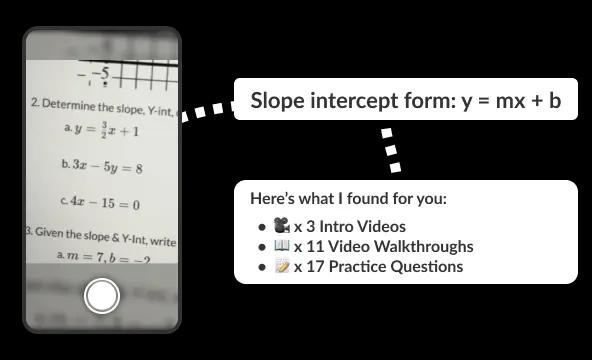
Search with Photo
Snap a photo of any problem and get the exact lesson
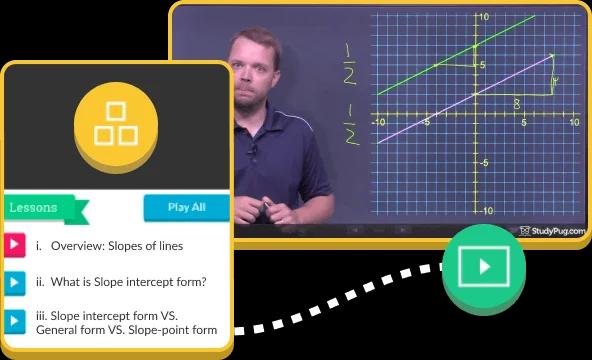
Expert Video Teaching
Certified teachers explain every concept with clear examples
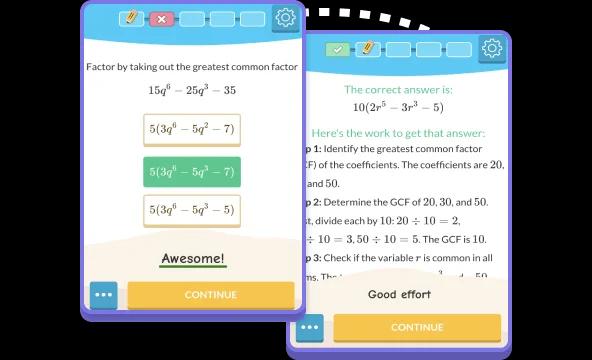
Unlimited Practice
Thousands of practice questions with step-by-step solutions
How Texas Students Use StudyPug
1

Select Grade Level
Choose your Texas grade (K-12) and current math topics.
2

Get Unstuck
Upload homework problems or browse curriculum-aligned lessons.
3

Practice & Master
Work through similar problems until concepts stick.
4

See Results
Track progress and watch grades improve week by week.
Texas Algebraic Reasoning Help: Master Concepts FastHelp
ID | Strand & Expectation | StudyPug Topic |
|---|---|---|
TX.AR.2.A | Determine the patterns that identify the relationship between a function and its common ratio or related finite differences as appropriate, including linear, quadratic, cubic, and exponential functions |
TX.AR.2.B | Classify a function as linear, quadratic, cubic, and exponential when a function is represented tabularly using finite differences or common ratios as appropriate |
TX.AR.2.C | Determine the function that models a given table of related values using finite differences and its restricted domain and range |
TX.AR.2.D | Determine a function that models real-world data and mathematical contexts using finite differences such as the age of a tree and its circumference, figurative numbers, average velocity, and average acceleration |
TX.AR.3.A | Compare and contrast the key attributes of a set of functions such as linear, quadratic, and exponential |
TX.AR.3.B | Compare and contrast the key attributes of a function and its inverse when it exists |
TX.AR.3.C | Verify that two functions are inverses of each other tabularly and graphically |
TX.AR.3.D | Represent a resulting function tabularly, graphically, and symbolically when functions are combined or separated using arithmetic operations |
TX.AR.3.E | Model a situation using function notation when the output of one function is the input of a second function |
TX.AR.3.F | Compare and contrast a function and possible functions that can be used to build it |
TX.AR.4.A | Connect tabular representations to symbolic representations when adding, subtracting, and multiplying polynomial functions |
TX.AR.4.B | Compare and contrast the results when adding two linear functions and multiplying two linear functions |
TX.AR.4.C | Determine the quotient of a polynomial function of degree three and of degree four when divided by a polynomial function of degree one and of degree two when represented tabularly and symbolically |
TX.AR.4.D | Determine the linear factors of a polynomial function of degree two and of degree three when represented symbolically and tabularly and graphically where appropriate |
TX.AR.5.A | Add and subtract matrices |
TX.AR.5.B | Multiply matrices |
TX.AR.5.C | Multiply matrices by a scalar |
TX.AR.5.D | Represent and solve systems of two linear equations arising from mathematical and real-world situations using matrices |
TX.AR.5.E | Represent and solve systems of three linear equations arising from mathematical and real-world situations using matrices and technology |
TX.AR.6.B | Solve equations arising from questions asked about functions that model real-world applications, including linear and quadratic functions |
TX.AR.6.C | Approximate solutions to equations arising from questions asked about exponential, logarithmic, square root, and cubic functions that model real-world applications |
TX.AR.7.A | Represent domain and range of a function using interval notation, inequalities, and set notation |
TX.AR.7.C | Determine the accuracy of a prediction from a function that models a set of data compared to the actual data |
TX.AR.7.D | Determine an appropriate function model, including linear, quadratic, and exponential functions, for a set of data arising from real-world situations using finite differences and average rates of change |
Complete Texas Algebraic Reasoning Coverage
Algebraic Reasoning Lessons
95
Video Explanations
705
Practice Problems
803
Texas Standards
100% Aligned
Why Texas Algebraic Reasoning Students Love StudyPug

STAAR EOC Preparation
Practice with real STAAR-style questions—be ready for exam day

Certified Teachers
Learn from expert Texas teachers who know exactly what you need for Algebraic Reasoning
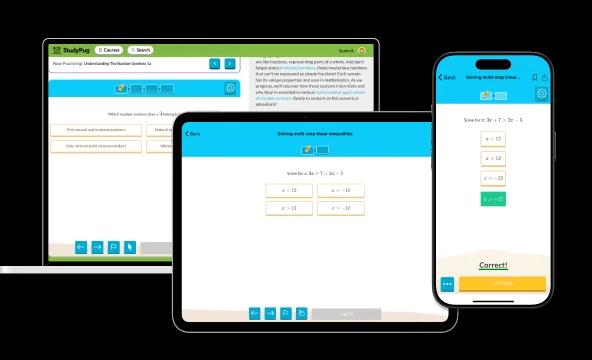
Learn Anywhere
Desktop, tablet, or phone—your Algebraic Reasoning lessons sync across all devices
Success Stories
Matrix operations confused me completely. The step-by-step videos made everything clear. Aced my chapter test with a 92%.
Jordan Lee
Polynomial division was my worst topic. Photo search found the exact lessons I needed. Raised my grade from C to A- in one semester.
Taylor Nguyen
Read More
Frequently Asked Questions
Get answers to common questions about Algebraic Reasoning on StudyPug
What does Algebraic Reasoning coverage include?
Complete Texas Algebraic Reasoning curriculum with video lessons on functions, matrices, polynomials, and modeling. Includes practice problems, step-by-step solutions, and progress tracking for every topic.
How does photo search work?
Take a photo of any Algebraic Reasoning problem, and StudyPug finds the exact lesson teaching that concept. It's like having a personal tutor who knows exactly what you need.
Are the teachers certified Texas educators?
Yes! Our teachers are certified Texas educators who understand Algebraic Reasoning curriculum and create lessons specifically for Texas TEKS standards.
Can I use StudyPug on my phone or tablet?
Absolutely! StudyPug works on desktop, tablet, and mobile. Your progress syncs automatically so you can learn anywhere, anytime.
How will StudyPug help me prepare for the STAAR EOC exam?
We include STAAR-style practice questions for every Algebraic Reasoning topic and teach the exact concepts tested on the exam. Students report significantly improved test scores and confidence.
Practice Smart, See Real Progress

Unlimited Targeted Practice
10,000+ questions adjust to your exact skill level. Never run out of problems that challenge you.
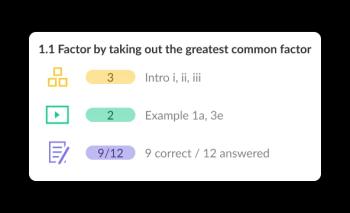
Visual Progress Tracking
See mastery percentage for every topic. Parents get weekly progress emails automatically.

Achievement System
Earn badges for consistency and improvement. Build learning streaks that motivate daily practice
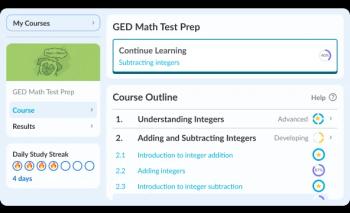
Detailed Analytics
Time spent, problems solved, concepts mastered. Identify exactly where more practice is needed.