Texas
TexasMaster Advanced Quantitative Reasoning
Watch AQR videos, practice with real-world problem solving

Statistical analysis was confusing until StudyPug. The video lessons on probability made everything clear. Aced my final.
Jordan Rodriguez

Why Advanced Quantitative Reasoning Students Choose StudyPug
The complete learning system to master Advanced Quantitative Reasoning
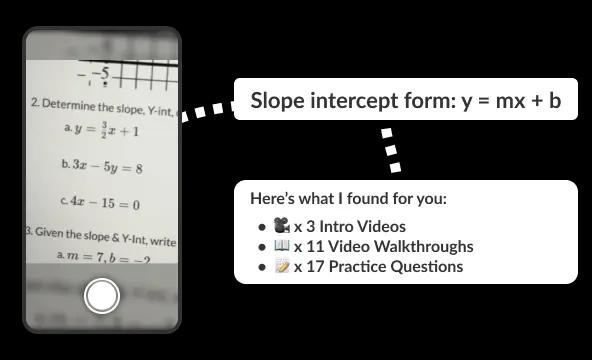
Search with Photo
Snap a photo of any problem and get the exact lesson
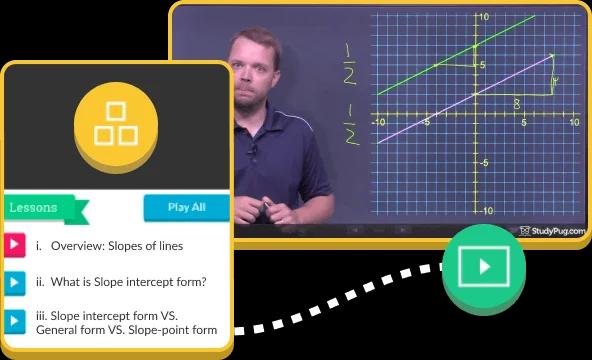
Expert Video Teaching
Certified teachers explain every concept with clear examples
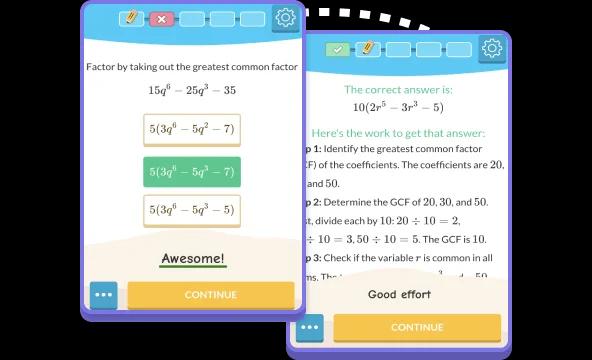
Unlimited Practice
Thousands of practice questions with step-by-step solutions
How Texas Students Use StudyPug
1

Select Grade Level
Choose your Texas grade (K-12) and current math topics.
2

Get Unstuck
Upload homework problems or browse curriculum-aligned lessons.
3

Practice & Master
Work through similar problems until concepts stick.
4

See Results
Track progress and watch grades improve week by week.
Advanced Quantitative Reasoning Help: Master Concepts FastHelp
ID | Strand & Expectation | StudyPug Topic |
|---|---|---|
TX.AQR.2.A | Use precision and accuracy in real-life situations related to measurement and significant figures |
TX.AQR.2.B | Apply and analyze published ratings, weighted averages, and indices to make informed decisions |
TX.AQR.2.C | Solve problems involving quantities that are not easily measured using proportionality |
TX.AQR.2.D | Solve geometric problems involving indirect measurement, including similar triangles, the Pythagorean Theorem, Law of Sines, Law of Cosines, and the use of dynamic geometry software |
TX.AQR.2.E | Solve problems involving large quantities using combinatorics |
TX.AQR.2.F | Use arrays to efficiently manage large collections of data and add, subtract, and multiply matrices to solve applied problems, including geometric transformations |
TX.AQR.2.G | Analyze various voting and selection processes to compare results in given situations |
TX.AQR.2.H | Select and apply an algorithm of interest to solve real-life problems such as problems using recursion or iteration involving population growth or decline, fractals, and compound interest; the validity in recorded and transmitted data using checksums and hashing; sports rankings, weighted class rankings, and search engine rankings; and problems involving scheduling or routing situations using vertex-edge graphs, critical paths, Euler paths, and minimal spanning trees and communicate to peers the application of the algorithm in precise mathematical and nontechnical language |
TX.AQR.3.A | Create and use mathematical models to represent and analyze personal financial situations, and to solve problems involving planning, managing, and paying federal and state taxes |
TX.AQR.3.C | Use arrays to efficiently manage large collections of data and add, subtract, and multiply matrices to solve applied problems |
TX.AQR.3.D | Solve geometric problems involving indirect measurement |
TX.AQR.3.E | Represent and analyze mathematical models for various voting and selection processes to compare results in given situations |
TX.AQR.3.F | Use regression methods available through technology to model linear and exponential functions, interpret correlations, and make predictions |
TX.AQR.3.G | Generate and use linear, exponential, logistic, and trigonometric functions to model and solve problems involving periodic data |
TX.AQR.3.H | Create, represent, and analyze mathematical models for various types of income calculations to determine the best option for a given situation |
TX.AQR.3.I | Create, represent, and analyze mathematical models for expenditures, including those involving credit, to determine the best option for a given situation |
TX.AQR.3.J | Create, represent, and analyze mathematical models and appropriate representations, including formulas and amortization tables, for various types of loans and investments to determine the best option for a given situation |
TX.AQR.4.A | Use a two-way frequency table as a sample space to identify whether two events are independent and to interpret the results |
TX.AQR.4.B | Use the Addition Rule, P(A or B) = P(A) + P(B) - P(A and B), in mathematical and real-world problems |
TX.AQR.4.C | Calculate conditional probabilities and probabilities of compound events using tree diagrams, Venn diagrams, area models, and formulas |
TX.AQR.4.E | Use probabilities to make and justify decisions about risks in everyday life |
TX.AQR.4.F | Calculate expected value to analyze mathematical fairness, payoff, and risk |
TX.AQR.4.G | Determine the validity of logical arguments that include compound conditional statements by constructing truth tables |
TX.AQR.4.H | Identify limitations and lack of relevant information in studies reporting statistical information, especially when studies are reported in condensed form |
TX.AQR.4.I | Interpret and compare statistical results using appropriate technology given a margin of error |
TX.AQR.4.K | Describe strengths and weaknesses of sampling techniques, data and graphical displays, and interpretations of summary statistics and other results appearing in a study, including reports published in the media |
TX.AQR.4.L | Determine the need for and purpose of a statistical investigation and what type of statistical analysis can be used to answer a specific question or set of questions |
TX.AQR.4.N | Identify the variables to be used in a study |
TX.AQR.4.P | Create data displays for given data sets to investigate, compare, and estimate center, shape, spread, and unusual features of the data |
TX.AQR.4.Q | Analyze possible sources of data variability, including those that can be controlled and those that cannot be controlled |
TX.AQR.4.S | Justify the design and the conclusion(s) of statistical studies, including the methods used |
Complete Texas Advanced Quantitative Reasoning Coverage
Advanced Quantitative Reasoning Lessons
100
Video Explanations
808
Practice Problems
805
Texas Standards
100% Aligned
Why Texas Advanced Quantitative Reasoning Students Love StudyPug

College Prep Focus
Practice with real-world applications—be ready for college math courses

Certified Teachers
Learn from expert Texas teachers who know exactly what you need for Advanced Quantitative Reasoning
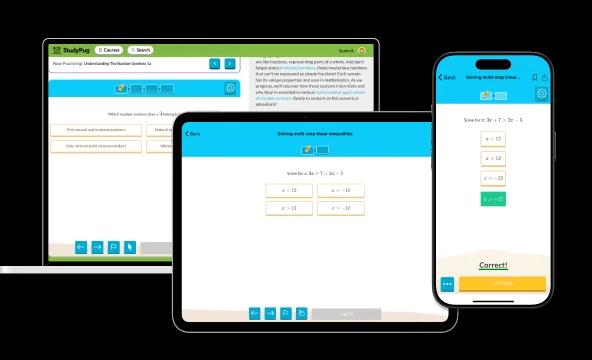
Learn Anywhere
Desktop, tablet, or phone—your AQR lessons sync across all devices
Success Stories
Matrix operations were impossible. The step-by-step videos made them click. Went from failing to a B+ in one semester.
Alex Nguyen
The AI photo search saved me hours. Found exact lessons for every homework problem. Cut my study time in half.
Riley Thompson
Read More
Frequently Asked Questions
Everything you need to know about mastering Advanced Quantitative Reasoning with StudyPug
What does Advanced Quantitative Reasoning coverage include?
Complete AQR curriculum with video lessons on statistics, probability, mathematical modeling, financial math, and real-world problem solving. Includes practice problems, step-by-step solutions, and progress tracking for every topic.
How does photo search work for AQR problems?
Take a photo of any quantitative reasoning problem, and StudyPug finds the exact lesson teaching that concept. It's like having a personal tutor who knows exactly what you need for college readiness.
Are the teachers certified Texas educators?
Yes! Our teachers are certified Texas educators who understand Advanced Quantitative Reasoning curriculum and create lessons specifically for Texas college prep standards.
Can I use StudyPug on my phone or tablet?
Absolutely! StudyPug works on desktop, tablet, and mobile. Your progress syncs automatically so you can study for college readiness anywhere.
How will StudyPug help me prepare for college math?
We teach real-world applications of statistics, financial planning, and data analysis—the exact skills you'll need in college. Students report improved confidence and stronger problem-solving abilities.
Practice Smart, See Real Progress

Unlimited Targeted Practice
10,000+ questions adjust to your exact skill level. Never run out of problems that challenge you.
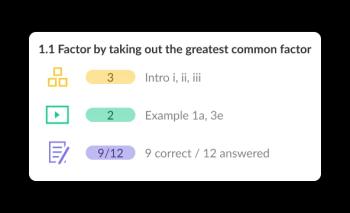
Visual Progress Tracking
See mastery percentage for every topic. Parents get weekly progress emails automatically.

Achievement System
Earn badges for consistency and improvement. Build learning streaks that motivate daily practice
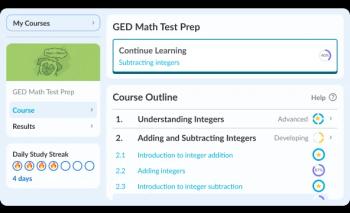
Detailed Analytics
Time spent, problems solved, concepts mastered. Identify exactly where more practice is needed.