Texas
TexasTexas 8th Grade Math
Watch algebra and geometry videos, practice with hundreds of real-world problems

My son went from struggling with equations to solving them independently in just two months. His confidence is incredible now.
Maria G.

Why Choose StudyPug for 8th Grade
Trusted platform that prepares students for high school math
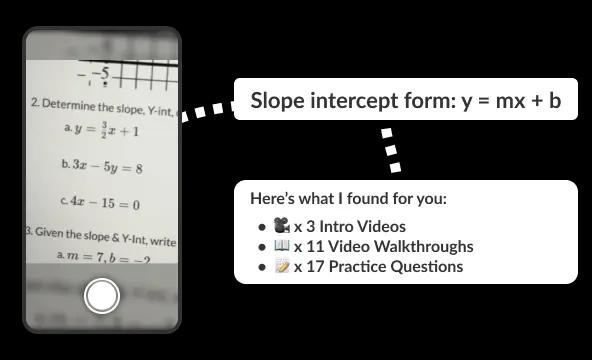
Search with Photo
Snap a photo of any problem and get the exact lesson you need
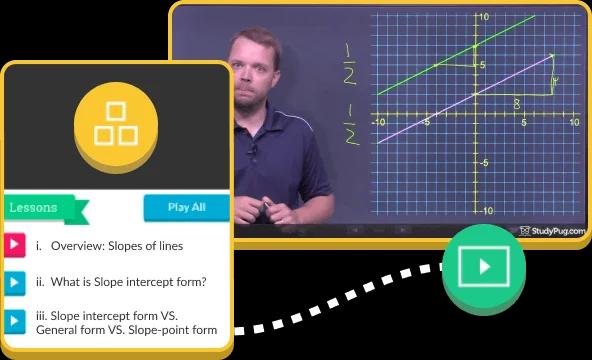
Expert Video Teaching
Certified teachers explain every concept with clear examples
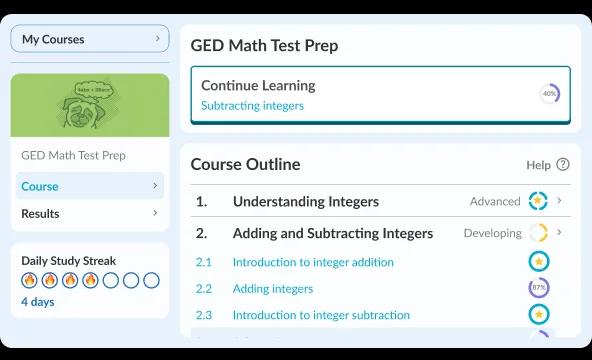
Track Progress
See exactly what they've mastered and what needs more work
How Texas Students Use StudyPug
1

Select Grade Level
Choose your Texas grade (K-12) and current math topics.
2

Get Unstuck
Upload homework problems or browse curriculum-aligned lessons.
3

Practice & Master
Work through similar problems until concepts stick.
4

See Results
Track progress and watch grades improve week by week.
Texas 8th Grade Math Help | Build Strong SkillsHelp
ID | Strand & Expectation | StudyPug Topic |
|---|---|---|
TX.8.2.A | Extend previous knowledge of sets and subsets using a visual representation to describe relationships between sets of real numbers |
TX.8.2.B | Approximate the value of an irrational number, including π and square roots of numbers less than 225, and locate that rational number approximation on a number line |
TX.8.2.C | Convert between standard decimal notation and scientific notation |
TX.8.2.D | Order a set of real numbers arising from mathematical and real-world contexts |
TX.8.3.A | Generalize that the ratio of corresponding sides of similar shapes are proportional, including a shape and its dilation |
TX.8.3.B | Compare and contrast the attributes of a shape and its dilation(s) on a coordinate plane |
TX.8.4.A | Use similar right triangles to develop an understanding that slope, m, given as the rate comparing the change in y-values to the change in x-values, (y2 - y1)/ (x2 - x1), is the same for any two points (x1, y1) and (x2, y2) on the same line |
TX.8.4.B | Graph proportional relationships, interpreting the unit rate as the slope of the line that models the relationship |
TX.8.4.C | Use data from a table or graph to determine the rate of change or slope and y-intercept in mathematical and real-world problems |
TX.8.5.A | Represent linear proportional situations with tables, graphs, and equations in the form of y = kx |
TX.8.5.B | Represent linear non-proportional situations with tables, graphs, and equations in the form of y = mx + b, where b ≠ 0 |
TX.8.5.C | Contrast bivariate sets of data that suggest a linear relationship with bivariate sets of data that do not suggest a linear relationship from a graphical representation |
TX.8.5.E | Solve problems involving direct variation |
TX.8.5.F | Distinguish between proportional and non-proportional situations using tables, graphs, and equations in the form y = kx or y = mx + b, where b ≠ 0 |
TX.8.5.G | Identify functions using sets of ordered pairs, tables, mappings, and graphs |
TX.8.5.H | Identify examples of proportional and non-proportional functions that arise from mathematical and real-world problems |
TX.8.5.I | Write an equation in the form y = mx + b to model a linear relationship between two quantities using verbal, numerical, tabular, and graphical representations |
TX.8.6.A | Describe the volume formula V = Bh of a cylinder in terms of its base area and its height |
TX.8.6.B | Model the relationship between the volume of a cylinder and a cone having both congruent bases and heights and connect that relationship to the formulas |
TX.8.6.C | Use models and diagrams to explain the Pythagorean theorem |
TX.8.7.A | Solve problems involving the volume of cylinders, cones, and spheres |
TX.8.7.B | Use previous knowledge of surface area to make connections to the formulas for lateral and total surface area and determine solutions for problems involving rectangular prisms, triangular prisms, and cylinders |
TX.8.7.C | Use the Pythagorean Theorem and its converse to solve problems |
TX.8.7.D | Determine the distance between two points on a coordinate plane using the Pythagorean Theorem |
TX.8.8.A | Write one-variable equations or inequalities with variables on both sides that represent problems using rational number coefficients and constants |
TX.8.8.B | Write a corresponding real-world problem when given a one-variable equation or inequality with variables on both sides of the equal sign using rational number coefficients and constants |
TX.8.8.C | Model and solve one-variable equations with variables on both sides of the equal sign that represent mathematical and real-world problems using rational number coefficients and constants |
TX.8.8.D | Use informal arguments to establish facts about the angle sum and exterior angle of triangles, the angles created when parallel lines are cut by a transversal, and the angle-angle criterion for similarity of triangles |
TX.8.9 | Identify and verify the values of x and y that simultaneously satisfy two linear equations in the form y = mx + b from the intersections of the graphed equations |
TX.8.10.A | Generalize the properties of orientation and congruence of rotations, reflections, translations, and dilations of two-dimensional shapes on a coordinate plane |
TX.8.10.B | Differentiate between transformations that preserve congruence and those that do not |
TX.8.11.A | Construct a scatterplot and describe the observed data to address questions of association such as linear, non-linear, and no association between bivariate data |
TX.8.11.B | Determine the mean absolute deviation and use this quantity as a measure of the average distance data are from the mean using a data set of no more than 10 data points |
TX.8.11.C | Simulate generating random samples of the same size from a population with known characteristics to develop the notion of a random sample being representative of the population from which it was selected |
TX.8.12.A | Solve real-world problems comparing how interest rate and loan length affect the cost of credit |
TX.8.12.B | Calculate the total cost of repaying a loan, including credit cards and easy access loans, under various rates of interest and over different periods using an online calculator |
TX.8.12.C | Explain how small amounts of money invested regularly, including money saved for college and retirement, grow over time |
TX.8.12.E | Identify and explain the advantages and disadvantages of different payment methods |
TX.8.12.G | Estimate the cost of a two-year and four-year college education, including family contribution, and devise a periodic savings plan for accumulating the money needed to contribute to the total cost of attendance for at least the first year of college |
Complete Texas 8th Grade Math Coverage
8th Grade Math Lessons
74
Video Explanations
527
Practice Problems
347
Texas TEKS Standards
100% Aligned



Success Stories
Her STAAR math score jumped 15 points this year. The video lessons made algebra finally click for her.
Jennifer L.
He works through geometry problems without my help now. StudyPug's step-by-step solutions taught him how to think through problems.
Robert M.
Read More
Common Questions About 8th Grade Math
Everything Texas parents need to know about helping their 8th grader succeed in math
Is StudyPug aligned with Texas TEKS standards for 8th grade math?
Yes, our 8th grade math curriculum is 100% aligned with Texas Essential Knowledge and Skills standards, covering all required topics including linear functions, geometry, and algebraic equations.
How does StudyPug prepare students for the STAAR test?
Our practice problems match STAAR test format and difficulty. Students get experience with the same question types they'll see on test day, building both skills and confidence.
What 8th grade math topics does StudyPug cover?
We cover all Texas TEKS topics: linear relationships, proportional reasoning, Pythagorean theorem, transformations, volume formulas, scatter plots, and multi-step equations with rational numbers.
Can StudyPug help if my child is struggling with algebra?
Absolutely. Our diagnostic assessment identifies specific algebra gaps, then creates a personalized learning path with video lessons and adaptive practice targeting exactly what they need.
How much time should my 8th grader spend on StudyPug weekly?
Most students benefit from 30-45 minutes, 3-4 times per week. The adaptive practice adjusts to their pace, so they can master concepts without feeling overwhelmed or bored.
Practice Smart, See Real Progress

Unlimited Targeted Practice
10,000+ questions adjust to your exact skill level. Never run out of problems that challenge you.
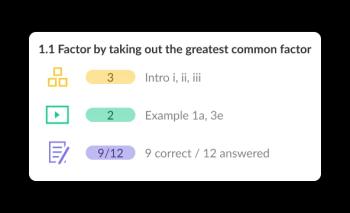
Visual Progress Tracking
See mastery percentage for every topic. Parents get weekly progress emails automatically.

Achievement System
Earn badges for consistency and improvement. Build learning streaks that motivate daily practice
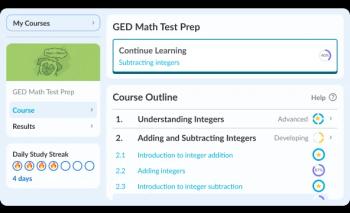
Detailed Analytics
Time spent, problems solved, concepts mastered. Identify exactly where more practice is needed.