Texas
TexasTexas 7th Grade Math
Watch algebra and geometry videos, practice with hundreds of STAAR-aligned problems

My daughter went from a 68 to an 89 in just two months. The step-by-step videos made ratios and proportions finally click.
Maria G.

Why Choose StudyPug for 7th Grade
Trusted platform that builds strong math foundations
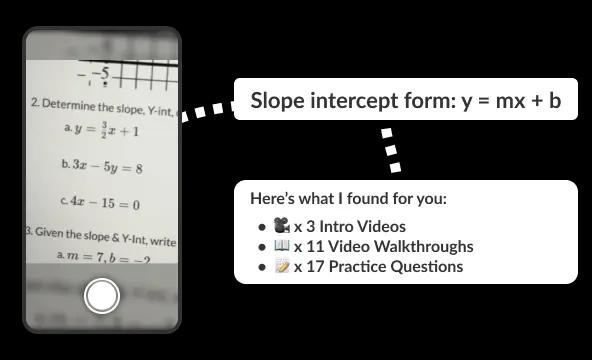
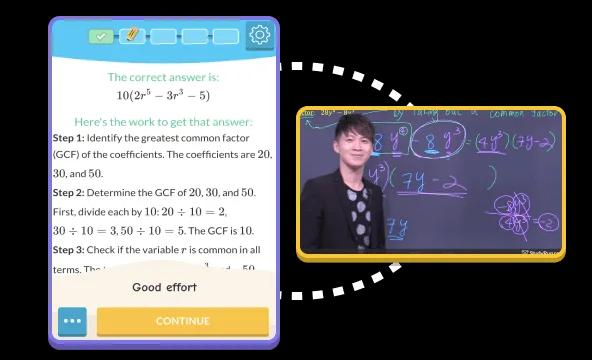
Search with Photo
Snap a photo of any problem and get the exact lesson you need
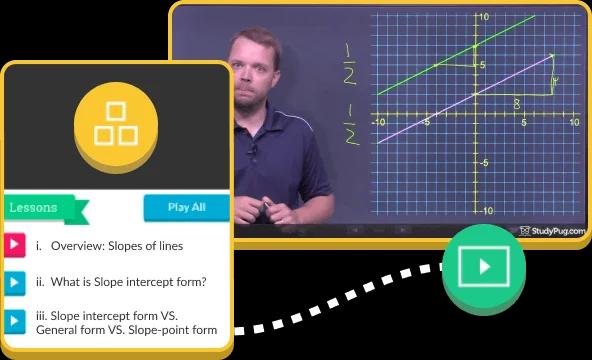
Expert Video Teaching
Certified teachers explain every concept with clear examples
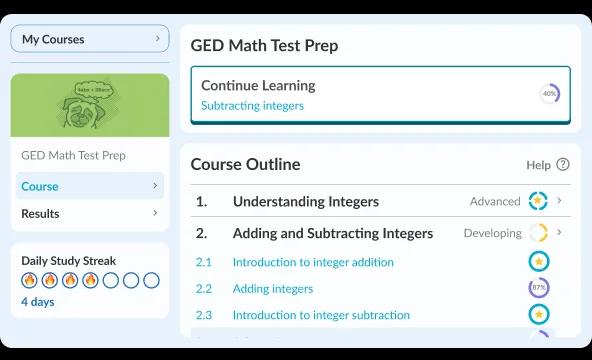
Track Progress
See exactly what they've mastered and what needs more work
How Texas Students Use StudyPug
1

Select Grade Level
Choose your Texas grade (K-12) and current math topics.
2

Get Unstuck
Upload homework problems or browse curriculum-aligned lessons.
3

Practice & Master
Work through similar problems until concepts stick.
4

See Results
Track progress and watch grades improve week by week.
Texas 7th Grade Math Help | Build Strong SkillsHelp
ID | Strand & Expectation | StudyPug Topic |
|---|---|---|
TX.7.2 | Extend previous knowledge of sets and subsets using a visual representation to describe relationships between sets of rational numbers |
TX.7.3.A | Add, subtract, multiply, and divide rational numbers fluently |
TX.7.3.B | Apply and extend previous understandings of operations to solve problems using addition, subtraction, multiplication, and division of rational numbers |
TX.7.4.A | Represent constant rates of change in mathematical and real-world problems given pictorial, tabular, verbal, numeric, graphical, and algebraic representations, including d = rt |
TX.7.4.C | Determine the constant of proportionality (k = y/x) within mathematical and real-world problems |
TX.7.4.D | Solve problems involving ratios, rates, and percents, including multi-step problems involving percent increase and percent decrease, and financial literacy problems |
TX.7.4.E | Convert between measurement systems, including the use of proportions and the use of unit rates |
TX.7.5.A | Generalize the critical attributes of similarity, including ratios within and between similar shapes |
TX.7.5.B | Describe π as the ratio of the circumference of a circle to its diameter |
TX.7.5.C | Solve mathematical and real-world problems involving similar shape and scale drawings |
TX.7.6.A | Represent sample spaces for simple and compound events using lists and tree diagrams |
TX.7.6.B | Select and use different simulations to represent simple and compound events with and without technology |
TX.7.6.C | Make predictions and determine solutions using experimental data for simple and compound events |
TX.7.6.E | Find the probabilities of a simple event and its complement and describe the relationship between the two |
TX.7.6.F | Use data from a random sample to make inferences about a population |
TX.7.6.G | Solve problems using data represented in bar graphs, dot plots, and circle graphs, including part-to-whole and part-to-part comparisons and equivalents |
TX.7.6.I | Determine experimental and theoretical probabilities related to simple and compound events using data and sample spaces |
TX.7.7 | Represent linear relationships using verbal descriptions, tables, graphs, and equations that simplify to the form y = mx + b |
TX.7.8.A | Model the relationship between the volume of a rectangular prism and a rectangular pyramid having both congruent bases and heights and connect that relationship to the formulas |
TX.7.8.C | Use models to determine the approximate formulas for the circumference and area of a circle and connect the models to the actual formulas |
TX.7.9.D | Solve problems involving the lateral and total surface area of a rectangular prism, rectangular pyramid, triangular prism, and triangular pyramid by determining the area of the shape's net |
TX.7.10.A | Write one-variable, two-step equations and inequalities to represent constraints or conditions within problems |
TX.7.10.B | Represent solutions for one-variable, two-step equations and inequalities on number lines |
TX.7.11.A | Model and solve one-variable, two-step equations and inequalities |
TX.7.11.C | Write and solve equations using geometry concepts, including the sum of the angles in a triangle, and angle relationships |
TX.7.12.A | Compare two groups of numeric data using comparative dot plots or box plots by comparing their shapes, centers, and spreads |
Complete Texas 7th Grade Math Coverage
7th Grade Math Lessons
84
Video Explanations
801
Practice Problems
421
Texas TEKS Standards
100% Aligned


Success Stories
He used to be hesitant with word problems. Now he tackles them confidently and even helps his classmates during group work.
James T.
The probability unit was confusing her in class. After three weeks with StudyPug, she aced her unit test with a 94.
Lisa M.
Read More
Common Questions About 7th Grade Math
Everything Texas parents need to know about helping their 7th grader succeed in math
How does StudyPug align with Texas TEKS standards?
Every lesson is mapped to Texas Essential Knowledge and Skills. Our curriculum covers all 7th grade TEKS requirements including ratios, proportions, probability, geometry, and algebra readiness.
Will this help my child prepare for the STAAR test?
Yes, our practice problems match STAAR test format and difficulty. Students get extensive practice with the question types and math concepts that appear on the actual 7th grade STAAR mathematics assessment.
What topics are covered in 7th grade math?
Texas 7th grade covers ratios and proportions, unit rates, percent problems, similarity and scale drawings, probability, statistics, equations and inequalities, geometry including volume and surface area, and circle measurements.
How long does it take to see improvement?
Most students show measurable progress within 3-4 weeks of consistent practice. The diagnostic assessment targets weak areas immediately, so your child focuses on what they actually need to learn.
Can my child use this alongside their school curriculum?
Absolutely. StudyPug complements classroom learning perfectly. Students can review concepts taught in class, get ahead on upcoming topics, or catch up on areas where they're struggling. Works with any Texas district curriculum.
Practice Smart, See Real Progress

Unlimited Targeted Practice
10,000+ questions adjust to your exact skill level. Never run out of problems that challenge you.
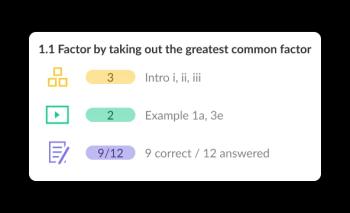
Visual Progress Tracking
See mastery percentage for every topic. Parents get weekly progress emails automatically.

Achievement System
Earn badges for consistency and improvement. Build learning streaks that motivate daily practice
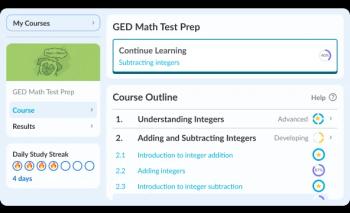
Detailed Analytics
Time spent, problems solved, concepts mastered. Identify exactly where more practice is needed.