New York
Master NY Math Plus Standards
Watch advanced math videos, practice with Regents-style problems

Complex numbers were destroying me. The video lessons on polar form made everything click. Went from C to A- in one semester.
Alex Rodriguez

Why Math Plus Standards Students Choose StudyPug
The complete learning system to master NY Math Plus Standards
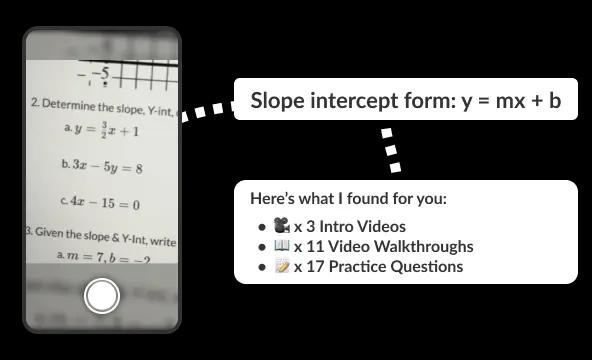
Search with Photo
Snap a photo of any problem and get the exact lesson
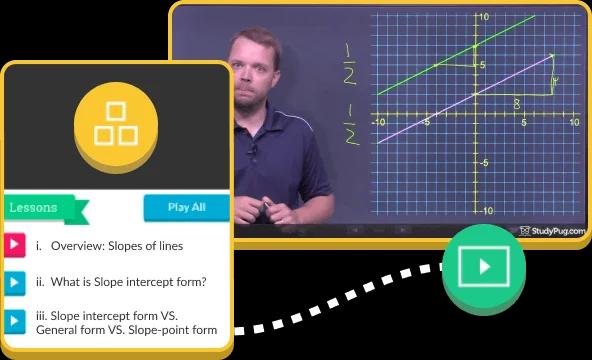
Expert Video Teaching
Certified teachers explain every concept with clear examples
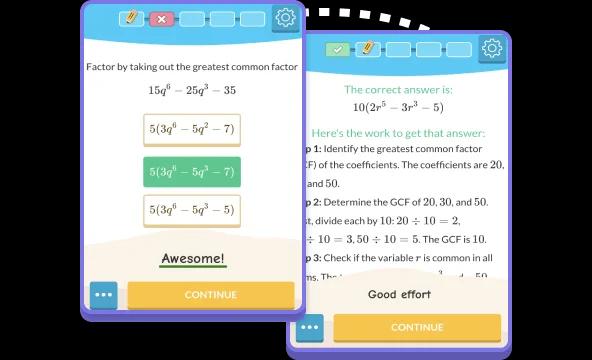
Unlimited Practice
Thousands of practice questions with step-by-step solutions
How New York Students Use StudyPug
1

Select Grade Level
Choose your New York grade (K-12) and current math topics.
2

Get Unstuck
Upload homework problems or browse curriculum-aligned lessons.
3

Practice & Master
Work through similar problems until concepts stick.
4

See Results
Track progress and watch grades improve week by week.
NY Math Plus Standards Help: Master Concepts FastHelp
ID | Math Standard Description | StudyPug Topic |
|---|---|---|
NY.N-CN.A.3+ | Find the conjugate of a complex number; use conjugates to find moduli and quotients of complex numbers. |
NY.N-CN.B.4+ | Represent complex numbers on the complex plane in rectangular and polar form. |
NY.N-CN.B.5+ | Represent addition, subtraction, multiplication, and conjugation of complex numbers geometrically on the complex plane. |
NY.N-CN.B.6+ | Calculate the distance between numbers in the complex plane as the modulus of the difference, and the midpoint of a segment as the average of the numbers at its endpoints. |
NY.N-CN.C.8+ | Extend polynomial identities to the complex numbers. |
NY.N-CN.C.9+ | Know the Fundamental Theorem of Algebra; show that it is true for quadratic polynomials. |
NY.N-VM.A.1+ | Recognize vector quantities as having both magnitude and direction. Represent vector quantities by directed line segments, and use appropriate symbols for vectors and their magnitudes. |
NY.N-VM.A.2+ | Find the components of a vector by subtracting the coordinates of an initial point from the coordinates of a terminal point. |
NY.N-VM.A.3+ | Solve problems involving velocity and other quantities that can be represented by vectors. |
NY.N-VM.B.4+ | Add and subtract vectors. |
NY.N-VM.B.5+ | Multiply a vector by a scalar. |
NY.N-VM.C.6+ | Use matrices to represent and manipulate data. |
NY.N-VM.C.7+ | Multiply matrices by scalars to produce new matrices. |
NY.N-VM.C.8+ | Add, subtract, and multiply matrices of appropriate dimensions. |
NY.N-VM.C.9+ | Understand that matrix multiplication for square matrices is not a commutative operation, but still satisfies the associative and distributive properties. |
NY.N-VM.C.10+ | Understand that the zero and identity matrices play a role in matrix addition and multiplication similar to the role of 0 and 1 in the real numbers. The determinant of a square matrix is nonzero if and only if the matrix has a multiplicative inverse. |
NY.N-VM.C.11+ | Multiply a vector (regarded as a matrix with one column) by a matrix of suitable dimensions to produce another vector. Work with matrices as transformations of vectors. |
NY.N-VM.C.12+ | Work with 2 × 2 matrices as transformations of the plane, and interpret the absolute value of the determinant in terms of area. |
NY.A-APR.C.5+ | Know and apply the Binomial Theorem for the expansion of (x + y)^n in powers of x and y for a positive integer n, where x and y are any numbers. |
NY.A-APR.D.7+ | Understand that rational expressions form a system analogous to the rational numbers, closed under addition, subtraction, multiplication, and division by a nonzero rational expression; add, subtract, multiply, and divide rational expressions. |
NY.F-BF.B.5+ | Understand the inverse relationship between exponents and logarithms and use this relationship to solve problems involving logarithms and exponents. |
NY.F-TF.A.3+ | Use special triangles to determine geometrically the values of sine, cosine, tangent for π/3, π/4 and π/6, and use the unit circle to express the values of sine, cosine, and tangent for π–x, π+x, and 2π–x in terms of their values for x. |
NY.F-TF.C.8+ | Prove the Pythagorean identity sin^2(θ) + cos^2(θ) = 1 and use it to find sin(θ), cos(θ), or tan(θ) given sin(θ), cos(θ), or tan(θ) and the quadrant of the angle. |
NY.F-TF.C.9+ | Prove the addition and subtraction formulas for sine, cosine, and tangent and use them to solve problems. |
NY.G-SRT.D.9+ | Derive the formula A = 1/2 ab sin(C) for the area of a triangle by drawing an auxiliary line from a vertex perpendicular to the opposite side. |
NY.G-SRT.D.10+ | Prove the Laws of Sines and Cosines and use them to solve problems. |
NY.G-SRT.D.11+ | Understand and apply the Law of Sines and the Law of Cosines to find unknown measurements in right and non-right triangles. |
Complete New York Math Plus Standards Coverage
Math Plus Lessons
70
Video Explanations
488
Practice Problems
745
New York Standards
100% Aligned
Success Stories
Read More
New York Plus (+) Standards Math FAQ
We’ve got answers to some popular questions.
What are the main topics covered in Grade 1 math in Alberta?
Grade 1 math in Alberta covers counting to 100, basic addition and subtraction within 20, introduction to fractions (halves), shape recognition, and simple data representation through concrete graphs.
How can I help my child transition from kindergarten to Grade 1 math?
Encourage counting during daily activities, practice simple addition with objects, and explore shapes in your environment. Maintaining a positive attitude towards math is crucial for a smooth transition.
Are there specific math skills my child should master by the end of Grade 1?
By the end of Grade 1, children should confidently count to 100, add and subtract within 20, recognize basic shapes, understand the concept of half, and create simple concrete graphs.
Practice Smart, See Real Progress

Unlimited Targeted Practice
10,000+ questions adjust to your exact skill level. Never run out of problems that challenge you.
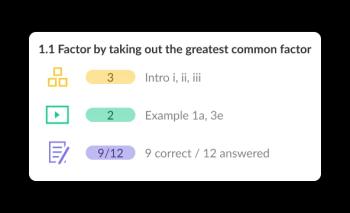
Visual Progress Tracking
See mastery percentage for every topic. Parents get weekly progress emails automatically.
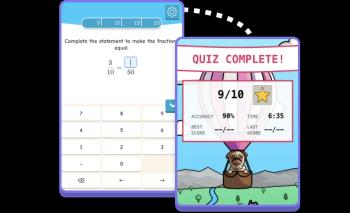
Achievement System
Earn badges for consistency and improvement. Build learning streaks that motivate daily practice
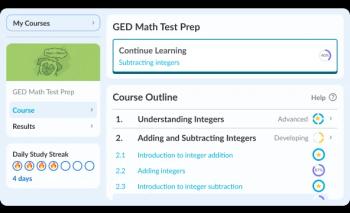
Detailed Analytics
Time spent, problems solved, concepts mastered. Identify exactly where more practice is needed.