New York
New York 4th Grade Math
Watch multiplication videos, practice with hundreds of fraction problems

My daughter went from struggling with fractions to solving them confidently in just 6 weeks with StudyPug's step-by-step approach.
Jennifer M.

Why Choose StudyPug for 4th Grade
Trusted platform that builds strong math foundations
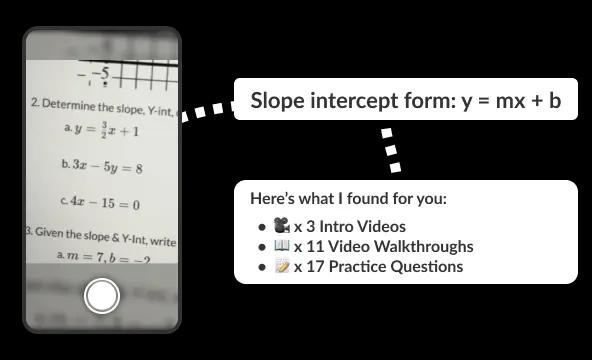
Search with Photo
Snap a photo of any problem and get the exact lesson you need
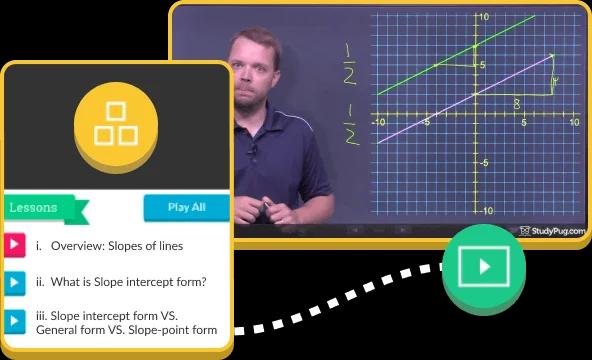
Expert Video Teaching
Certified teachers explain every concept with clear examples
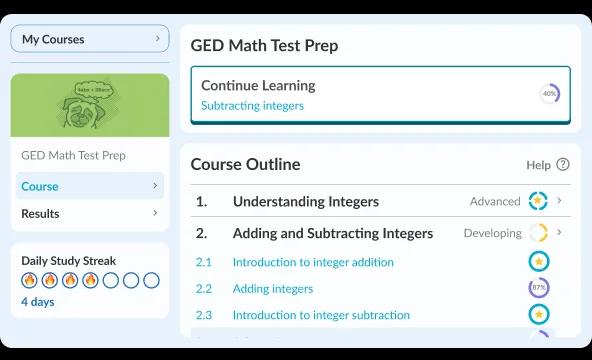
Track Progress
See exactly what they've mastered and what needs more work
How New York Students Use StudyPug
1

Select Grade Level
Choose your New York grade (K-12) and current math topics.
2

Get Unstuck
Upload homework problems or browse curriculum-aligned lessons.
3

Practice & Master
Work through similar problems until concepts stick.
4

See Results
Track progress and watch grades improve week by week.
New York 4th Grade Math Help | Build Strong SkillsHelp
ID | Math Standard Description | StudyPug Topic |
|---|---|---|
NY.4.OA.1 | Interpret a multiplication equation as a comparison. |
NY.4.OA.2 | Multiply or divide to solve word problems involving multiplicative comparison. |
NY.4.OA.3 | Solve multistep word problems posed with whole numbers and having whole-number answers using the four operations. |
NY.4.OA.4 | Find all factor pairs for a whole number in the range 1–100. |
NY.4.OA.5 | Generate a number or shape pattern that follows a given rule. |
NY.4.NBT.1 | Recognize that in a multi-digit whole number, a digit in one place represents ten times what it represents in the place to its right. |
NY.4.NBT.2 | Read and write multi-digit whole numbers using base-ten numerals, number names, and expanded form. |
NY.4.NBT.3 | Use place value understanding to round multi-digit whole numbers to any place. |
NY.4.NBT.4 | Fluently add and subtract multi-digit whole numbers using the standard algorithm. |
NY.4.NBT.5 | Multiply a whole number of up to four digits by a one-digit whole number, and multiply two two-digit numbers. |
NY.4.NBT.6 | Find whole-number quotients and remainders with up to four-digit dividends and one-digit divisors. |
NY.4.NF.1 | Explain why a fraction a/b is equivalent to a fraction (n × a)/(n × b) by using visual fraction models. |
NY.4.NF.2 | Compare two fractions with different numerators and different denominators. |
NY.4.NF.3 | Understand a fraction a/b with a > 1 as a sum of fractions 1/b. |
NY.4.NF.5 | Express a fraction with denominator 10 as an equivalent fraction with denominator 100, and use this technique to add two fractions with respective denominators 10 and 100. |
NY.4.NF.6 | Use decimal notation for fractions with denominators 10 or 100. |
NY.4.NF.7 | Compare two decimals to hundredths by reasoning about their size. |
NY.4.MD.1 | Know relative sizes of measurement units within one system of units. |
NY.4.MD.2 | Use the four operations to solve word problems involving distances, intervals of time, liquid volumes, masses of objects, and money. |
NY.4.MD.3 | Apply the area and perimeter formulas for rectangles in real world and mathematical problems. |
NY.4.MD.4 | Make a line plot to display a data set of measurements in fractions of a unit. |
NY.4.MD.5 | Recognize angles as geometric shapes that are formed wherever two rays share a common endpoint, and understand concepts of angle measurement. |
NY.4.G.1 | Draw points, lines, line segments, rays, angles (right, acute, obtuse), and perpendicular and parallel lines. Identify these in two-dimensional figures. |
NY.4.G.2 | Classify two-dimensional figures based on the presence or absence of parallel or perpendicular lines, or the presence or absence of angles of a specified size. |
NY.4.G.3 | Recognize a line of symmetry for a two-dimensional figure as a line across the figure such that the figure can be folded along the line into matching parts. |
Complete New York 4th Grade Math Coverage
4th Grade Math Lessons
58
Video Explanations
856
Practice Problems
455
New York Standards
100% Aligned



Success Stories
The visual fraction models helped my son finally understand equivalent fractions. He now tackles homework independently.
Michael T.
Her NYSTP math scores jumped 15 points after just one semester. The adaptive practice really works to build skills gradually.
Priya S.
Read More
Common Questions About 4th Grade Math
Everything you need to know about helping your child succeed in 4th Grade Math
What topics are covered in 4th Grade Math?
4th Grade Math covers multiplication and division, multi-digit operations, fractions and decimals, measurement, geometry, and angles. All content aligns with New York Next Generation Learning Standards.
How does StudyPug prepare students for the NYSTP?
StudyPug provides practice questions that match NYSTP format and difficulty. Students work through problems covering all tested standards with step-by-step solutions and immediate feedback.
Can my child use StudyPug if they're ahead or behind grade level?
Yes. Our diagnostic assessment identifies their exact level and creates a personalized path. They can access any grade level content to work at their own pace and fill gaps or advance.
How much time should my child spend on StudyPug each week?
Most students benefit from 20-30 minutes of practice 3-4 times per week. Consistent short sessions are more effective than occasional long sessions for building math skills.
What makes StudyPug different from other math programs?
StudyPug combines video lessons from certified teachers, adaptive practice, AI photo search, and progress tracking. Students learn at their own pace with content aligned to New York standards.
Practice Smart, See Real Progress

Unlimited Targeted Practice
10,000+ questions adjust to your exact skill level. Never run out of problems that challenge you.
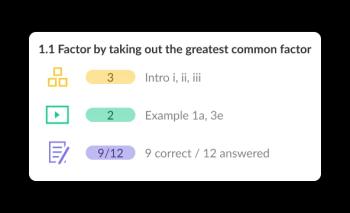
Visual Progress Tracking
See mastery percentage for every topic. Parents get weekly progress emails automatically.

Achievement System
Earn badges for consistency and improvement. Build learning streaks that motivate daily practice
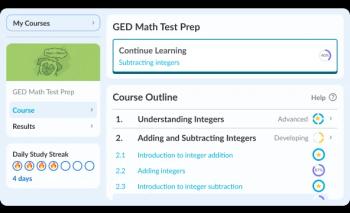
Detailed Analytics
Time spent, problems solved, concepts mastered. Identify exactly where more practice is needed.