New Jersey
New Jersey 6th Grade Math
Watch ratio and fraction videos, practice with hundreds of real-world problems

The ratio lessons finally made sense to my son. He went from confused to confident in just three weeks of practice.
Maria T.

Why Choose StudyPug for 6th Grade
Trusted platform that builds strong math foundations
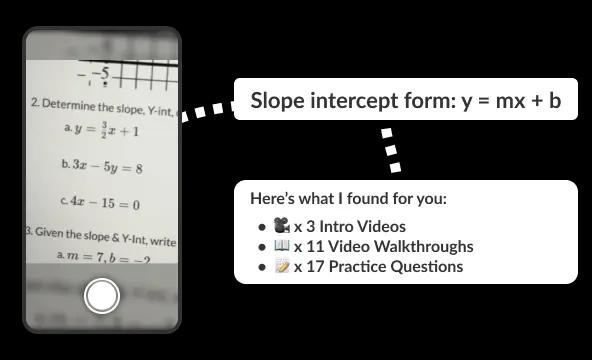
Search with Photo
Snap a photo of any problem and get the exact lesson you need
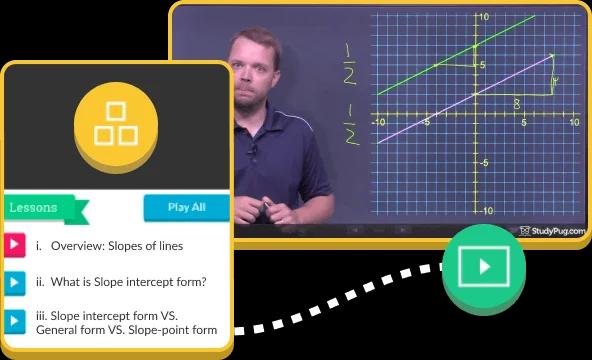
Expert Video Teaching
Certified teachers explain every concept with clear examples
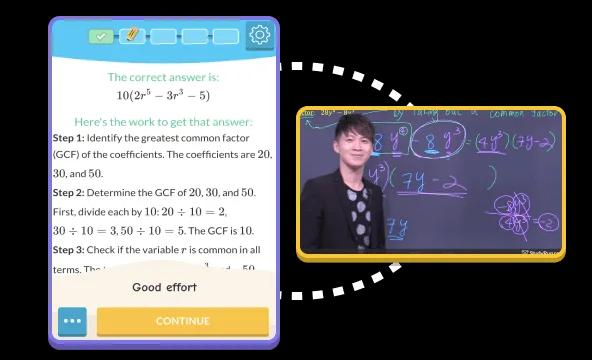
Step-by-Step Solutions
See the complete solution process for every practice problem
How New Jersey Students Use StudyPug
1

Select Grade Level
Choose your New Jersey grade (K-12) and current math topics.
2

Get Unstuck
Upload homework problems or browse curriculum-aligned lessons.
3

Practice & Master
Work through similar problems until concepts stick.
4

See Results
Track progress and watch grades improve week by week.
New Jersey 6th Grade Math Help | Build Strong SkillsHelp
ID | Standard | StudyPug Topic |
|---|---|---|
6.RP.A.1 | Understand the concept of a ratio and use ratio language to describe a ratio relationship between two quantities. |
6.RP.A.2 | Understand the concept of a unit rate a/b associated with a ratio a:b with b ≠ 0, and use rate language in the context of a ratio relationship. |
6.RP.A.3 | Use ratio and rate reasoning to solve real-world and mathematical problems. |
6.NS.A.1 | Interpret and compute quotients of fractions, and solve word problems involving division of fractions by fractions. |
6.NS.B.2 | Fluently divide multi-digit numbers using the standard algorithm. |
6.NS.B.3 | Fluently add, subtract, multiply, and divide multi-digit decimals using the standard algorithm for each operation. |
6.NS.B.4 | Find the greatest common factor of two whole numbers less than or equal to 100 and the least common multiple of two whole numbers less than or equal to 12. |
6.NS.5 | Understand that positive and negative numbers are used together to describe quantities having opposite directions or values. |
6.NS.6 | Understand a rational number as a point on the number line. Extend number line diagrams and coordinate axes familiar from previous grades to represent points on the line and in the plane with negative number coordinates. |
6.NS.7 | Understand ordering and absolute value of rational numbers. |
6.NS.8 | Solve real-world and mathematical problems by graphing points in all four quadrants of the coordinate plane. |
6.EE.A.1 | Write and evaluate numerical expressions involving whole-number exponents. |
6.EE.A.2 | Write, read, and evaluate expressions in which letters stand for numbers. |
6.EE.A.3 | Apply the properties of operations to generate equivalent expressions. |
6.EE.A.4 | Identify when two expressions are equivalent. |
6.EE.A.5 | Understand solving an equation or inequality as a process of answering a question: which values from a specified set, if any, make the equation or inequality true? |
6.EE.B.6 | Use variables to represent numbers and write expressions when solving a real-world or mathematical problem. |
6.EE.B.7 | Solve real-world and mathematical problems by writing and solving equations of the form x + p = q and px = q for cases in which p, q and x are all nonnegative rational numbers. |
6.EE.B.8 | Write an inequality of the form x > c or x < c to represent a constraint or condition in a real-world or mathematical problem. |
6.EE.C.9 | Use variables to represent two quantities in a real-world problem that change in relationship to one another; write an equation to express one quantity, thought of as the dependent variable, in terms of the other quantity, thought of as the independent variable. |
6.G.A.1 | Find the area of right triangles, other triangles, special quadrilaterals, and polygons by composing into rectangles or decomposing into triangles and other shapes. |
6.G.A.2 | Find the volume of a right rectangular prism with fractional edge lengths by packing it with unit cubes of the appropriate unit fraction edge lengths. |
6.G.A.3 | Draw polygons in the coordinate plane given coordinates for the vertices; use coordinates to find the length of a side joining points with the same first coordinate or the same second coordinate. |
6.G.A.4 | Represent three-dimensional figures using nets made up of rectangles and triangles, and use the nets to find the surface area of these figures. |
6.SP.A.1 | Recognize a statistical question as one that anticipates variability in the data related to the question and accounts for it in the answers. |
6.SP.A.2 | Understand that a set of data collected to answer a statistical question has a distribution which can be described by its center, spread, and overall shape. |
6.SP.A.3 | Recognize that a measure of center for a numerical data set summarizes all of its values with a single number, while a measure of variation describes how its values vary with a single number. |
6.SP.B.4 | Display numerical data in plots on a number line, including dot plots, histograms, and box plots. |
6.SP.B.5 | Summarize numerical data sets in relation to their context. |
Complete New Jersey 6th Grade Math Coverage
6th Grade Math Lessons
58
Video Explanations
503
Practice Problems
276
New Jersey Standards
100% Aligned
Success Stories
My daughter's NJSLA scores jumped an entire level. The coordinate plane lessons were especially helpful for her.
Jennifer K.
He can do homework independently now. The step-by-step solutions taught him how to work through problems on his own.
David L.
Read More
Common Questions About 6th Grade Math
Everything you need to know about helping your child succeed
Is StudyPug aligned with New Jersey 6th grade math standards?
Yes, StudyPug is 100% aligned with New Jersey Student Learning Standards. Our curriculum covers all required topics including ratios, fractions, expressions, and geometry that appear on NJSLA assessments.
How does StudyPug help with NJSLA test preparation?
StudyPug provides comprehensive NJSLA preparation with practice questions that match the real test format. Students work through problems covering all tested standards including ratios, statistics, and coordinate planes.
What 6th grade math topics does StudyPug cover?
StudyPug covers all New Jersey 6th grade standards: ratios and rates, fraction operations, decimals, integers, expressions, equations, geometry, and statistics with data analysis.
Can StudyPug help if my child is struggling with ratios?
Absolutely. Our diagnostic assessment identifies specific ratio concepts your child needs help with, then provides targeted video lessons and adaptive practice problems for unit rates and proportional reasoning.
How quickly will my child see improvement in math?
Most students show measurable improvement within 3-4 weeks of consistent practice. The adaptive system ensures they master foundational concepts before moving to more complex topics.
Practice Smart, See Real Progress

Unlimited Targeted Practice
10,000+ questions adjust to your exact skill level. Never run out of problems that challenge you.
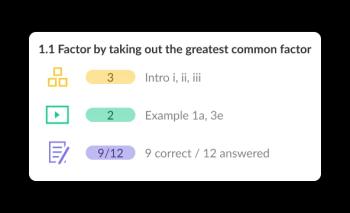
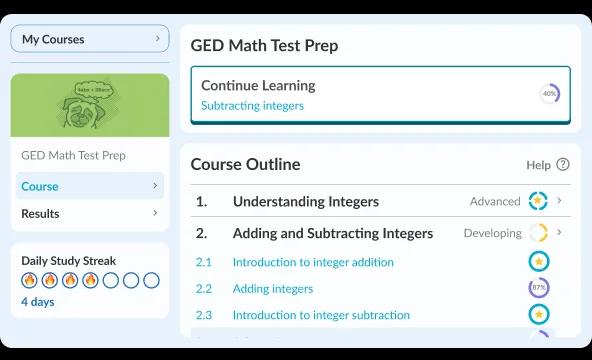
Visual Progress Tracking
See mastery percentage for every topic. Parents get weekly progress emails automatically.
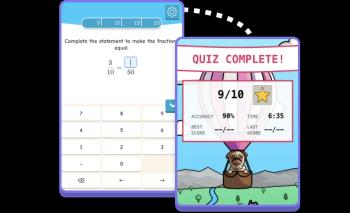
Achievement System
Earn badges for consistency and improvement. Build learning streaks that motivate daily practice
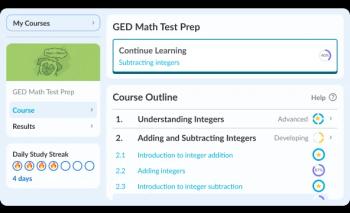
Detailed Analytics
Time spent, problems solved, concepts mastered. Identify exactly where more practice is needed.