North Dakota
North Dakota 7th Grade Math
Watch algebra and geometry videos, practice with hundreds of ratio and probability problems

My daughter went from a C+ to an A- in just two months. The step-by-step videos made all the difference with ratios and proportions.
Jennifer M.

Why Choose StudyPug for 7th Grade
Trusted platform that builds strong math foundations
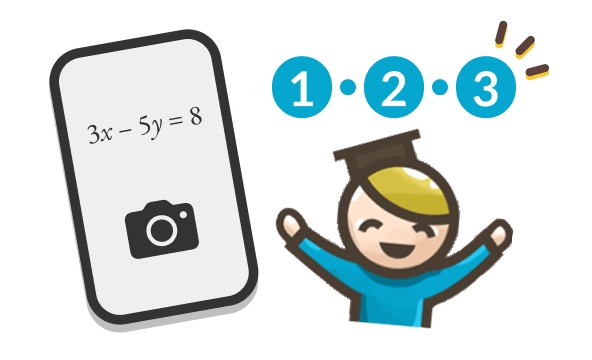
Search with Photo
Search with Photo
Snap a photo of any problem and get the exact lesson you need
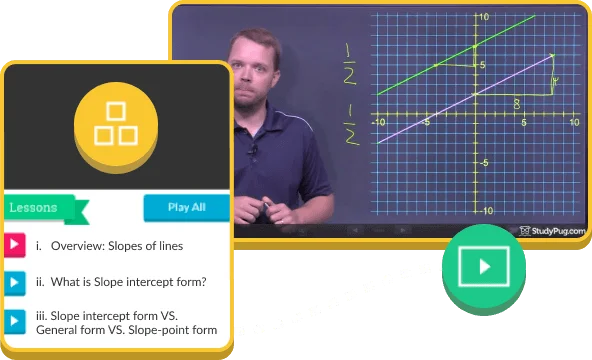
Expert Video Teaching
Expert Video Teaching
Certified teachers explain every concept with clear examples
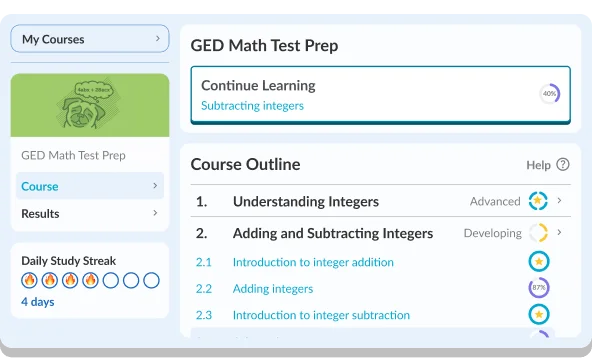
Track Progress
Track Progress
See exactly what they've mastered and what needs more work
How North Dakota Students Use StudyPug
1

Select Grade Level
Choose your North Dakota grade (K-12) and current math topics.
2

Get Unstuck
Upload homework problems or browse curriculum-aligned lessons.
3

Practice & Master
Work through similar problems until concepts stick.
4

See Results
Track progress and watch grades improve week by week.
North Dakota 7th Grade Math Help | Build Strong SkillsHelp
ID | Standard | StudyPug Topic |
|---|---|---|
7.RP.A.1 | Compute unit rates associated with ratios of fractions, including ratios of lengths, areas and other quantities measured in like or different units. |
7.RP.A.2 | Recognize and represent proportional relationships between quantities. |
7.RP.A.3 | Use proportional relationships to solve multistep ratio and percent problems. |
7.NS.A.1 | Apply and extend previous understandings of addition and subtraction to add and subtract rational numbers; represent addition and subtraction on a horizontal or vertical number line diagram. |
7.NS.A.2 | Apply and extend previous understandings of multiplication and division and of fractions to multiply and divide rational numbers. |
7.NS.A.3 | Solve real-world and mathematical problems involving the four operations with rational numbers. |
7.EE.A.1 | Apply properties of operations as strategies to add, subtract, factor, and expand linear expressions with rational coefficients. |
7.EE.A.2 | Understand that rewriting an expression in different forms in a problem context can shed light on the problem and how the quantities in it are related. |
7.EE.B.3 | Solve multi-step real-life and mathematical problems posed with positive and negative rational numbers in any form, using tools strategically. Apply properties of operations to calculate with numbers in any form; convert between forms as appropriate; and assess the reasonableness of answers using mental computation and estimation strategies. |
7.EE.B.4 | Use variables to represent quantities in a real-world or mathematical problem, and construct simple equations and inequalities to solve problems by reasoning about the quantities. |
7.G.A.1 | Solve problems involving scale drawings of geometric figures, including computing actual lengths and areas from a scale drawing and reproducing a scale drawing at a different scale. |
7.G.A.2 | Draw (freehand, with ruler and protractor, and with technology) geometric shapes with given conditions. Focus on constructing triangles from three measures of angles or sides, noticing when the conditions determine a unique triangle, more than one triangle, or no triangle. |
7.G.A.3 | Describe the two-dimensional figures that result from slicing three-dimensional figures, as in plane sections of right rectangular prisms and right rectangular pyramids. |
7.G.B.4 | Know the formulas for the area and circumference of a circle and use them to solve problems; give an informal derivation of the relationship between the circumference and area of a circle. |
7.G.B.5 | Use facts about supplementary, complementary, vertical, and adjacent angles in a multi-step problem to write and solve simple equations for an unknown angle in a figure. |
7.G.B.6 | Solve real-world and mathematical problems involving area, volume and surface area of two- and three-dimensional objects composed of triangles, quadrilaterals, polygons, cubes, and right prisms. |
7.SP.A.1 | Understand that statistics can be used to gain information about a population by examining a sample of the population; generalizations about a population from a sample are valid only if the sample is representative of that population. |
7.SP.A.2 | Use data from a random sample to draw inferences about a population with an unknown characteristic of interest. |
7.SP.B.3 | Informally assess the degree of visual overlap of two numerical data distributions with similar variabilities, measuring the difference between the centers by expressing it as a multiple of a measure of variability. |
7.SP.B.4 | Use measures of center and measures of variability for numerical data from random samples to draw informal comparative inferences about two populations. |
7.SP.C.5 | Understand that the probability of a chance event is a number between 0 and 1 that expresses the likelihood of the event occurring. |
7.SP.C.6 | Approximate the probability of a chance event by collecting data on the chance process that produces it and observing its long-run relative frequency, and predict the approximate relative frequency given the probability. |
7.SP.C.7 | Develop a probability model and use it to find probabilities of events. Compare probabilities from a model to observed frequencies; if the agreement is not good, explain possible sources of the discrepancy. |
7.SP.C.8 | Find probabilities of compound events using organized lists, tables, tree diagrams, and simulation. |
Complete North Dakota 7th Grade Math Coverage
7th Grade Math Lessons
70
Video Explanations
631
Practice Problems
246
North Dakota Standards
100% Aligned

Success Stories
The adaptive practice was perfect. My son finally understands proportional relationships after struggling all semester.
Robert K.
She now does homework independently and her test scores jumped 15 points. The progress tracking keeps us both informed.
Michelle D.
Read More
Frequently Asked Questions
Get answers to common questions about 7th Grade Math help
Is StudyPug aligned with North Dakota 7th Grade Math standards?
Yes, our 7th Grade Math course is 100% aligned with North Dakota Academic Standards, covering all required topics including ratios, rational numbers, expressions, geometry, and probability.
How does StudyPug help prepare for the North Dakota State Assessment?
StudyPug provides comprehensive NDSA preparation with practice questions matching the real test format, diagnostic assessments to identify weak areas, and video lessons covering all tested concepts.
What 7th Grade Math topics are covered in the course?
Our course covers ratios and proportions, rational number operations, linear expressions and equations, geometry including scale drawings and angles, statistics, and probability with compound events.
How do the video lessons work for 7th Grade Math?
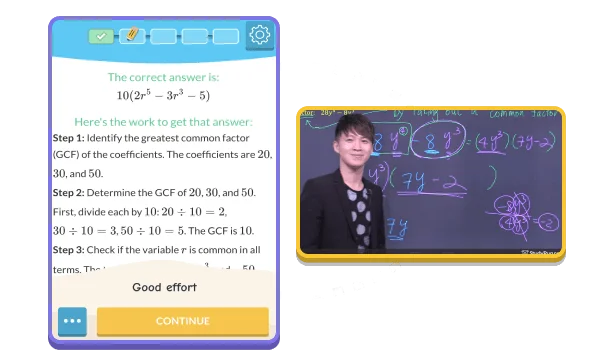
Each topic features certified teachers explaining concepts step-by-step with clear examples. Students can watch lessons at their own pace, pause and rewind as needed, and practice with aligned problems immediately after.
Can my child use StudyPug for homework help?
Absolutely. Students can search by topic or use photo recognition to find relevant lessons instantly. Step-by-step solutions and adaptive practice help them understand and master homework problems independently.
Practice Smart, See Real Progress

Unlimited Targeted Practice
10,000+ questions adjust to your exact skill level. Never run out of problems that challenge you.
Visual Progress Tracking
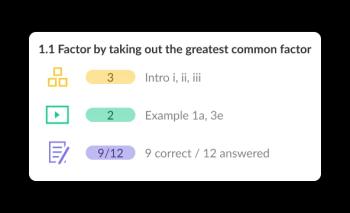
See mastery percentage for every topic. Parents get weekly progress emails automatically.

Achievement System
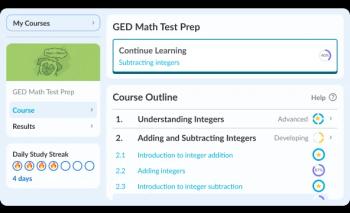
Earn badges for consistency and improvement. Build learning streaks that motivate daily practice
Detailed Analytics
Time spent, problems solved, concepts mastered. Identify exactly where more practice is needed.