flagGeorgia

Algebra

Georgia Algebra

Watch algebra videos, practice with equations and graph problems step-by-step

students image

My daughter went from a C to an A- in algebra within two months. The video lessons made everything click for her.

Jennifer K.

pug

Why Choose StudyPug for Algebra

Trusted platform that builds strong algebra foundations
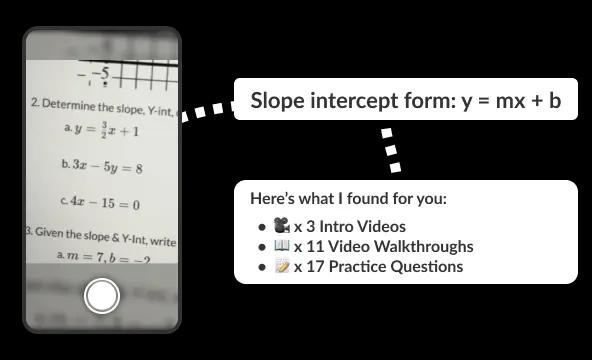
Search with Photo

Search with Photo

Snap a photo of any problem and get the exact lesson you need
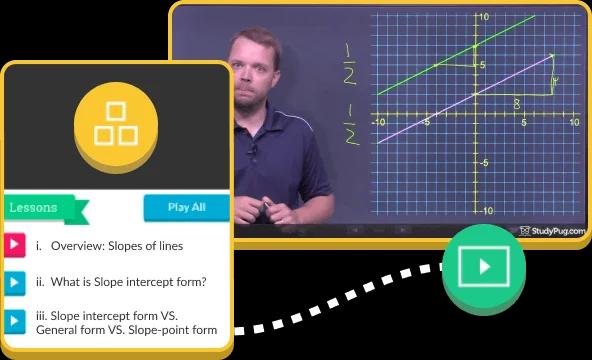
Expert Video Teaching

Expert Video Teaching

Certified teachers explain every concept with clear examples
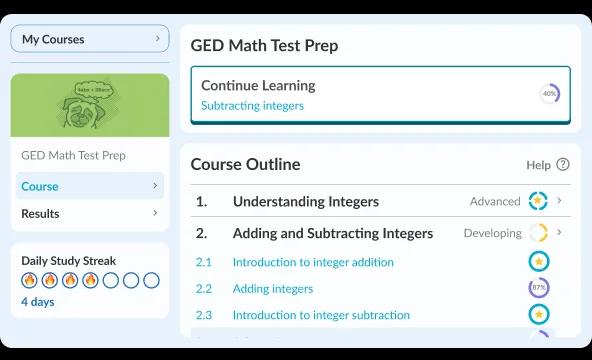
Track Progress

Track Progress

See exactly what they've mastered and what needs more work

How Georgia Students Use StudyPug

1

Select Grade Level
Select Grade Level

Choose your Georgia grade (K-12) and current math topics.

2

Get Unstuck
Get Unstuck

Upload homework problems or browse curriculum-aligned lessons.

3

Practice & Master
Practice & Master

Work through similar problems until concepts stick.

4

See Results
See Results

Track progress and watch grades improve week by week.

Georgia Algebra Help | Build Strong Math SkillsHelp

Print

ID

Standard

StudyPug Topic

CC.HSA.CED.A.1

Create equations and inequalities in one variable and use them to solve problems. Include equations arising from linear and quadratic functions, and simple rational and exponential functions.

CC.HSA.CED.A.2

Create equations in two or more variables to represent relationships between quantities; graph equations on coordinate axes with labels and scales.

CC.HSA.CED.A.3

Represent constraints by equations or inequalities, and by systems of equations and/or inequalities, and interpret solutions as viable or non-viable options in a modeling context.

CC.HSA.CED.A.4

Rearrange formulas to highlight a quantity of interest, using the same reasoning as in solving equations.

CC.HSA.REI.A.1

Explain each step in solving a simple equation as following from the equality of numbers asserted at the previous step, starting from the assumption that the original equation has a solution. Construct a viable argument to justify a solution method.

CC.HSA.REI.B.3

Solve linear equations and inequalities in one variable, including equations with coefficients represented by letters.

CC.HSA.REI.C.5

Prove that, given a system of two equations in two variables, replacing one equation by the sum of that equation and a multiple of the other produces a system with the same solutions.

CC.HSA.REI.C.6

Solve systems of linear equations exactly and approximately (e.g., with graphs), focusing on pairs of linear equations in two variables.

CC.HSA.REI.D.10

Understand that the graph of an equation in two variables is the set of all its solutions plotted in the coordinate plane, often forming a curve (which could be a line).

CC.HSA.REI.D.11

Explain why the x-coordinates of the points where the graphs of the equations y = f(x) and y = g(x) intersect are the solutions of the equation f(x) = g(x); find the solutions approximately, e.g., using technology to graph the functions, make tables of values, or find successive approximations. Include cases where f(x) and/or g(x) are linear, polynomial, rational, absolute value, exponential, and logarithmic functions.

CC.HSA.REI.D.12

Graph the solutions to a linear inequality in two variables as a half-plane (excluding the boundary in the case of a strict inequality), and graph the solution set to a system of linear inequalities in two variables as the intersection of the corresponding half-planes.

CC.HSA.SSE.A.1

Interpret expressions that represent a quantity in terms of its context.

CC.HSA.SSE.B.3

Choose and produce an equivalent form of an expression to reveal and explain properties of the quantity represented by the expression.

CC.HSA.APR.A.1

Understand that polynomials form a system analogous to the integers, namely, they are closed under the operations of addition, subtraction, and multiplication; add, subtract, and multiply polynomials.

CC.HSA.APR.B.3

Identify zeros of polynomials when suitable factorizations are available, and use the zeros to construct a rough graph of the function defined by the polynomial.

CC.HSN.RN.A.1

Explain how the definition of the meaning of rational exponents follows from extending the properties of integer exponents to those values, allowing for a notation for radicals in terms of rational exponents.

CC.HSF.IF.A.1

Understand that a function from one set (called the domain) to another set (called the range) assigns to each element of the domain exactly one element of the range. If f is a function and x is an element of its domain, then f(x) denotes the output of f corresponding to the input x. The graph of f is the graph of the equation y = f(x).

CC.HSF.IF.A.2

Use function notation, evaluate functions for inputs in their domains, and interpret statements that use function notation in terms of a context.

CC.HSF.IF.B.5

Relate the domain of a function to its graph and, where applicable, to the quantitative relationship it describes.

CC.HSF.IF.B.6

Calculate and interpret the average rate of change of a function (presented symbolically or as a table) over a specified interval. Estimate the rate of change from a graph.

CC.HSF.IF.C.9

Compare properties of two functions each represented in a different way (algebraically, graphically, numerically in tables, or by verbal descriptions).

CC.HSF.BF.A.2

Write arithmetic and geometric sequences both recursively and with an explicit formula, use them to model situations, and translate between the two forms.

CC.HSF.BF.B.3

Identify the effect on the graph of replacing f(x) by f(x) + k, k f(x), f(kx), and f(x + k) for specific values of k (both positive and negative); find the value of k given the graphs. Experiment with cases and illustrate an explanation of the effects on the graph using technology.

CC.HSF.LE.A.1

Distinguish between situations that can be modeled with linear functions and with exponential functions.

CC.HSF.LE.A.2

Construct linear and exponential functions, including arithmetic and geometric sequences, given a graph, a description of a relationship, or two input-output pairs (include reading these from a table).

CC.HSF.LE.A.3

Observe using graphs and tables that a quantity increasing exponentially eventually exceeds a quantity increasing linearly, quadratically, or (more generally) as a polynomial function.

CC.HSA.REI.C.7

Solve a simple system consisting of a linear equation and a quadratic equation in two variables algebraically and graphically.

CC.HSS.ID.A.1

Represent data with plots on the real number line (dot plots, histograms, and box plots).

CC.HSS.ID.A.2

Use statistics appropriate to the shape of the data distribution to compare center (median, mean) and spread (interquartile range, standard deviation) of two or more different data sets.

CC.HSS.ID.A.3

Interpret differences in shape, center, and spread in the context of the data sets, accounting for possible effects of extreme data points (outliers).

CC.HSS.ID.B.6

Represent data on two quantitative variables on a scatter plot, and describe how the variables are related.

CC.HSS.ID.C.7

Interpret the slope (rate of change) and the intercept (constant term) of a linear model in the context of the data.
Complete Georgia Algebra Coverage

Algebra Lessons

172

Video Explanations

1085

Practice Problems

1851

Georgia Standards

100% Aligned

Why Georgia Families Choose StudyPug

Georgia Milestones Prep

Georgia Milestones Prep

Practice questions match the real Georgia Milestones format

Certified Teachers

Certified Teachers

Certified teachers who know your standards

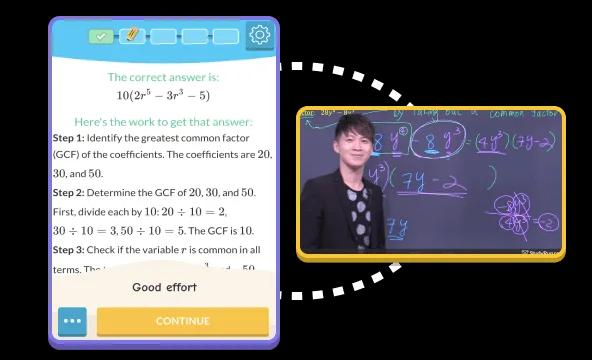
Step-by-Step Solutions

Step-by-Step Solutions

See the full solution for every problem

Success Stories

He finally understands functions! Used to avoid algebra homework, now he works independently and asks great questions.

Marcus T.

Passed the Georgia Milestones with a score she never thought possible. The test prep section was incredibly helpful.

Priya S.

Read More

Frequently Asked Questions

Everything you need to know about StudyPug Algebra

Is StudyPug aligned with Georgia Standards of Excellence?

Yes, our Algebra course is 100% aligned with Georgia Standards of Excellence and covers all required topics for Georgia Milestones preparation.

How does StudyPug help with Georgia Milestones preparation?

Our practice problems match the Georgia Milestones format, and our diagnostic assessments identify gaps in knowledge so your child can focus on areas that need improvement.

Can my child use StudyPug for homework help?

Absolutely. Students can search by topic or snap a photo of their homework problem to find the exact video lesson and step-by-step solution they need.

What topics are covered in the Algebra course?

We cover all algebra topics including equations, inequalities, functions, graphing, polynomials, rational exponents, systems, and data analysis.

How do I track my child's progress in Algebra?

Our parent portal shows exactly which topics they've mastered, where they need help, quiz scores, and time spent studying each concept.

Practice Smart, See Real Progress

Unlimited Targeted Practice

10,000+ questions adjust to your exact skill level. Never run out of problems that challenge you.
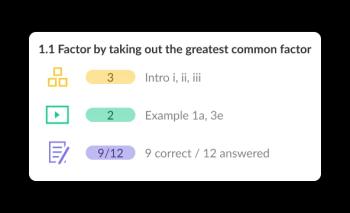
Visual Progress Tracking

See mastery percentage for every topic. Parents get weekly progress emails automatically.

Achievement System
Achievement System

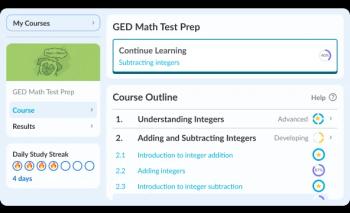
Earn badges for consistency and improvement. Build learning streaks that motivate daily practice
Detailed Analytics
Detailed Analytics

Time spent, problems solved, concepts mastered. Identify exactly where more practice is needed.

student
CallToActionContent

End Math Struggles Today

Georgia standard-aligned help that actually works

mathImage