Florida
Florida 8th Grade Math
Watch algebra videos, practice with equations and real-world problems

My son went from barely passing algebra to getting B's in just two months. The step-by-step videos made everything click.
Maria C.

Why Choose StudyPug for 8th Grade
Trusted platform that builds strong algebra foundations
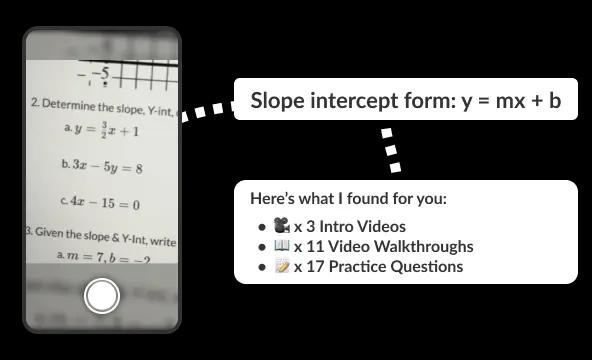
Search with Photo
Snap a photo of any problem and get the exact lesson you need
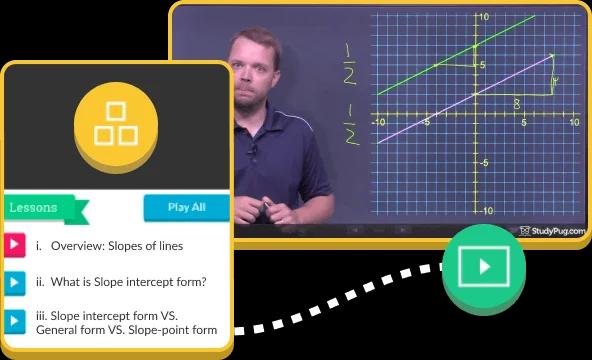
Expert Video Teaching
Certified teachers explain every concept with clear examples
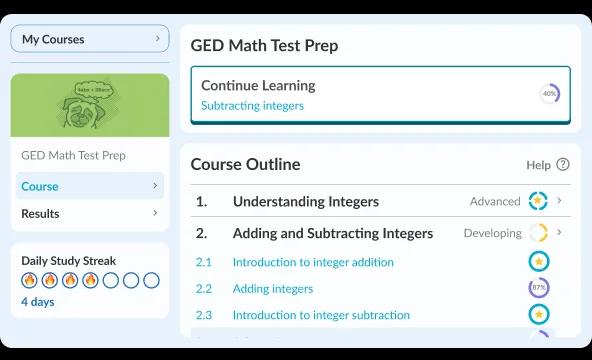
Track Progress
See exactly what they've mastered and what needs more work
How Florida Students Use StudyPug
1

Select Grade Level
Choose your Florida grade (K-12) and current math topics.
2

Get Unstuck
Upload homework problems or browse curriculum-aligned lessons.
3

Practice & Master
Work through similar problems until concepts stick.
4

See Results
Track progress and watch grades improve week by week.
Florida 8th Grade Math Help | Build Strong SkillsHelp
FL Standard | Shortened Benchmark | StudyPug Topic |
|---|---|---|
MA.8.NSO.1.1 | Extend previous understanding of rational numbers to define irrational numbers within the real number system |
MA.8.NSO.1.2 | Plot, order and compare rational and irrational numbers, represented in various forms |
MA.8.NSO.1.3 | Extend previous understanding of the Laws of Exponents to include integer exponents |
MA.8.NSO.1.4 | Express numbers in scientific notation to represent and approximate very large or very small quantities |
MA.8.NSO.1.5 | Add, subtract, multiply and divide numbers expressed in scientific notation |
MA.8.NSO.1.6 | Solve real-world problems involving operations with numbers expressed in scientific notation |
MA.8.NSO.1.7 | Solve multi-step mathematical and real-world problems involving the order of operations with rational numbers including exponents and radicals |
MA.8.AR.1.1 | Apply the Laws of Exponents to generate equivalent algebraic expressions, limited to integer exponents and monomial bases |
MA.8.AR.1.2 | Apply properties of operations to multiply two linear expressions with rational coefficients |
MA.8.AR.1.3 | Rewrite the sum of two algebraic expressions having a common monomial factor as a common factor multiplied by the sum of two algebraic expressions |
MA.8.AR.2.1 | Solve multi-step linear equations in one variable, with rational number coefficients |
MA.8.AR.2.2 | Solve two-step linear inequalities in one variable and represent solutions algebraically and graphically |
MA.8.AR.2.3 | Given an equation in the form of x² = p and x³ = q, where p is a whole number and q is an integer, determine the real solutions |
MA.8.AR.3.1 | Determine if a linear relationship is also a proportional relationship |
MA.8.AR.3.2 | Given a table, graph or written description of a linear relationship, determine the slope |
MA.8.AR.3.4 | Given a mathematical or real-world context, graph a linear equation in slope-intercept form |
MA.8.AR.3.5 | Solve problems involving linear equations in two variables |
MA.8.AR.4.1 | Given a system of two linear equations and a defined solution, determine whether the solution makes both equations true |
MA.8.AR.4.2 | Given a system of two linear equations represented graphically on the same coordinate plane, determine whether the system has one solution, no solution or infinitely many solutions |
MA.8.AR.4.3 | Solve systems of two linear equations algebraically using substitution and elimination |
MA.8.F.1.1 | Given a set of ordered pairs, a table, a graph or mapping diagram, determine whether the relationship is a function |
MA.8.F.1.2 | Given a function defined by a graph or an equation, determine whether the function is a linear function |
MA.8.F.1.3 | Analyze a real-world written description or graphical representation of a functional relationship between two quantities and identify where the function is increasing, decreasing or constant |
MA.8.GR.1.1 | Apply the Pythagorean Theorem to solve mathematical and real-world problems involving unknown side lengths in right triangles |
MA.8.GR.1.2 | Apply the Pythagorean Theorem to solve mathematical and real-world problems involving the distance between two points in a coordinate plane |
MA.8.GR.1.3 | Use the Triangle Inequality Theorem to determine if a triangle can be formed from a given set of sides |
MA.8.GR.1.4 | Solve mathematical problems involving the relationships between supplementary, complementary, vertical or adjacent angles |
MA.8.GR.1.5 | Solve problems involving the relationships of interior and exterior angles of a triangle |
MA.8.GR.1.6 | Develop and use formulas for the sums of the interior angles of regular polygons by decomposing them into triangles |
MA.8.GR.2.1 | Given a preimage and image generated by a single transformation, identify the transformation that describes the relationship |
MA.8.GR.2.2 | Given a preimage and image generated by a single dilation, identify the scale factor that describes the relationship |
MA.8.GR.2.3 | Describe and apply the effect of a single transformation on two-dimensional figures using coordinates and the coordinate plane |
MA.8.GR.2.4 | Solve mathematical and real-world problems involving proportional relationships between similar triangles |
MA.8.DP.1.1 | Given a set of real-world bivariate numerical data, construct a scatter plot or a line graph as appropriate for the context |
MA.8.DP.1.2 | Given a scatter plot within a real-world context, describe patterns of association |
MA.8.DP.1.3 | Given a scatter plot with a linear association, informally fit a straight line |
MA.8.DP.2.1 | Determine the sample space for a repeated experiment |
MA.8.DP.2.2 | Find the theoretical probability of an event related to a repeated experiment |
MA.8.DP.2.3 | Solve real-world problems involving probabilities related to single or repeated experiments |
Complete Florida 8th Grade Math Coverage
8th Grade Math Lessons
78
Video Explanations
616
Practice Problems
558
Florida Standards
100% Aligned


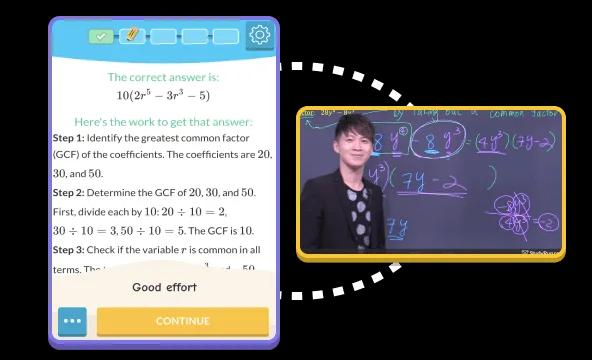
Success Stories
Her FAST scores improved dramatically. She actually understands algebra now instead of just memorizing formulas.
Jennifer M.
The photo search feature is incredible. He can get help immediately without waiting for me to figure out the problem.
Robert K.
Read More
Frequently Asked Questions
Everything you need to know about 8th Grade Math help
What topics are covered in 8th Grade Math?
Our program covers all Florida 8th grade standards including linear equations, systems of equations, exponents, scientific notation, functions, Pythagorean theorem, geometry, and data analysis.
How does StudyPug help with FAST preparation?
We provide practice problems that match the FAST format, covering all tested standards. Students practice with questions similar to what they'll see on test day.
Are the lessons aligned with Florida standards?
Yes, all our 8th grade lessons are 100% aligned with Florida B.E.S.T. standards. We cover every topic your child needs for success in school and on state assessments.
Can my child work at their own pace?
Absolutely. Students can move through lessons as quickly or slowly as needed. Our adaptive practice adjusts to their level, ensuring they master each concept before moving forward.
How do I track my child's progress?
Our parent portal shows exactly what your child has completed, their quiz scores, and areas needing more practice. You can see their progress in real-time anytime.
Practice Smart, See Real Progress

Unlimited Targeted Practice
10,000+ questions adjust to your exact skill level. Never run out of problems that challenge you.
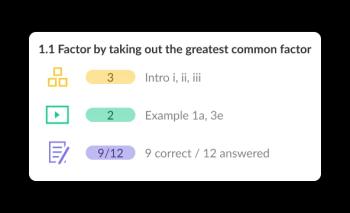
Visual Progress Tracking
See mastery percentage for every topic. Parents get weekly progress emails automatically.

Achievement System
Earn badges for consistency and improvement. Build learning streaks that motivate daily practice
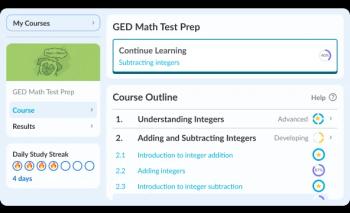
Detailed Analytics
Time spent, problems solved, concepts mastered. Identify exactly where more practice is needed.