California
Master California Mathematics II
Watch math videos, practice with step-by-step solutions

I was failing Math II until I found StudyPug. The video lessons on quadratic functions saved me. Went from D+ to B in one semester.
Alex Kim

Why Mathematics II Students Choose StudyPug
The complete learning system to master Mathematics II
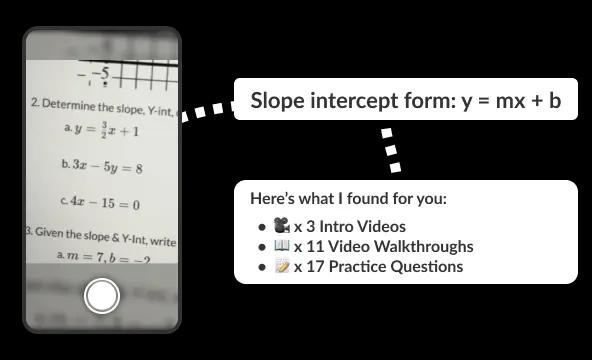
Search with Photo
Snap a photo of any problem and get the exact lesson instantly
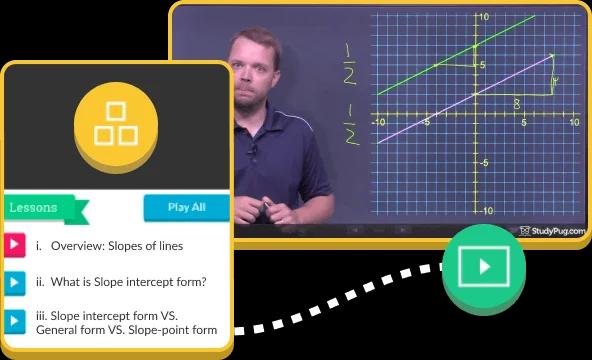
Expert Video Teaching
Certified teachers explain every concept with clear, step-by-step examples
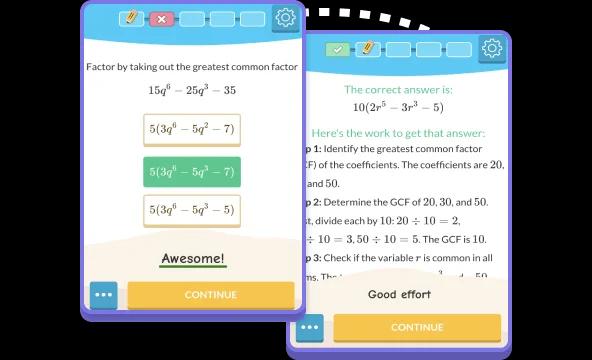
Unlimited Practice
Thousands of practice questions with complete step-by-step solutions
How California Students Use StudyPug
1

Select Grade Level
Choose your California grade (K-12) and current math topics.
2

Get Unstuck
Upload homework problems or browse curriculum-aligned lessons.
3

Practice & Master
Work through similar problems until concepts stick.
4

See Results
Track progress and watch grades improve week by week.
California Mathematics II Help: Master Concepts FastHelp
ID | Standard | StudyPug Topic |
|---|---|---|
CA.M2.N.RN.1 | Explain rational exponents |
CA.M2.N.RN.2 | Rewrite expressions with radicals and rational exponents |
CA.M2.N.RN.3 | Explain properties of rational and irrational numbers |
CA.M2.N.CN.1 | Know there is a complex number i |
CA.M2.N.CN.2 | Use the relation i² = −1 |
CA.M2.N.CN.7 | Solve quadratic equations with complex solutions |
CA.M2.N.CN.8 | Extend polynomial identities to complex numbers |
CA.M2.N.CN.9 | Know the Fundamental Theorem of Algebra |
CA.M2.A.SSE.1 | Interpret expressions |
CA.M2.A.SSE.2 | Recognize structure in expressions |
CA.M2.A.SSE.3 | Choose and produce equivalent forms of expressions |
CA.M2.A.APR.1 | Perform arithmetic operations on polynomials |
CA.M2.A.CED.1 | Create equations and inequalities |
CA.M2.A.CED.2 | Create equations in two or more variables |
CA.M2.A.CED.4 | Rearrange formulas |
CA.M2.A.REI.4 | Solve quadratic equations |
CA.M2.A.REI.7 | Solve a simple system of a linear and quadratic equation |
CA.M2.F.IF.4 | Interpret key features of graphs and tables |
CA.M2.F.IF.5 | Relate the domain of a function to its graph |
CA.M2.F.IF.6 | Calculate and interpret the average rate of change |
CA.M2.F.IF.7 | Graph functions |
CA.M2.F.IF.8 | Write functions in different but equivalent forms |
CA.M2.F.IF.9 | Compare properties of two functions |
CA.M2.F.BF.1 | Write a function that describes a relationship |
CA.M2.F.BF.3 | Identify the effect of transformations on graphs |
CA.M2.F.BF.4 | Find inverse functions |
CA.M2.F.LE.3 | Observe exponential functions using graphs and tables |
CA.M2.F.TF.8 | Prove the Pythagorean identity |
CA.M2.G.CO.9 | Prove theorems about lines and angles |
CA.M2.G.CO.10 | Prove theorems about triangles |
CA.M2.G.CO.11 | Prove theorems about parallelograms |
CA.M2.G.SRT.1 | Verify properties of dilations |
CA.M2.G.SRT.2 | Given similarity transformations, explain similarity |
CA.M2.G.SRT.3 | Use the AA criterion for similar triangles |
CA.M2.G.SRT.5 | Use congruence and similarity criteria for triangles |
CA.M2.G.SRT.6 | Understand trigonometric ratios |
CA.M2.G.SRT.7 | Explain and use the relationship between sine and cosine of complementary angles |
CA.M2.G.SRT.8 | Solve right triangles |
CA.M2.G.SRT.8.1 | Derive and use trigonometric ratios for special right triangles |
CA.M2.G.C.1 | Prove that all circles are similar |
CA.M2.G.C.2 | Identify and describe relationships among angles, radii, and chords |
CA.M2.G.C.3 | Construct inscribed and circumscribed circles of a triangle |
CA.M2.G.C.5 | Derive and use the formula for the area of a sector |
CA.M2.G.GPE.1 | Derive the equation of a circle |
CA.M2.G.GPE.2 | Derive the equation of a parabola |
CA.M2.G.GPE.4 | Use coordinates to prove simple geometric theorems |
CA.M2.G.GPE.6 | Find the point that partitions a directed line segment in a given ratio |
CA.M2.G.GMD.1 | Give informal arguments for geometric formulas |
CA.M2.G.GMD.3 | Use volume formulas |
CA.M2.G.GMD.6 | Verify the properties of triangles and apply them to solve problems |
CA.M2.S.CP.1 | Describe events as subsets of a sample space |
CA.M2.S.CP.2 | Understand independence and conditional probability |
CA.M2.S.CP.3 | Interpret independence of events |
CA.M2.S.CP.4 | Construct and interpret two-way frequency tables |
CA.M2.S.CP.5 | Recognize and explain concepts of conditional probability |
CA.M2.S.CP.6 | Find conditional probability |
CA.M2.S.CP.8 | Apply multiplication rule of probability |
CA.M2.S.CP.9 | Use permutations and combinations to compute probabilities |
CA.M2.S.MD.6 | Use probabilities to make fair decisions |
Complete California Mathematics II Coverage
Mathematics II Lessons
117
Video Explanations
784
Practice Problems
927
California Standards
100% Aligned
Why California Mathematics II Students Love StudyPug

SAT Math Preparation
Practice with real SAT-style algebra and geometry questions—be ready for test day

Certified Teachers
Learn from expert California teachers who know exactly what you need for Mathematics II
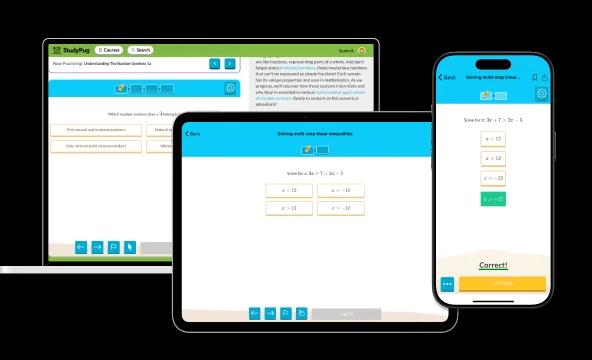
Learn Anywhere
Desktop, tablet, or phone—your Mathematics II lessons sync across all devices
Success Stories
Geometric proofs made no sense to me. The step-by-step videos broke everything down. Aced my final and got an A in the class.
Jordan Martinez
Math homework used to take hours. The photo search finds lessons instantly. Cut my study time in half and my grades went up.
Taylor Chen
Read More
Frequently Asked Questions
Everything you need to know about Mathematics II on StudyPug
What does California Mathematics II coverage include?
Complete Math II curriculum with video lessons on algebra, functions, geometry, trigonometry, circles, and probability. Includes practice problems, step-by-step solutions, and progress tracking for every California standard.
How does the photo search feature work?
Take a photo of any Mathematics II problem, and StudyPug's AI finds the exact lesson teaching that concept. It's like having a personal tutor who knows exactly what you need to learn.
Are your teachers certified California educators?
Yes! Our teachers are certified California educators who understand Mathematics II curriculum and create lessons specifically aligned to California state standards and testing requirements.
Can I access StudyPug on my phone or tablet?
Absolutely! StudyPug works seamlessly on desktop, tablet, and mobile devices. Your progress syncs automatically across all devices so you can study Mathematics II anywhere, anytime.
How will StudyPug help me prepare for the SAT Math test?
We include SAT-style practice questions covering algebra, functions, and geometry concepts from Mathematics II. Students report significantly improved test scores and confidence on exam day.
Practice Smart, See Real Progress

Unlimited Targeted Practice
10,000+ questions adjust to your exact skill level. Never run out of problems that challenge you.
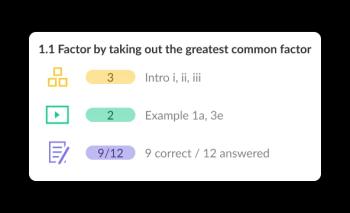
Visual Progress Tracking
See mastery percentage for every topic. Parents get weekly progress emails automatically.

Achievement System
Earn badges for consistency and improvement. Build learning streaks that motivate daily practice
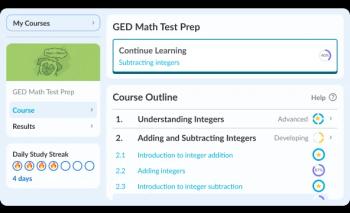
Detailed Analytics
Time spent, problems solved, concepts mastered. Identify exactly where more practice is needed.