flagCalifornia

Math

Algebra II

Master Algebra II

Watch algebra videos, practice with step-by-step solutions

students image

I was failing Algebra II until I found StudyPug. The AI helped me nail logarithms. Went from D to B in two months.

Alex Kim

pug

Why Algebra II Students Choose StudyPug

The complete learning system to master Algebra II
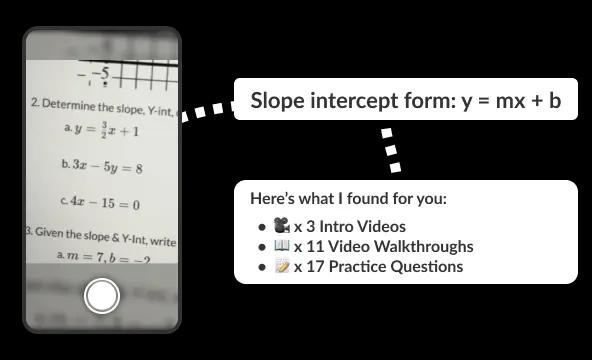
Search with Photo

Search with Photo

Upload Algebra II problems—AI searches and finds the right lesson teaching the concept

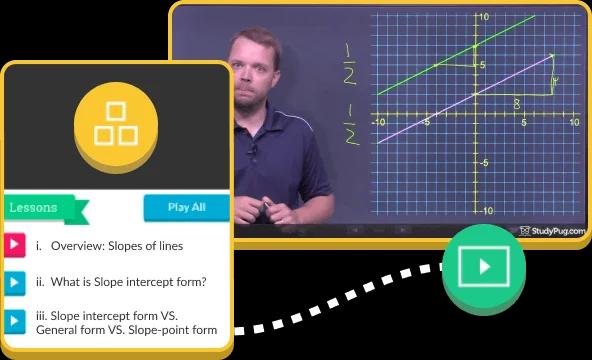
Expert Video Teaching

Expert Video Teaching

Certified teachers break down polynomials, rational expressions, and logarithms step-by-step

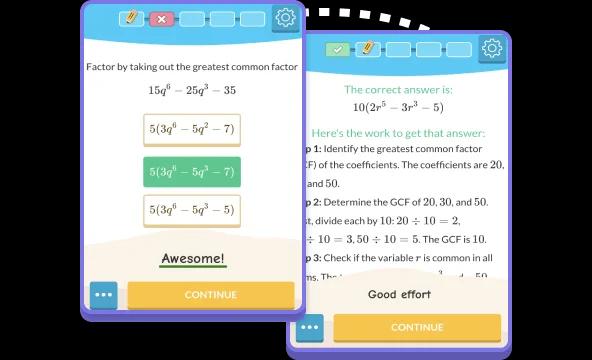
Unlimited Practice

Unlimited Practice

5,000+ teacher-created practice questions prepare you for Algebra II exams

How California Students Use StudyPug

1

Select Grade Level
Select Grade Level

Choose your California grade (K-12) and current math topics.

2

Get Unstuck
Get Unstuck

Upload homework problems or browse curriculum-aligned lessons.

3

Practice & Master
Practice & Master

Work through similar problems until concepts stick.

4

See Results
See Results

Track progress and watch grades improve week by week.

Algebra II Help: Master Concepts Fast | CaliforniaHelp

Print

ID

Standard

StudyPug Topic

CA.A2.N.CN.1

Know there is a complex number i such that i^2 = −1, and every complex number has the form a + bi with a and b real.

CA.A2.N.CN.2

Use the relation i^2 = –1 and the commutative, associative, and distributive properties to add, subtract, and multiply complex numbers.

CA.A2.N.CN.8

(+) Extend polynomial identities to the complex numbers. For example, rewrite x^2 + 4 as (x + 2i)(x – 2i).

CA.A2.N.CN.9

(+) Know the Fundamental Theorem of Algebra; show that it is true for quadratic polynomials.

CA.A2.A.SSE.1

Interpret expressions that represent a quantity in terms of its context.

CA.A2.A.SSE.4

Derive the formula for the sum of a finite geometric series (when the common ratio is not 1), and use the formula to solve problems.

CA.A2.A.APR.1

Understand that polynomials form a system analogous to the integers, namely, they are closed under the operations of addition, subtraction, and multiplication; add, subtract, and multiply polynomials.

CA.A2.A.APR.2

Know and apply the Remainder Theorem: For a polynomial p(x) and a number a, the remainder on division by x – a is p(a), so p(a) = 0 if and only if (x – a) is a factor of p(x).

CA.A2.A.APR.3

Identify zeros of polynomials when suitable factorizations are available, and use the zeros to construct a rough graph of the function defined by the polynomial.

CA.A2.A.APR.5

(+) Know and apply the Binomial Theorem for the expansion of (x + y)^n in powers of x and y for a positive integer n, where x and y are any numbers, with coefficients determined for example by Pascal's Triangle.

CA.A2.A.APR.6

Rewrite simple rational expressions in different forms; write a(x)/b(x) in the form q(x) + r(x)/b(x), where a(x), b(x), q(x), and r(x) are polynomials with the degree of r(x) less than the degree of b(x), using inspection, long division, or, for the more complicated examples, a computer algebra system.

CA.A2.A.APR.7

(+) Understand that rational expressions form a system analogous to the rational numbers, closed under addition, subtraction, multiplication, and division by a nonzero rational expression; add, subtract, multiply, and divide rational expressions.

CA.A2.A.CED.1

Create equations and inequalities in one variable and use them to solve problems. Include equations arising from linear and quadratic functions, and simple rational and exponential functions.

CA.A2.A.CED.2

Create equations in two or more variables to represent relationships between quantities; graph equations on coordinate axes with labels and scales.

CA.A2.A.CED.3

Represent constraints by equations or inequalities, and by systems of equations and/or inequalities, and interpret solutions as viable or nonviable options in a modeling context.

CA.A2.A.CED.4

Rearrange formulas to highlight a quantity of interest, using the same reasoning as in solving equations.

CA.A2.A.REI.2

Solve simple rational and radical equations in one variable, and give examples showing how extraneous solutions may arise.

CA.A2.A.REI.3.1

Solve one-variable equations and inequalities involving absolute value, graphing the solutions and interpreting them in context.

CA.A2.A.REI.11

Explain why the x-coordinates of the points where the graphs of the equations y = f(x) and y = g(x) intersect are the solutions of the equation f(x) = g(x); find the solutions approximately, e.g., using technology to graph the functions, make tables of values, or find successive approximations. Include cases where f(x) and/or g(x) are linear, polynomial, rational, absolute value, exponential, and logarithmic functions.

CA.A2.F.IF.4

For a function that models a relationship between two quantities, interpret key features of graphs and tables in terms of the quantities, and sketch graphs showing key features given a verbal description of the relationship.

CA.A2.F.IF.5

Relate the domain of a function to its graph and, where applicable, to the quantitative relationship it describes.

CA.A2.F.IF.6

Calculate and interpret the average rate of change of a function (presented symbolically or as a table) over a specified interval. Estimate the rate of change from a graph.

CA.A2.F.IF.7

Graph functions expressed symbolically and show key features of the graph, by hand in simple cases and using technology for more complicated cases.

CA.A2.F.IF.8

Write a function defined by an expression in different but equivalent forms to reveal and explain different properties of the function.

CA.A2.F.IF.9

Compare properties of two functions each represented in a different way (algebraically, graphically, numerically in tables, or by verbal descriptions).

CA.A2.F.BF.3

Identify the effect on the graph of replacing f(x) by f(x) + k, k f(x), f(kx), and f(x + k) for specific values of k (both positive and negative); find the value of k given the graphs. Experiment with cases and illustrate an explanation of the effects on the graph using technology.

CA.A2.F.BF.4

Find inverse functions.

CA.A2.F.LE.4

For exponential models, express as a logarithm the solution to ab^ct = d where a, c, and d are numbers and the base b is 2, 10, or e; evaluate the logarithm using technology.

CA.A2.F.LE.4.3

Understand and use the properties of logarithms to simplify logarithmic numeric expressions and to identify their approximate values.

CA.A2.F.LE.5

Interpret the parameters in a linear or exponential function in terms of a context.

CA.A2.F.TF.1

Understand radian measure of an angle as the length of the arc on the unit circle subtended by the angle.

CA.A2.F.TF.2

Explain how the unit circle in the coordinate plane enables the extension of trigonometric functions to all real numbers, interpreted as radian measures of angles traversed counterclockwise around the unit circle.

CA.A2.F.TF.5

Choose trigonometric functions to model periodic phenomena with specified amplitude, frequency, and midline.

CA.A2.F.TF.8

Prove the Pythagorean identity sin^2(θ) + cos^2(θ) = 1 and use it to find sin(θ), cos(θ), or tan(θ) given sin(θ), cos(θ), or tan(θ) and the quadrant of the angle.

CA.A2.G.GPE.3.1

Given a quadratic equation of the form ax^2 + by^2 + cx + dy + e = 0, use the method for completing the square to put the equation into standard form; identify whether the graph of the equation is a circle, ellipse, parabola, or hyperbola and graph the equation. [In Algebra II, this standard addresses only circles and parabolas.]

CA.A2.S.ID.4

Use the mean and standard deviation of a data set to fit it to a normal distribution and to estimate population percentages. Recognize that there are data sets for which such a procedure is not appropriate. Use calculators, spreadsheets, and tables to estimate areas under the normal curve.

CA.A2.S.IC.1

Understand statistics as a process for making inferences about population parameters based on a random sample from that population.

CA.A2.S.IC.2

Decide if a specified model is consistent with results from a given data-generating process, e.g., using simulation.

CA.A2.S.IC.3

Recognize the purposes of and differences among sample surveys, experiments, and observational studies; explain how randomization relates to each.

CA.A2.S.IC.4

Use data from a sample survey to estimate a population mean or proportion; develop a margin of error through the use of simulation models for random sampling.

CA.A2.S.IC.5

Use data from a randomized experiment to compare two treatments; use simulations to decide if differences between parameters are significant.

CA.A2.S.MD.6

(+) Use probabilities to make fair decisions (e.g., drawing by lots, using a random number generator).
Complete California Algebra II Coverage

Algebra II Lessons

172

Video Explanations

980

Practice Problems

1700

California Standards

100% Aligned

Why California Algebra II Students Love StudyPug

SAT Math Preparation

SAT Math Preparation

Practice with real SAT-style algebra questions—be ready for test day

Certified Teachers

Certified Teachers

Learn from expert California teachers who know exactly what you need for Algebra II
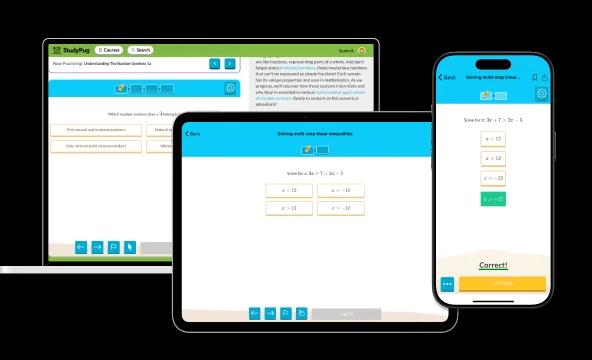
Learn Anywhere

Learn Anywhere

Desktop, tablet, or phone—your Algebra II lessons sync across all devices

Success Stories

Polynomial division made no sense until StudyPug. The step-by-step videos saved my grade. Got an A on my final exam.

Jordan Martinez

Rational expressions were killing me. The AI found exact lessons instantly. Cut my homework time in half.

Taylor Chen

Read More

Frequently Asked Questions

Everything you need to know about mastering Algebra II with StudyPug

What does Algebra II coverage include?

Complete Algebra II curriculum with video lessons on complex numbers, polynomials, rational expressions, exponential and logarithmic functions, and trigonometry. Includes practice problems, step-by-step solutions, and progress tracking for every topic.

How does the AI photo search work?

Take a photo of any Algebra II problem, and our AI finds the exact lesson teaching that concept. It's like having a personal tutor who knows exactly what you need for your homework or test prep.

Are the teachers certified California educators?

Yes! Our teachers are certified California educators who understand Algebra II curriculum and create lessons specifically for California math standards and SAT preparation.

Can I use StudyPug on my phone or tablet?

Absolutely! StudyPug works on desktop, tablet, and mobile devices. Your progress syncs automatically so you can study for Algebra II tests anywhere, anytime.

How will StudyPug help me prepare for SAT Math?

We include SAT-style practice questions for every Algebra II topic and teach the exact concepts tested on the SAT. Students report significantly improved scores and confidence on test day.

Practice Smart, See Real Progress

Unlimited Targeted Practice

10,000+ questions adjust to your exact skill level. Never run out of problems that challenge you.
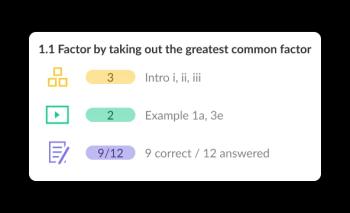
Visual Progress Tracking

See mastery percentage for every topic. Parents get weekly progress emails automatically.

Achievement System
Achievement System

Earn badges for consistency and improvement. Build learning streaks that motivate daily practice
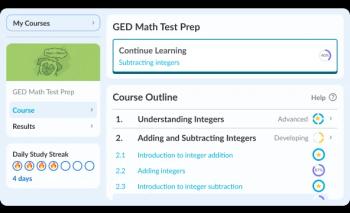
Detailed Analytics
Detailed Analytics

Time spent, problems solved, concepts mastered. Identify exactly where more practice is needed.

student
CallToActionContent

End Math Struggles Today

California standard-aligned help that actually works

mathImage