Ontario
Ontario Grade 6 Math
Watch fraction and integer videos, practice with thousands of step-by-step problems
My daughter went from 68% to 84% in just two months. The step-by-step videos made fractions finally click for her.
Sarah M.
Why Choose StudyPug for Grade 6
Trusted platform that builds strong math foundations
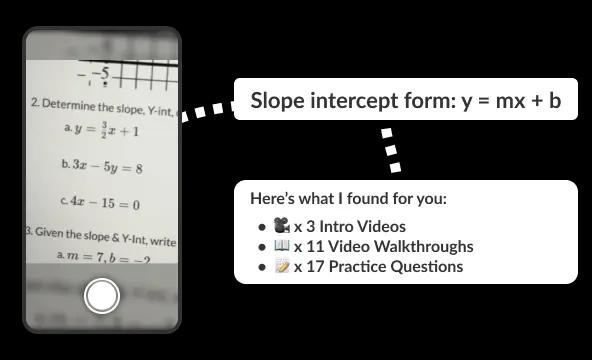
Search with Photo
Snap a photo of any problem and get the exact lesson you need
Expert Video Teaching
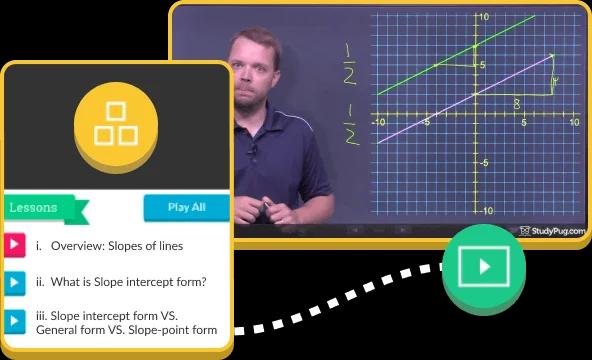
Canadian certified teachers explain every concept clearly
Track Progress
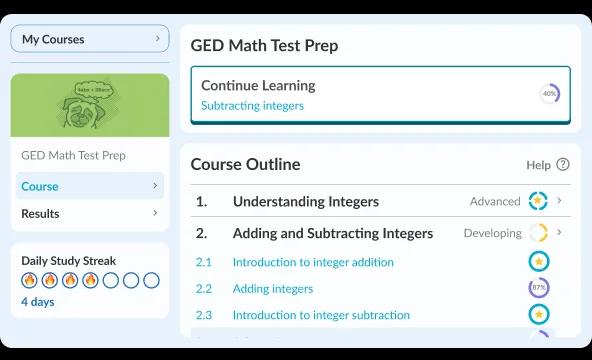
See exactly what they've mastered and what needs more work
How Ontario Students Use StudyPug
1

Select Grade Level
Choose your Ontario grade (K-12) and current math topics.
2

Get Unstuck
Upload homework problems or browse curriculum-aligned lessons.
3

Practice & Master
Work through similar problems until concepts stick.
4
See Results
Track progress and watch grades improve week by week.
Ontario Grade 6 Math Help | Build Strong SkillsHelp
OE_ID | Expectations | StudyPug Topic |
|---|---|---|
ON.OE.6.B.1.1 | B1.1 Whole Numbers: read, represent, compose, and decompose whole numbers up to and including one million, using appropriate tools and strategies, and describe various ways they are used in everyday life |
ON.OE.6.B.1.2 | B1.2 Rational Numbers: read and represent integers, using a variety of tools and strategies, including horizontal and vertical number lines |
ON.OE.6.B.1.3 | B1.3 Rational Numbers: compare and order integers, decimal numbers, and fractions, separately and in combination, in various contexts |
ON.OE.6.B.1.4 | B1.4 Fractions, Decimals, and Percents: read, represent, compare, and order fractions, decimal numbers up to thousandths, and whole number percents, using a variety of tools and strategies |
ON.OE.6.B.1.6 | B1.6 Fractions, Decimals, and Percents: describe relationships and show equivalences among fractions, decimal numbers, and percents, using appropriate tools and drawings, in various contexts |
ON.OE.6.B.2.1 | B2.1 Properties and Relationships: use the properties and order of operations, and the relationships between operations, to solve problems involving whole numbers, decimal numbers, fractions, ratios, rates, and whole number percents, including those requiring multiple steps or multiple operations |
ON.OE.6.B.2.2 | B2.2 Math Facts: understand and recall commonly used square numbers and their square roots |
ON.OE.6.B.2.3 | B2.3 Mental Math: use mental math strategies to calculate percents of whole numbers, including 1%, 5%, 10%, 15%, 25%, and 50%, and explain the strategies used |
ON.OE.6.B.2.4 | B2.4 Addition and Subtraction: represent and solve problems involving the addition and subtraction of whole numbers and decimal numbers, using estimation and algorithms |
ON.OE.6.B.2.5 | B2.5 Addition and Subtraction: add and subtract fractions with like and unlike denominators, using appropriate tools, in various contexts |
ON.OE.6.B.2.6 | B2.6 Multiplication and Division: represent and solve problems involving the multiplication of whole numbers by proper fractions, using appropriate tools and strategies |
ON.OE.6.B.2.7 | B2.7 Multiplication and Division: represent and solve problems involving the division of whole numbers by proper fractions, using appropriate tools and strategies |
ON.OE.6.B.2.8 | B2.8 Multiplication and Division: multiply whole numbers by proper fractions, using appropriate tools and strategies |
ON.OE.6.B.2.9 | B2.9 Multiplication and Division: divide whole numbers by proper fractions, using appropriate tools and strategies |
ON.OE.6.C.1.1 | C1.1 Patterns: identify and compare a variety of repeating, growing, and shrinking patterns, including patterns found in real-life contexts, and compare linear growing patterns on the basis of their constant rates and initial values |
ON.OE.6.C.1.2 | C1.2 Patterns: create and translate repeating, growing, and shrinking patterns involving whole numbers and decimal numbers using various representations, including algebraic expressions and equations for linear growing patterns |
ON.OE.6.C.1.3 | C1.3 Patterns: determine pattern rules and use them to extend patterns, make and justify predictions, and identify missing elements in repeating, growing, and shrinking patterns involving whole numbers and decimal numbers, and use algebraic representations of the pattern rules to solve for unknown values in linear growing patterns |
ON.OE.6.C.1.4 | C1.4 Patterns: create and describe patterns to illustrate relationships among integers |
ON.OE.6.C.2.1 | C2.1 Variables and Expressions: add monomials with a degree of 1 that involve whole numbers, using tools |
ON.OE.6.C.2.3 | C2.3 Equalities and Inequalities: solve equations that involve multiple terms, whole numbers, and decimal numbers in various contexts, and verify solutions |
ON.OE.6.C.2.4 | C2.4 Equalities and Inequalities: solve inequalities that involve multiple terms and whole numbers, and verify and graph the solutions |
ON.OE.6.D.1.1 | D1.1 Data Collection and Organization: explain why percentages are used to represent the distribution of a variable for a population or sample in large sets of data, and provide examples |
ON.OE.6.D.1.3 | D1.3 Data Visualization: select from among a variety of graphs, including circle graphs, the type of graph best suited to represent various sets of data; display the data in the graphs with proper sources, titles, and labels, and appropriate scales; and justify their choice of graphs |
ON.OE.6.D.1.5 | D1.5 Data Analysis: determine the impact of adding or removing data from a data set on a measure of central tendency, and describe how these changes alter the shape and distribution of the data |
ON.OE.6.D.1.6 | D1.6 Data Analysis: analyse different sets of data presented in various ways, including in circle graphs and in misleading graphs, by asking and answering questions about the data, challenging preconceived notions, and drawing conclusions, then make convincing arguments and informed decisions |
ON.OE.6.D.2.1 | D2.1 Probability: describe the difference between independent and dependent events, and explain how their probabilities differ, providing examples |
ON.OE.6.D.2.2 | D2.2 Probability: determine and compare the theoretical and experimental probabilities of two independent events happening and of two dependent events happening |
ON.OE.6.E.1.1 | E1.1 Geometric Reasoning: create lists of the geometric properties of various types of quadrilaterals, including the properties of the diagonals, rotational symmetry, and line symmetry |
ON.OE.6.E.1.2 | E1.2 Geometric Reasoning: construct three-dimensional objects when given their top, front, and side views |
ON.OE.6.E.1.3 | E1.3 Location and Movement: plot and read coordinates in all four quadrants of a Cartesian plane, and describe the translations that move a point from one coordinate to another |
ON.OE.6.E.1.4 | E1.4 Location and Movement: describe and perform combinations of translations, reflections, and rotations up to 360° on a grid, and predict the results of these transformations |
ON.OE.6.E.2.1 | E2.1 The Metric System: measure length, area, mass, and capacity using the appropriate metric units, and solve problems that require converting smaller units to larger ones and vice versa |
ON.OE.6.E.2.5 | E2.5 Area and Surface Area: create and use nets to demonstrate the relationship between the faces of prisms and pyramids and their surface areas |
ON.OE.6.E.2.6 | E2.6 Area and Surface Area: determine the surface areas of prisms and pyramids by calculating the areas of their two-dimensional faces and adding them together |
ON.OE.6.F.1.4 | F1.4 Consumer and Civic Awareness: explain the concept of interest rates, and identify types of interest rates and fees associated with different accounts and loans offered by various banks and other financial institutions |
Complete Ontario Grade 6 Math Coverage
Grade 6 Lessons
90
Video Explanations
1015
Practice Problems
633
Ontario Standards
100% Aligned


Success Stories
He was completely lost with integers. Three weeks with StudyPug and he's now confident with positive and negative numbers.
Michael T.
EQAO prep was stressing us both out. The practice tests helped her feel ready and she scored Level 3 on the actual assessment.
Priya K.
Read More
Common Questions About Grade 6 Math
Get answers to frequently asked questions about our Ontario Grade 6 Math program
Is StudyPug aligned with the Ontario Grade 6 curriculum?
Yes, our content is 100% aligned with Ontario curriculum standards. We cover all required topics including integers, fractions, algebra, geometry, and data management as outlined by the Ontario Ministry of Education.
How does StudyPug help with EQAO preparation?
We provide practice questions that match the EQAO format for Grade 6. Students work through problems similar to what they'll see on the assessment, building confidence and test-taking skills with instant feedback.
What topics are covered in Grade 6 Math?
We cover all Ontario Grade 6 topics: whole numbers to one million, integers, fractions, decimals, percents, patterns, algebraic expressions, equations, geometry, angles, area, surface area, and data management.
Can my child use StudyPug for homework help?
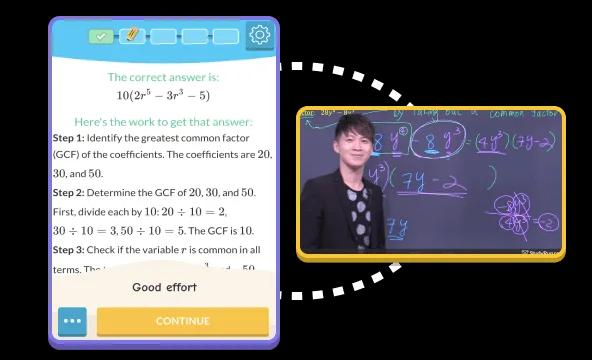
Absolutely. Students can search by topic or snap a photo of any problem to find the exact lesson they need. Each concept includes video explanations and step-by-step solutions for immediate help.
How do I track my child's progress?
The parent portal shows exactly what your child has completed, their quiz scores, time spent studying, and which topics need more practice. You'll see their strengths and areas for improvement in real-time.
Practice Smart, See Real Progress

Unlimited Targeted Practice
10,000+ questions adjust to your exact skill level. Never run out of problems that challenge you.
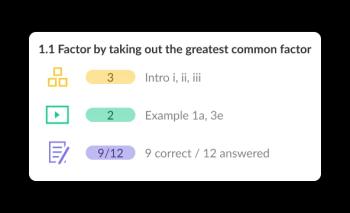
Visual Progress Tracking
See mastery percentage for every topic. Parents get weekly progress emails automatically.
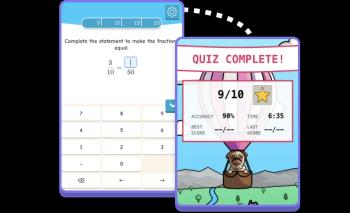
Achievement System
Earn badges for consistency and improvement. Build learning streaks that motivate daily practice
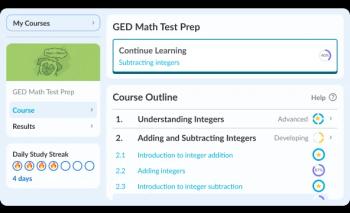
Detailed Analytics
Time spent, problems solved, concepts mastered. Identify exactly where more practice is needed.