Ontario
Ontario Grade 3 Math
Practice with fun worksheets, build multiplication and fraction foundations

My daughter went from confused about fractions to confidently solving problems in just six weeks with the practice activities.
Sarah M.
Why Choose StudyPug for Grade 3
Trusted platform that builds strong math foundations
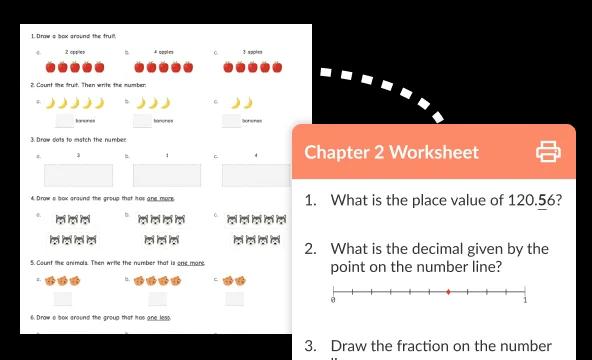
Practice & Worksheets
Printable worksheets and interactive practice for every topic
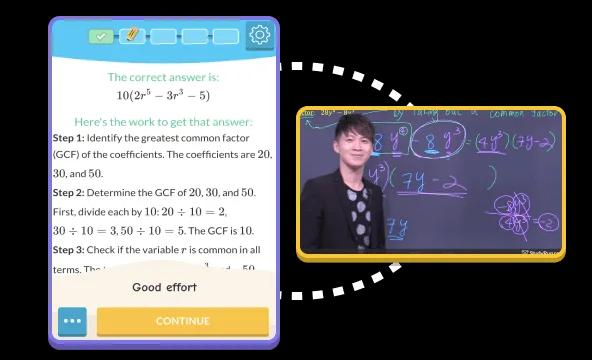
Step-by-Step Solutions
See the complete solution process for every practice problem
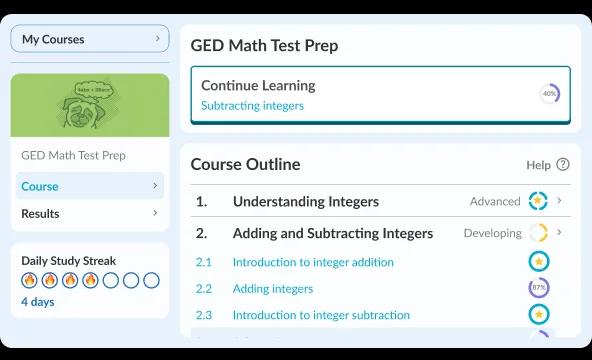
Track Progress
See exactly what they've mastered and what needs more work
How Ontario Students Use StudyPug
1

Select Grade Level
Choose your Ontario grade (K-12) and current math topics.
2
Get Unstuck
Upload homework problems or browse curriculum-aligned lessons.
3

Practice & Master
Work through similar problems until concepts stick.
4
See Results
Track progress and watch grades improve week by week.
Ontario Grade 3 Math Help | Build Strong SkillsHelp
OE_ID | Expectations | StudyPug Topic |
|---|---|---|
ON.OE.3.B.1.1 | B1.1 Whole Numbers: read, represent, compose, and decompose whole numbers up to and including 1000, using a variety of tools and strategies, and describe various ways they are used in everyday life |
ON.OE.3.B.1.2 | B1.2 Whole Numbers: compare and order whole numbers up to and including 1000, in various contexts |
ON.OE.3.B.1.3 | B1.3 Whole Numbers: round whole numbers to the nearest ten or hundred, in various contexts |
ON.OE.3.B.1.5 | B1.5 Whole Numbers: use place value when describing and representing multi-digit numbers in a variety of ways, including with base ten materials |
ON.OE.3.B.1.7 | B1.7 Fractions: represent and solve fair-share problems that focus on determining and using equivalent fractions, including problems that involve halves, fourths, and eighths; thirds and sixths; and fifths and tenths |
ON.OE.3.B.2.1 | B2.1 Properties and Relationships: use the properties of operations, and the relationships between multiplication and division, to solve problems and check calculations |
ON.OE.3.B.2.2 | B2.2 Math Facts: recall and demonstrate multiplication facts of 2, 5, and 10, and related division facts |
ON.OE.3.B.2.3 | B2.3 Mental Math: use mental math strategies, including estimation, to add and subtract whole numbers that add up to no more than 1000, and explain the strategies used |
ON.OE.3.B.2.4 | B2.4 Addition and Subtraction: demonstrate an understanding of algorithms for adding and subtracting whole numbers by making connections to and describing the way other tools and strategies are used to add and subtract |
ON.OE.3.B.2.5 | B2.5 Addition and Subtraction: represent and solve problems involving the addition and subtraction of whole numbers that add up to no more than 1000, using various tools and algorithms |
ON.OE.3.B.2.6 | B2.6 Multiplication and Division: represent multiplication of numbers up to 10 × 10 and division up to 100 ÷ 10, using a variety of tools and drawings, including arrays |
ON.OE.3.B.2.7 | B2.7 Multiplication and Division: represent and solve problems involving multiplication and division, including problems that involve groups of one half, one fourth, and one third, using tools and drawings |
ON.OE.3.B.2.8 | B2.8 Multiplication and Division: represent the connection between the numerator of a fraction and the repeated addition of the unit fraction with the same denominator using various tools and drawings, and standard fractional notation |
ON.OE.3.B.2.9 | B2.9 Multiplication and Division: use the ratios of 1 to 2, 1 to 5, and 1 to 10 to scale up numbers and to solve problems |
ON.OE.3.C.2.1 | C2.1 Variables: describe how variables are used, and use them in various contexts as appropriate |
ON.OE.3.C.2.2 | C2.2 Equalities and Inequalities: determine whether given sets of addition, subtraction, multiplication, and division expressions are equivalent or not |
ON.OE.3.C.2.3 | C2.3 Equalities and Inequalities: identify and use equivalent relationships for whole numbers up to 1000, in various contexts |
ON.OE.3.D.1.1 | D1.1 Data Collection and Organization: sort sets of data about people or things according to two and three attributes, using tables and logic diagrams, including Venn, Carroll, and tree diagrams, as appropriate |
ON.OE.3.D.1.4 | D1.4 Data Analysis: determine the mean and identify the mode(s), if any, for various data sets involving whole numbers, and explain what each of these measures indicates about the data |
ON.OE.3.E.2.7 | E2.7 Area: compare the areas of two-dimensional shapes by matching, covering, or decomposing and recomposing the shapes, and demonstrate that different shapes can have the same area |
ON.OE.3.E.2.8 | E2.8 Area: use appropriate non-standard units to measure area, and explain the effect that gaps and overlaps have on accuracy |
ON.OE.3.E.2.9 | E2.9 Area: use square centimetres (cm2) and square metres (m2) to estimate, measure, and compare the areas of various two-dimensional shapes, including those with curved sides |
ON.OE.3.F.1.1 | F1.1 Money Concepts: estimate and calculate the change required for various simple cash transactions involving whole-dollar amounts and amounts of less than one dollar |
Complete Ontario Grade 3 Math Coverage
Grade 3 Lessons
52
Practice Activities
195
Practice Problems
191
Ontario Standards
100% Aligned


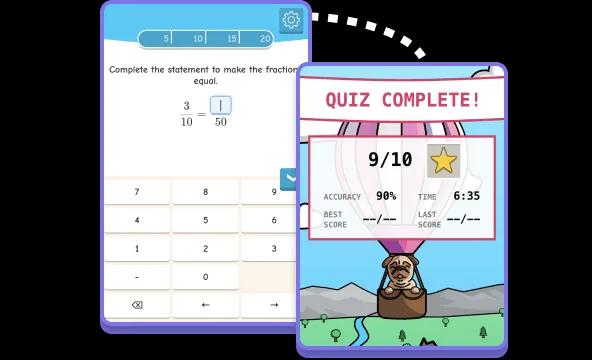
Success Stories
The multiplication practice helped him go from barely knowing his times tables to mastering 2s, 5s, and 10s in eight weeks.
Michael T.
She now asks to practice fractions on her own. The visual worksheets made halves, thirds, and fourths finally click for her.
Priya K.
Read More
Common Questions About Grade 3 Math
Everything you need to know about helping your child succeed
Is StudyPug aligned with the Ontario Grade 3 curriculum?
Yes, StudyPug is 100% aligned with Ontario curriculum standards. We cover all topics including numbers to 1000, multiplication and division facts, fractions, patterns, geometry, and measurement as required by the Ontario curriculum.
How does StudyPug help with EQAO preparation?
StudyPug provides practice activities and problems that match EQAO question formats. Students build strong foundations in all tested areas including number sense, patterns, measurement, and data management through our comprehensive practice system.
What math topics are covered in Grade 3?
Grade 3 covers numbers to 1000, multiplication and division facts, fractions including equivalents, patterns and algebra, 3D shapes and geometry, measurement including perimeter and area, data management, and probability concepts.
Can my child practice multiplication facts?
Yes, StudyPug provides extensive practice for multiplication facts of 2, 5, and 10, along with related division facts. The adaptive practice system helps students master these essential facts through repeated, targeted practice.
Are printable worksheets available for Grade 3?
Yes, StudyPug includes printable worksheets for all Grade 3 topics. These worksheets complement the interactive practice activities and provide additional offline practice opportunities for your child.
Practice Smart, See Real Progress
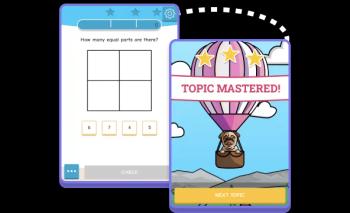
Unlimited Targeted Practice
10,000+ questions adjust to your exact skill level. Never run out of problems that challenge you.
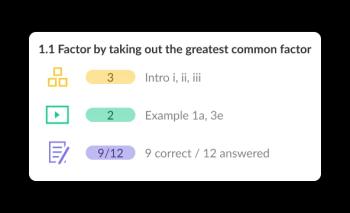
Visual Progress Tracking
See mastery percentage for every topic. Parents get weekly progress emails automatically.
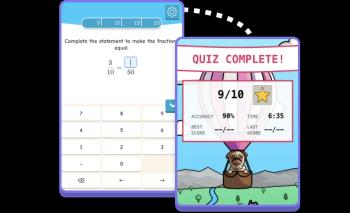
Achievement System
Earn badges for consistency and improvement. Build learning streaks that motivate daily practice
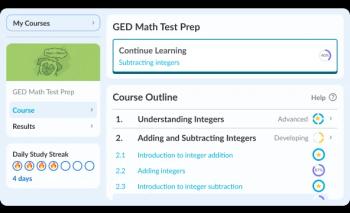
Detailed Analytics
Time spent, problems solved, concepts mastered. Identify exactly where more practice is needed.