New Brunswick
New Brunswick Grade 9 Math
Watch algebra and exponent videos, practice with hundreds of polynomial problems

My daughter went from a 68% to 84% in just one semester. The step-by-step videos made polynomials finally click for her.
Jennifer M.

Why Choose StudyPug for Grade 9
Trusted platform that builds strong algebra and geometry foundations
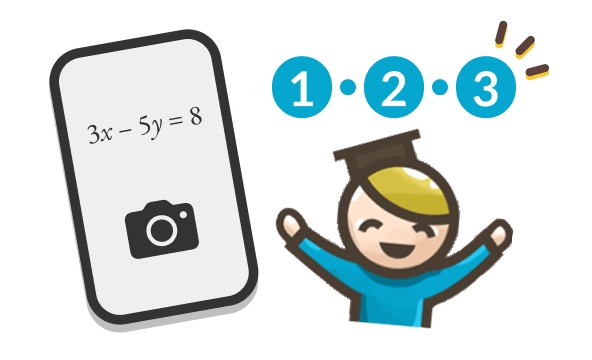
Search with Photo
Search with Photo
Snap a photo of any problem and get the exact lesson you need
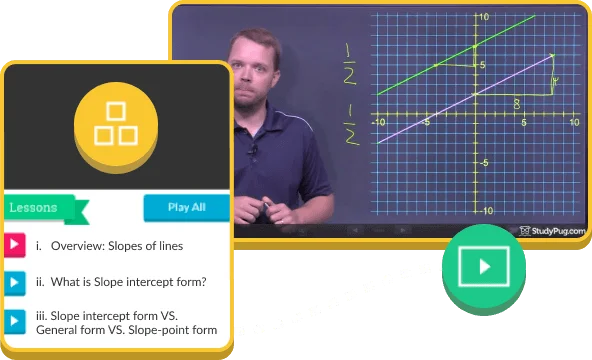
Expert Video Teaching
Expert Video Teaching
Certified teachers explain every concept with clear examples
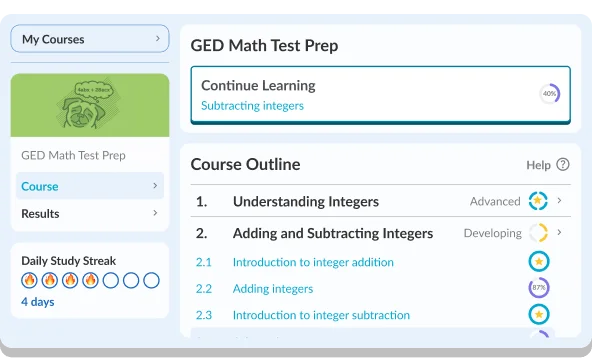
Track Progress
Track Progress
See exactly what they've mastered and what needs more work
How New Brunswick Students Use StudyPug
1

Select Grade Level
Choose your New Brunswick grade (K-12) and current math topics.
2

Get Unstuck
Upload homework problems or browse curriculum-aligned lessons.
3

Practice & Master
Work through similar problems until concepts stick.
4

See Results
Track progress and watch grades improve week by week.
New Brunswick Grade 9 Math Help | Build Strong SkillsHelp
SCO_ID | Curriculum Outcome - Elaborations | StudyPug Topic |
|---|---|---|
NB.SCO.9.N1 | Demonstrate an understanding of powers with integral bases and whole number exponents: Represent repeated multiplication using powers, show patterns with exponent of zero, solve problems |
NB.SCO.9.N3 | Demonstrate an understanding of rational numbers: Compare and order rational numbers, solve problems with arithmetic operations on rational numbers |
NB.SCO.9.N4 | Explain and apply the order of operations, including exponents, with and without technology: Apply order of operations to expressions with exponents and rational numbers |
NB.SCO.9.N5 | Determine the square root of positive rational numbers that are perfect squares: Identify and calculate square roots of perfect squares |
NB.SCO.9.N6 | Determine an approximate square root of positive rational numbers that are non-perfect squares: Estimate and calculate approximate square roots of non-perfect squares |
NB.SCO.9.PR1 | Generalize a pattern arising from a problem-solving context using linear equations and verify by substitution: Create and verify linear equations from patterns in problem contexts |
NB.SCO.9.PR2 | Graph linear relations, analyze the graph and interpolate or extrapolate to solve problems: Create and interpret graphs of linear relations to solve problems |
NB.SCO.9.PR3 | Model and solve problems using linear equations: Solve various forms of linear equations in problem-solving contexts |
NB.SCO.9.PR4 | Explain and illustrate strategies to solve single variable linear inequalities with rational coefficients: Solve and graph linear inequalities with rational coefficients |
NB.SCO.9.PR5 | Demonstrate an understanding of polynomials: Identify and describe characteristics of polynomials |
NB.SCO.9.PR6 | Model, record and explain the operations of addition and subtraction of polynomial expressions: Add and subtract polynomials using concrete, pictorial, and symbolic representations |
NB.SCO.9.PR7 | Model, record and explain the operations of multiplication and division of polynomial expressions by monomials: Multiply and divide polynomials by monomials using various methods |
NB.SCO.9.SS1 | Solve problems and justify the solution strategy using circle properties: Apply properties of circles to solve problems and justify solutions |
NB.SCO.9.SS2 | Determine the surface area of composite 3-D objects to solve problems: Calculate surface area of composite 3D objects in problem-solving contexts |
NB.SCO.9.SS3 | Demonstrate an understanding of similarity of polygons: Identify and describe similar polygons, solve problems using similarity |
NB.SCO.9.SS5 | Demonstrate an understanding of line and rotation symmetry: Identify and describe line and rotational symmetry in 2D shapes |
NB.SCO.9.SP1 | Describe the effect of various factors on data collection: Analyze how bias, language, ethics, cost, time, privacy, and culture affect data collection |
NB.SCO.9.SP2 | Select and defend the choice of using either a population or a sample of a population to answer a question: Justify the use of population or sample in data collection |
NB.SCO.9.SP3 | Construct, label, and interpret histograms to solve problems: Create and analyze histograms to solve problems |
NB.SCO.9.SP4 | Develop and implement a project plan for data collection, display, and analysis: Plan and execute a complete data project from question to conclusion |
NB.SCO.9.SP5 | Demonstrate an understanding of the role of probability in society: Analyze and explain the use of probability in various societal contexts |
Complete New Brunswick Grade 9 Math Coverage
Grade 9 Lessons
68
Video Explanations
611
Practice Problems
395
New Brunswick Standards
100% Aligned
Why New Brunswick Families Choose StudyPug
Provincial Assessment Prep
Provincial Assessment Prep
Practice questions match New Brunswick assessment formats

Canadian Certified Teachers
Canadian Certified Teachers
Canadian certified teachers who know your standards

Step-by-Step Solutions
Step-by-Step Solutions
See the full solution for every problem
Success Stories
The polynomial videos were game-changers. My son now works independently and his confidence has completely transformed in 8 weeks.
Robert L.
She used to avoid math homework. Now she uses StudyPug every day and her test scores improved from mid-60s to low 80s this year.
Marie D.
Read More
Common Questions About Grade 9 Math
Get answers to frequently asked questions about New Brunswick Grade 9 Math curriculum and StudyPug
What topics are covered in New Brunswick Grade 9 Math?
Grade 9 Math covers powers and exponents, rational numbers, square roots, linear relations and equations, polynomials, circles and geometry, similarity and symmetry, and data analysis with probability.
How does StudyPug align with New Brunswick curriculum?
StudyPug's Grade 9 Math content is 100% aligned with the New Brunswick Curriculum Framework, covering all required outcomes and competencies taught in New Brunswick schools.
Can StudyPug help prepare for provincial assessments?
Yes, StudyPug provides practice questions and problem-solving strategies that match provincial assessment formats, helping students build confidence and skills for testing.
How do the video lessons work for Grade 9 Math?
Each topic includes step-by-step video lessons taught by certified teachers, followed by practice problems with complete solutions to reinforce understanding.
What if my child is struggling with specific topics like polynomials?
StudyPug's diagnostic assessment identifies weak areas, then creates a personalized learning path with targeted lessons and adaptive practice for those specific topics.
Practice Smart, See Real Progress

Unlimited Targeted Practice
10,000+ questions adjust to your exact skill level. Never run out of problems that challenge you.
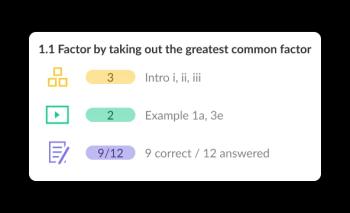
Visual Progress Tracking
See mastery percentage for every topic. Parents get weekly progress emails automatically.

Achievement System
Earn badges for consistency and improvement. Build learning streaks that motivate daily practice
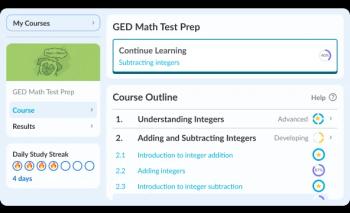
Detailed Analytics
Time spent, problems solved, concepts mastered. Identify exactly where more practice is needed.