British Columbia
British Columbia Grade 6 Math
Watch ratio and decimal videos, practice with hundreds of aligned problems

The diagnostic quiz showed us exactly where to focus. Two months later, her FSA scores improved dramatically and she's confident again.
Jennifer K

Why Choose StudyPug for Grade 6
Trusted platform that builds strong math foundations
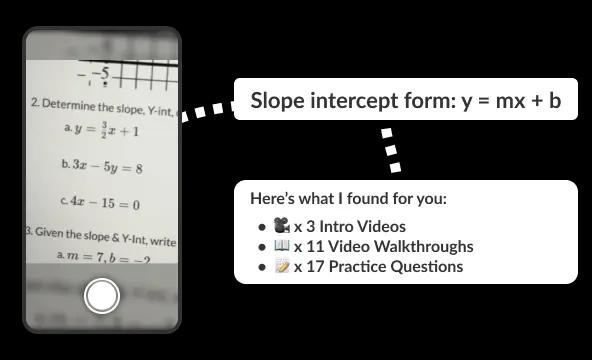
Search with Photo
Snap a photo of any problem and get the exact lesson you need
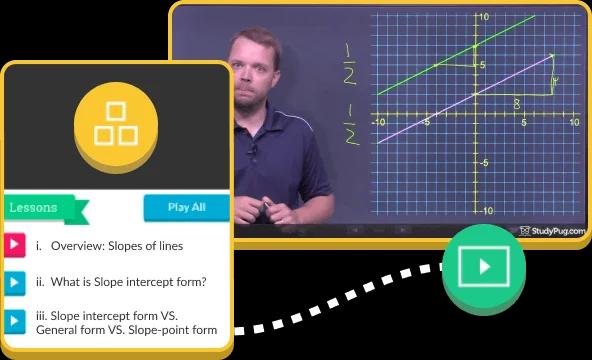
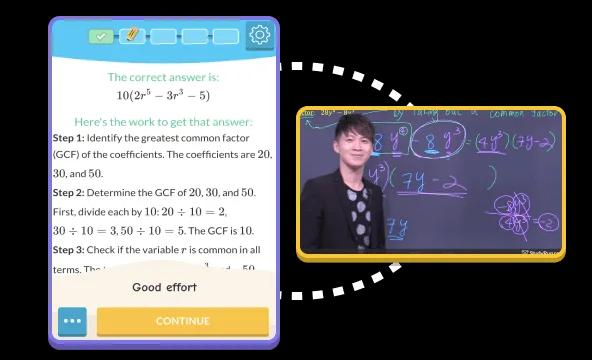
Expert Video Teaching
Certified teachers explain every concept with clear examples
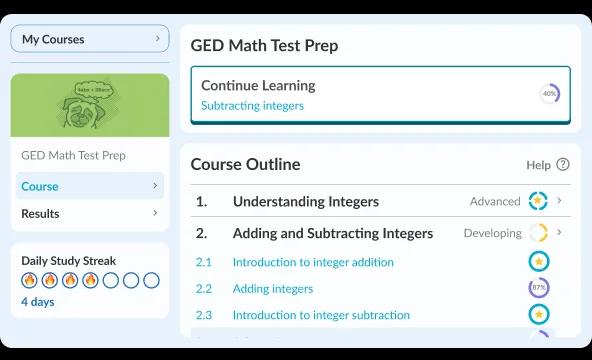
Track Progress
See exactly what they've mastered and what needs more work
How British Columbia Students Use StudyPug
1

Select Grade Level
Choose your British Columbia grade (K-12) and current math topics.
2

Get Unstuck
Upload homework problems or browse curriculum-aligned lessons.
3

Practice & Master
Work through similar problems until concepts stick.
4

See Results
Track progress and watch grades improve week by week.
BC Grade 6 Math Help | Build Strong SkillsHelp
CC_ID | Content-Elaborations | StudyPug Topic |
|---|---|---|
BC.CE.6.1 | Small to large numbers (thousandths to billions): Place value, operations, numbers in science and media, compare, order, estimate |
BC.CE.6.2 | Multiplication and division facts to 100: Developing computational fluency, mental math strategies |
BC.CE.6.3 | Order of operations with whole numbers: Includes brackets, excludes exponents, quotients can be rational numbers |
BC.CE.6.4 | Factors and multiples: Prime and composite numbers, divisibility rules, factor trees, graphic organizers |
BC.CE.6.5 | Improper fractions and mixed numbers: Using benchmarks, number line, common denominators to compare and order |
BC.CE.6.6 | Introduction to ratios: Comparing numbers and quantities, equivalent ratios, part-to-part and part-to-whole ratios |
BC.CE.6.7 | Whole-number percents and percentage discounts: Using base 10 blocks, geoboard, 10x10 grid, finding missing part |
BC.CE.6.8 | Multiplication and division of decimals: Using base 10 block array, examples with decimals |
BC.CE.6.9 | Increasing and decreasing patterns: Using expressions, tables, and graphs as functional relationships |
BC.CE.6.10 | One-step equations with whole-number coefficients and solutions: Preservation of equality, using balance and algebra tiles |
BC.CE.6.11 | Perimeter of complex shapes: Complex shape as a group of shapes with no holes |
BC.CE.6.14 | Volume and capacity: Using cubes to build 3D objects, referents and relationships between units |
BC.CE.6.15 | Triangles: Scalene, isosceles, equilateral, right, acute, obtuse, classified regardless of orientation |
BC.CE.6.16 | Transformations: Plotting points on Cartesian plane, translation, rotation, reflection on 2D shapes |
BC.CE.6.17 | Line graphs: Creating and interpreting line graphs from given data sets |
BC.CE.6.18 | Single-outcome probability, both theoretical and experimental: Listing outcomes, comparing experimental results with theoretical expectation |
BC.CE.6.19 | Financial literacy - simple budgeting and consumer math: Informed decision making on saving and purchasing |
Complete British Columbia Grade 6 Math Coverage
Grade 6 Lessons
57
Video Explanations
636
Practice Problems
358
BC Standards
100% Aligned
Success Stories
Started using it in September. By January, he went from hesitant to eager. Now he asks to practice ratios for fun.
Priya M
The area formulas finally clicked after watching the videos. Three weeks before FSA prep and she's explaining it to her friends now.
David L
Read More
Frequently Asked Questions
Everything you need to know about Grade 6 Math help
Is StudyPug aligned with the BC Grade 6 Math curriculum?
Yes, all our content is 100% aligned with the British Columbia curriculum. We cover ratios, decimals, fractions, geometry, and algebra exactly as taught in BC schools.
How does StudyPug help with FSA preparation?
Our practice questions match FSA format and difficulty. Students build fluency with ratios, operations, and problem-solving skills tested on the Grade 7 FSA.
What topics are covered in Grade 6 Math?
We cover all BC curriculum topics: place value, mental math, order of operations, factors, fractions, ratios, percentages, decimals, algebra, geometry, area, angles, transformations, data, and probability.
Can my child work independently with StudyPug?
Yes, the platform is designed for independent learning. Video lessons, step-by-step solutions, and adaptive practice let students work at their own pace with built-in support.
How do I track my child's progress?
The parent portal shows completed lessons, quiz scores, time spent, and mastery levels. You'll see exactly which topics they've mastered and where they need more practice.
Practice Smart, See Real Progress
Unlimited Targeted Practice
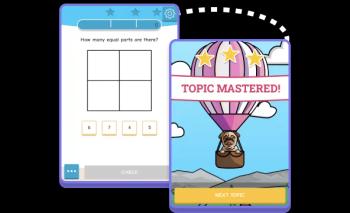
10,000+ questions adjust to your exact skill level. Never run out of problems that challenge you.
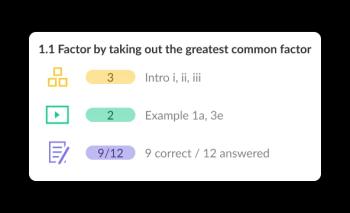
Visual Progress Tracking
See mastery percentage for every topic. Parents get weekly progress emails automatically.
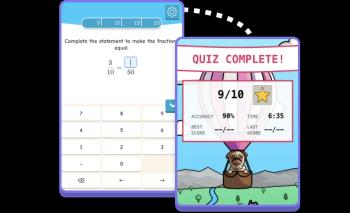
Achievement System
Earn badges for consistency and improvement. Build learning streaks that motivate daily practice
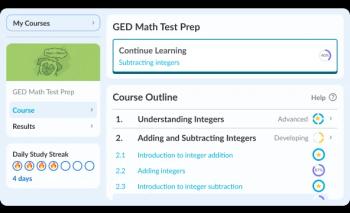
Detailed Analytics
Time spent, problems solved, concepts mastered. Identify exactly where more practice is needed.