Alberta
Alberta Grade 7 Math
Watch algebra videos, practice with hundreds of equations and decimal problems

My son went from barely passing to a B+ in just 8 weeks. The integer lessons finally clicked for him with StudyPug's approach.
Jennifer K.

Why Choose StudyPug for Grade 7
Trusted platform that builds strong algebra foundations
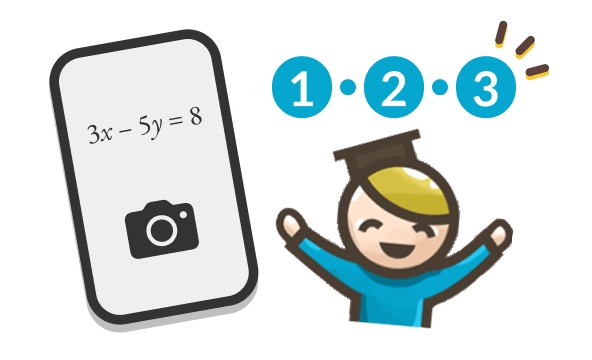
Search with Photo
Search with Photo
Snap a photo of any problem and get the exact lesson you need
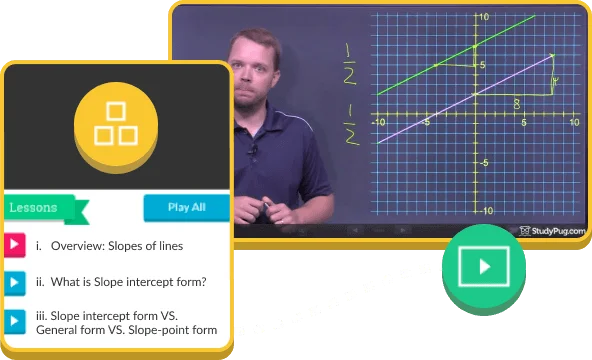
Expert Video Teaching
Expert Video Teaching
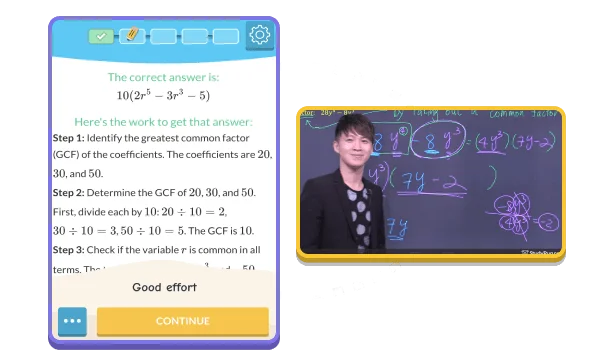
Canadian certified teachers explain every concept with examples
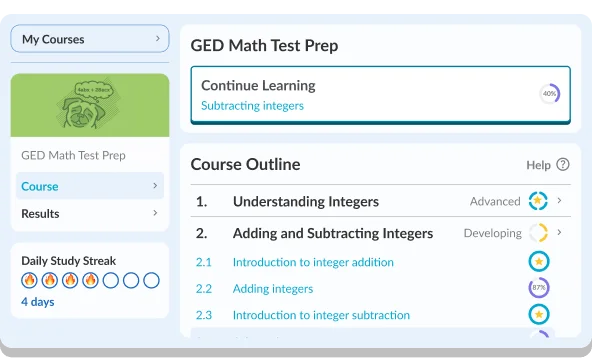
Track Progress
Track Progress
See exactly what they've mastered and what needs more work
How Alberta Students Use StudyPug
1

Select Grade Level
Choose your Alberta grade (K-12) and current math topics.
2

Get Unstuck
Upload homework problems or browse curriculum-aligned lessons.
3

Practice & Master
Work through similar problems until concepts stick.
4

See Results
Track progress and watch grades improve week by week.
Alberta Grade 7 Math Help | Build Strong SkillsHelp
LO_ID | Learning Outcome-Skills & Procedures | StudyPug Topic |
|---|---|---|
AB.LO.G7.1 | Develop number sense: Determine and explain why a number is divisible by 2, 3, 4, 5, 6, 8, 9 or 10, and why a number cannot be divided by 0; Demonstrate an understanding of the addition, subtraction, multiplication and division of decimals to solve problems; Solve problems involving percents from 1% to 100%; Demonstrate an understanding of the relationship between positive terminating decimals and positive fractions and between positive repeating decimals and positive fractions; Demonstrate an understanding of adding and subtracting positive fractions and mixed numbers, with like and unlike denominators, concretely, pictorially and symbolically; Demonstrate an understanding of addition and subtraction of integers, concretely, pictorially and symbolically; Compare and order positive fractions, positive decimals (to thousandths) and whole numbers by using benchmarks, place value, equivalent fractions and/or decimals |
AB.LO.G7.2 | Use patterns to describe the world and to solve problems: Demonstrate an understanding of oral and written patterns and their equivalent linear relations; Create a table of values from a linear relation, graph the table of values, and analyze the graph to draw conclusions and solve problems |
AB.LO.G7.3 | Represent algebraic expressions in multiple ways: Demonstrate an understanding of preservation of equality by modelling preservation of equality, concretely, pictorially and symbolically; Applying preservation of equality to solve equations; Explain the difference between an expression and an equation; Evaluate an expression, given the value of the variable(s); Model and solve, concretely, pictorially and symbolically, problems that can be represented by one-step linear equations of the form x + a = b, where a and b are integers; Model and solve, concretely, pictorially and symbolically, problems that can be represented by linear equations of the form: ax + b = c, ax = b, x/a = b, a ≠0, where a, b, and c are whole numbers |
AB.LO.G7.4 | Use direct and indirect measurement to solve problems: Demonstrate an understanding of circles by describing the relationships among radius, diameter and circumference; Relating circumference to pi; Determining the sum of the central angles; Constructing circles with a given radius or diameter; Solving problems involving the radii, diameters and circumferences of circles; Develop and apply a formula for determining the area of triangles, parallelograms, circles |
AB.LO.G7.5 | Describe the characteristics of 3-D objects and 2-D shapes, and analyze the relationships among them: Perform geometric constructions, including perpendicular line segments, parallel line segments, perpendicular bisectors, angle bisectors |
AB.LO.G7.6 | Describe and analyze position and motion of objects and shapes: Identify and plot points in the four quadrants of a Cartesian plane, using integral ordered pairs; Perform and describe transformations (translations, rotations or reflections) of a 2-D shape in all four quadrants of a Cartesian plane (limited to integral number vertices) |
AB.LO.G7.7 | Collect, display and analyze data to solve problems: Demonstrate an understanding of central tendency and range by determining the measures of central tendency (mean, median, mode) and range; Determining the most appropriate measures of central tendency to report findings; Determine the effect on the mean, median and mode when an outlier is included in a data set; Construct, label and interpret circle graphs to solve problems |
AB.LO.G7.8 | Use experimental or theoretical probabilities to represent and solve problems involving uncertainty: Express probabilities as ratios, fractions and percents; Identify the sample space (where the combined sample space has 36 or fewer elements) for a probability experiment involving two independent events; Conduct a probability experiment to compare the theoretical probability (determined using a tree diagram, table or other graphic organizer) and experimental probability of two independent events |
Complete Alberta Grade 7 Math Coverage
Grade 7 Lessons
59
Video Explanations
553
Practice Problems
244
Alberta Standards
100% Aligned
Success Stories
The integer lessons were a game-changer. My daughter now does her homework independently and her test scores improved by 25%.
Priya M.
He struggled with fractions all year. After 4 weeks on StudyPug, he's completing assignments with confidence and even helping classmates.
Michael T.
Read More
Frequently Asked Questions
Find answers to common questions about StudyPug for Alberta Grade 7 Math
Is StudyPug aligned with Alberta Grade 7 Math curriculum?
Yes, StudyPug is 100% aligned with the Alberta Program of Studies for Grade 7 Math, covering all topics including integers, decimals, fractions, linear relations, and geometry.
How does StudyPug help prepare for the PAT?
While PAT assessments are in Grades 6 and 9, StudyPug builds essential foundations in Grade 7 with practice problems that match provincial assessment formats and question styles.
Can my child use StudyPug if they're struggling with specific topics?
Absolutely. Our diagnostic assessment identifies gaps, then creates a personalized learning path focusing on areas like integers, fractions, or equations where they need the most help.
Are the teachers Canadian certified?
Yes, all our instructors are Canadian certified teachers with expertise in Alberta curriculum standards and years of classroom teaching experience.
How much time should my child spend on StudyPug each week?
Most students see results with 30-45 minutes, 3-4 times per week. The adaptive practice adjusts to their pace, making every session productive and focused.
Practice Smart, See Real Progress

Unlimited Targeted Practice
10,000+ questions adjust to your exact skill level. Never run out of problems that challenge you.
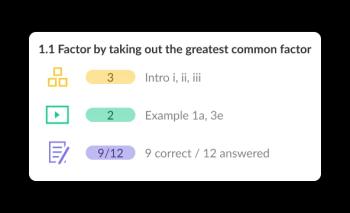
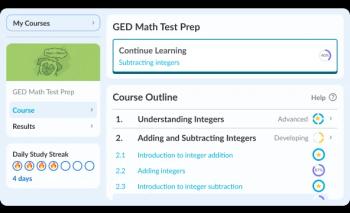
Visual Progress Tracking
See mastery percentage for every topic. Parents get weekly progress emails automatically.
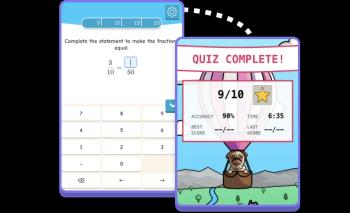
Achievement System
Earn badges for consistency and improvement. Build learning streaks that motivate daily practice
Detailed Analytics
Time spent, problems solved, concepts mastered. Identify exactly where more practice is needed.