Alberta
Alberta Grade 6 Math
Watch integer and ratio videos, practice with hundreds of algebra problems

The diagnostic quiz showed exactly where my daughter needed help with fractions. Two months later, she's confident and independent.
Jennifer K.

Why Choose StudyPug for Grade 6
Trusted platform that builds strong math foundations
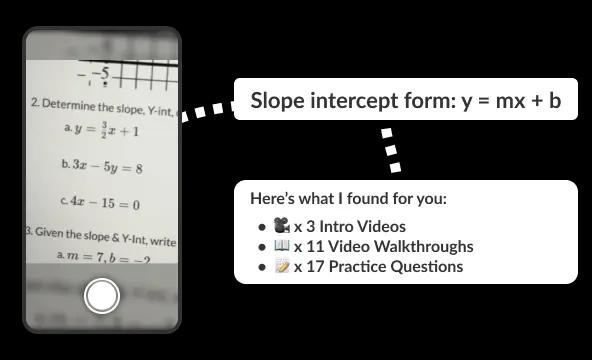
Search with Photo
Snap a photo of any problem and get the exact lesson you need
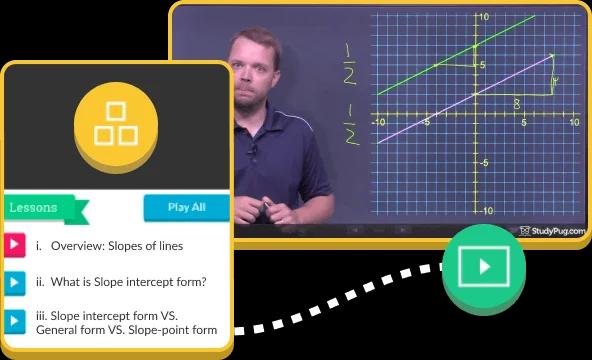
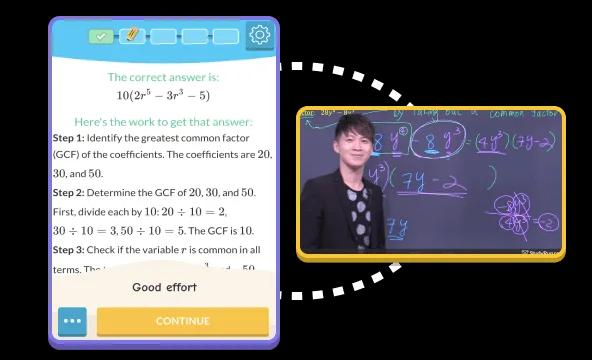
Expert Video Teaching
Certified teachers explain every concept with clear examples
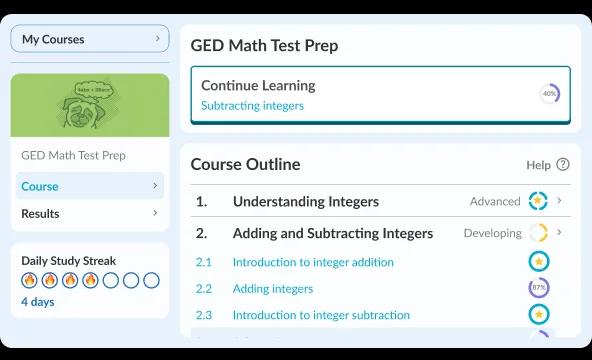
Track Progress
See exactly what they've mastered and what needs more work
How Alberta Students Use StudyPug
1

Select Grade Level
Choose your Alberta grade (K-12) and current math topics.
2

Get Unstuck
Upload homework problems or browse curriculum-aligned lessons.
3

Practice & Master
Work through similar problems until concepts stick.
4

See Results
Track progress and watch grades improve week by week.
Alberta Grade 6 Math Help | Build Strong SkillsHelp
LO_ID | Learning Outcome-Skills & Procedures | StudyPug Topic |
|---|---|---|
AB.LO.G6.1 | Investigate magnitude with positive and negative numbers: Identify negative numbers in familiar contexts, express positive and negative numbers symbolically, relate magnitude to distance from zero on number line, compare and order positive and negative numbers, express relationships using <, >, or =, investigate addition of integers and additive inverses, model sums of integers |
AB.LO.G6.2 | Solve problems using standard algorithms for addition and subtraction: Apply standard algorithms to solve addition and subtraction problems in various contexts |
AB.LO.G6.3 | Analyze numbers using prime factorization and exponentiation: Compose products in multiple ways, express prime factorization of composite numbers, determine common factors, identify base and exponent in powers, express products of identical factors as powers |
AB.LO.G6.4 | Apply standard algorithms to multiplication and division of decimal and natural numbers: Explain and use standard algorithms for multiplication and division of decimal numbers, multiply and divide up to 3-digit numbers by 2-digit numbers, assess reasonableness of results using estimation |
AB.LO.G6.5 | Relate fractions to quotients: Model equal-sharing situations, express fractions as division statements, convert quotients from fraction to decimal form |
AB.LO.G6.6 | Add and subtract fractions with denominators within 100: Recognize and express fractions with related denominators, add and subtract fractions, solve problems involving addition and subtraction of fractions |
AB.LO.G6.7 | Interpret the multiplication of natural numbers by fractions: Relate multiplication of natural numbers by fractions to repeated addition, multiply natural numbers by fractions, relate multiplication by unit fractions to division, solve problems using multiplication of fractions and natural numbers |
AB.LO.G6.8 | Apply equivalence to the interpretation of ratios and rates: Determine equivalent ratios, express unit rates, relate percentages to proportions, determine percentages of numbers, solve problems involving ratios, rates, and proportions |
AB.LO.G6.9 | Analyze expressions and solve algebraic equations: Evaluate numerical expressions, investigate like terms, simplify algebraic expressions, solve equations with one or two operations, verify solutions, solve problems using equations |
AB.LO.G6.10 | Analyze shapes through symmetry and congruence: Verify and describe symmetry of shapes, investigate tessellations, classify 2-D shapes based on symmetries, demonstrate congruence between shapes |
AB.LO.G6.11 | Explain location and movement in relation to position in the Cartesian plane: Locate and describe points in the Cartesian plane, model polygons using coordinates, create images of polygons through translations, reflections, and rotations |
AB.LO.G6.12 | Analyze areas of parallelograms and triangles: Determine areas of parallelograms and triangles, solve problems involving areas of parallelograms and triangles, determine areas of composite shapes |
AB.LO.G6.13 | Interpret and express volume: Recognize and model volume of prisms, express volume in cubic units, determine volume of right rectangular prisms, solve problems involving volume of right rectangular prisms |
AB.LO.G6.14 | Investigate functions to enhance understanding of change: Identify dependent and independent variables, describe function rules, represent functions in tables and Cartesian plane, write algebraic expressions for functions, solve problems involving functions |
AB.LO.G6.15 | Investigate relative frequency using experimental data: Interpret and express relative frequencies, identify possible outcomes of experiments, collect and analyze categorized data, describe likelihood of outcomes using relative frequency |
Complete Alberta Grade 6 Math Coverage
Grade 6 Math Lessons
89
Video Explanations
972
Practice Problems
466
Alberta Standards
100% Aligned
Success Stories
My son went from hesitant with integers to eager to solve problems. Three weeks of practice made all the difference for his confidence.
Rajesh P.
The video explanations for fractions were a game-changer. She finally understands why the steps work, not just how to do them.
Michelle L.
Read More
Frequently Asked Questions
Common questions about Grade 6 Math help
Is StudyPug aligned with the Alberta Grade 6 Math curriculum?
Yes, our content is 100% aligned with Alberta's Program of Studies for Grade 6 Math, covering all required topics from integers to volume.
How does StudyPug help prepare for the PAT?
Our practice questions mirror the format and difficulty of PAT assessments, helping students build familiarity and confidence with test-style problems.
Can my child work independently with StudyPug?
Absolutely. The video lessons and step-by-step solutions guide students through concepts independently, while you can monitor progress through the parent portal.
What topics are covered in Grade 6 Math?
We cover all Alberta curriculum topics including integers, fractions, decimals, ratios, percentages, algebra, geometry, area, volume, and functions.
How long does it take to see improvement?
Most students show improved understanding within 3-4 weeks of consistent practice. Progress depends on individual learning pace and practice frequency.
Practice Smart, See Real Progress

Unlimited Targeted Practice
10,000+ questions adjust to your exact skill level. Never run out of problems that challenge you.
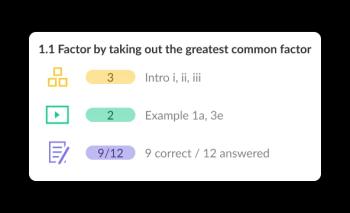
Visual Progress Tracking
See mastery percentage for every topic. Parents get weekly progress emails automatically.
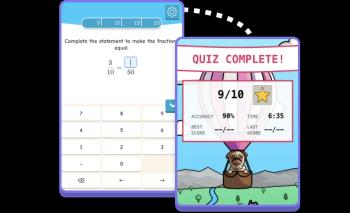
Achievement System
Earn badges for consistency and improvement. Build learning streaks that motivate daily practice
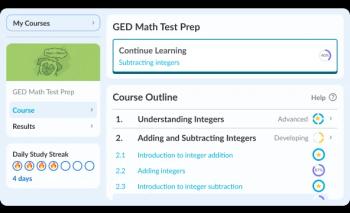
Detailed Analytics
Time spent, problems solved, concepts mastered. Identify exactly where more practice is needed.