flagAlberta

Math

Grade 5

Alberta Grade 5 Math

Watch decimal, fraction, and geometry videos, practice with hundreds of problems

students image

My daughter went from struggling with fractions to confidently solving mixed number problems in just 6 weeks with StudyPug.

Priya S.

pug

Why Choose StudyPug for Grade 5

Trusted platform that builds strong math foundations
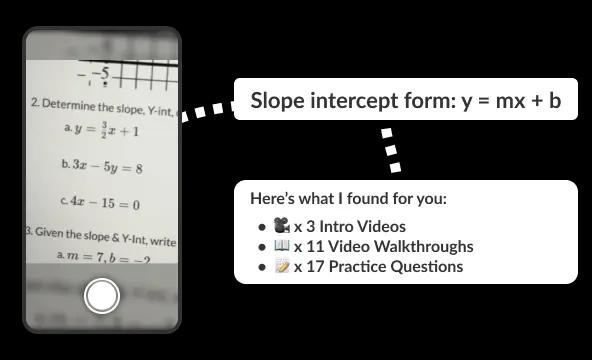
Search with Photo

Search with Photo

Upload Grade 5 problems—AI searches and finds the right lesson teaching the concept

Expert Video Teaching

Expert Video Teaching

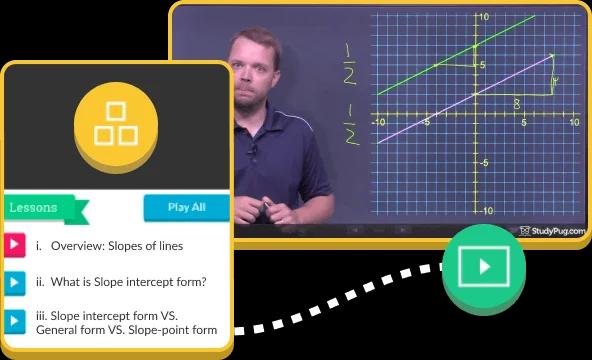
Certified teachers solve decimals, fractions, geometry, and algebra problems step-by-step

Track Progress

Track Progress

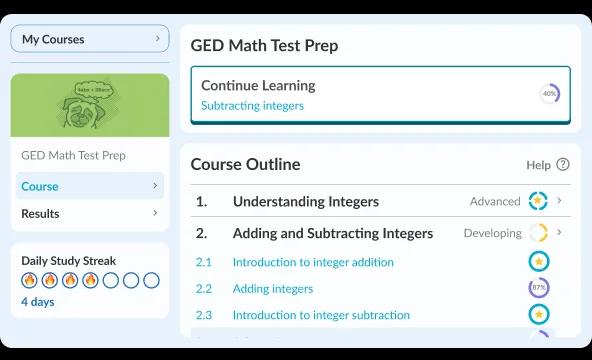
Visual progress tracking shows mastery and guides your child to Grade 6 readiness

How Alberta Students Use StudyPug

1

Select Grade Level
Select Grade Level

Choose your Alberta grade (K-12) and current math topics.

2

Get Unstuck
Get Unstuck

Upload homework problems or browse curriculum-aligned lessons.

3

Practice & Master
Practice & Master

Work through similar problems until concepts stick.

4

See Results
See Results

Track progress and watch grades improve week by week.
Alberta Grade 5 Math Help | Build Strong SkillsHelp

Print

LO_ID

Learning Outcome-Skills & Procedures

StudyPug Topic

AB.LO.G5.1

Analyze patterns in place value: Express numbers within 10 000 000, including decimal numbers to thousandths, using words and numerals; Relate a decimal number to its position on the number line; Compare and order numbers, including decimal numbers; Express the relationship between two numbers using <, >, or =; Round numbers, including decimal numbers, to various places according to context

AB.LO.G5.2

Add and subtract within 1 000 000, including decimal numbers to thousandths: Add and subtract numbers, including decimal numbers, using standard algorithms; Assess the reasonableness of a sum or difference using estimation; Solve problems using addition and subtraction, including problems involving money

AB.LO.G5.3

Determine divisibility of natural numbers: Investigate divisibility by natural numbers to 10, including 0; Generalize divisibility tests for 2, 3, and 5; Determine factors of natural numbers using divisibility tests

AB.LO.G5.4

Multiply and divide natural numbers within 100 000: Multiply up to 3-digit by 2-digit natural numbers using standard algorithms; Divide 3-digit by 1-digit natural numbers using standard algorithms; Express a quotient with or without a remainder according to context; Assess the reasonableness of a product or quotient using estimation; Solve problems using multiplication and division of natural numbers

AB.LO.G5.5

Interpret improper fractions: Relate fractions, improper fractions, and mixed numbers to their positions on the number line; Count beyond 1 using fractions with the same denominator; Model fractions, including improper fractions and mixed numbers, using quantities, lengths, and areas; Express improper fractions and mixed numbers symbolically; Compare fractions, including improper fractions and mixed numbers, to benchmarks of 0, 1/2, and 1

AB.LO.G5.6

Add and subtract fractions with common denominators: Investigate the composition and decomposition of a quantity within 1 using unit fractions; Express the composition or decomposition of fractions with common denominators as a sum or difference; Compare strategies for adding or subtracting improper fractions to strategies for adding or subtracting mixed numbers; Add and subtract fractions with common denominators within 100, including improper fractions and mixed numbers; Solve problems requiring addition and subtraction of fractions with common denominators

AB.LO.G5.7

Employ ratios to represent relationships between quantities: Express part-part ratios and part-whole ratios of the same whole to describe various situations; Express, symbolically, the same part-whole relationship as a ratio, fraction, decimal, and percentage

AB.LO.G5.8

Interpret numerical and algebraic expressions: Evaluate numerical expressions involving addition or subtraction in parentheses according to the order of operations; Relate repeated addition of a variable to the product of a number and a variable; Express the product of a number and a variable using a coefficient; Express the quotient of a variable and a number as a fraction; Recognize a product with a variable, a quotient with a variable, or a number as a single term; Write an algebraic expression involving one or two terms to describe an unknown value; Evaluate an algebraic expression by substituting a given number for the variable

AB.LO.G5.9

Investigate symmetry as a geometric property: Recognize symmetry in nature and in First Nations, Métis, and Inuit designs; Investigate symmetry in familiar 2-D and 3-D shapes using hands-on materials or digital applications; Show the line of symmetry of a 2-D shape; Describe the order of rotation symmetry of a 2-D shape; Compare the number of reflection and rotation symmetries of a 2-D shape to the number of equal sides and angles; Classify 2-D shapes according to the number of reflection or rotation symmetries

AB.LO.G5.10

Relate location to position on a grid: Locate a point on a coordinate grid given the coordinates of the point; Describe the location of a point on a coordinate grid using coordinates; Describe the location of a point on a coordinate grid in relation to the location of another point using positional language; Model a polygon on a coordinate grid using coordinates to indicate the vertices; Describe the location of the vertices of a polygon on a coordinate grid using coordinates

AB.LO.G5.11

Estimate and calculate area using standard units: Relate a centimetre to a square centimetre; Relate a metre to a square metre; Express the relationship between square centimetres, square metres, and square kilometres; Justify the choice of square centimetres, square metres, or square kilometres as appropriate units to express various areas; Estimate an area by comparing to a benchmark of a square centimetre or square metre; Express the area of a rectangle using standard units given the lengths of its sides; Compare the perimeters of various rectangles with the same area; Describe the rectangle with the least perimeter for a given area; Solve problems involving perimeter and area of rectangles

AB.LO.G5.12

Relate terms to position within an arithmetic sequence: Represent one-to-one correspondence between positions and terms of an arithmetic sequence in a table of values and on a coordinate grid; Describe the graph of an arithmetic sequence as a straight line; Describe a rule, limited to one operation, that expresses correspondence between positions and terms of an arithmetic sequence; Write an algebraic expression, limited to one operation, that represents correspondence between positions and terms of an arithmetic sequence; Determine the missing term in an arithmetic sequence that corresponds to a given position; Solve problems involving an arithmetic sequence

AB.LO.G5.13

Analyze frequency in categorial data: Examine categorized data in tables and graphs; Determine frequency for each category of a set of data by counting individual data points; Identify the mode in various representations of data; Recognize data sets with no mode, one mode, or multiple modes; Justify possible answers to a statistical question using mode; Discuss potential categories for open-ended questions and closed-list questions in relation to the same statistical question; Formulate closed-list questions to collect data to answer a statistical question; Categorize data that was collected using closed-list questions; Organize counts of categorized data in a frequency table; Create various representations of data, including with technology, to interpret frequency

AB.LO.G5.14

Analyze areas of parallelograms and triangles: Rearrange the area of a parallelogram to form a rectangular area using hands-on materials or digital applications; Determine the area of a parallelogram using multiplication; Determine the base or height of a parallelogram using division; Model the area of a parallelogram as two congruent triangles; Describe the relationship between the area of a triangle and the area of a parallelogram with the same base and height; Determine the area of a triangle, including various triangles with the same base and height; Solve problems involving the areas of parallelograms and triangles; Visualize the decomposition of composite areas in various ways; Determine the area of composite shapes using the areas of triangles and parallelograms

AB.LO.G5.15

Interpret and express volume: Recognize volume in familiar contexts; Model volume of prisms by dragging or iterating an area using hands-on materials or digital applications; Create a model of a three-dimensional shape by stacking congruent non-standard units or cubic centimetres without gaps or overlaps; Express volume in non-standard units or cubic centimetres; Visualize and model the volume of various right rectangular prisms as three-dimensional arrays of cube-shaped units; Determine the volume of a right rectangular prism using multiplication; Solve problems involving volume of right rectangular prisms

AB.LO.G5.16

Investigate functions to enhance understanding of change: Identify the dependent and independent variables in a given situation, including situations involving change over time; Describe the rule that determines the values of the dependent variable from values of the independent variable; Represent corresponding values of the independent and dependent variables of a function in a table of values and as points in the Cartesian plane; Write an algebraic expression that represents a function; Recognize various representations of the same function; Determine a value of the dependent variable of a function given the corresponding value of the independent variable; Investigate strategies for determining a value of the independent variable of a function given the corresponding value of the dependent variable; Solve problems involving a function
Complete Alberta Grade 5 Math Coverage

Grade 5 Lessons

83

Video Explanations

1371

Practice Problems

684

Alberta Standards

100% Aligned

Why Alberta Families Choose StudyPug

PAT Prep

PAT Prep

Practice problems and lessons prepare your child for Provincial Achievement Tests

Canadian Certified Teachers

Canadian Certified Teachers

Canadian certified teachers with expertise in Alberta curriculum and teaching standards

Step-by-Step Solutions

Step-by-Step Solutions

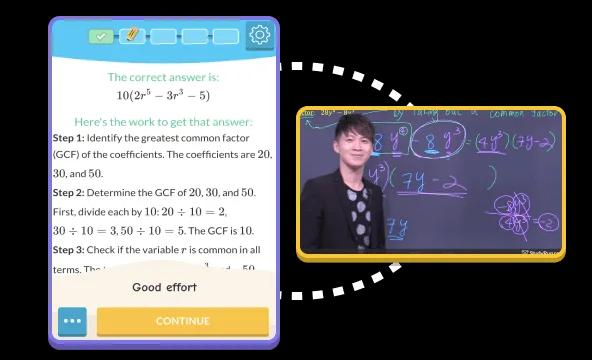
Every problem includes detailed written solutions showing all work to build understanding

Success Stories

StudyPug's PAT-focused practice helped my son score in the top percentile on his provincial assessment this year.

Michael T.

After 2 months, my daughter now asks to do extra math practice. The video lessons made everything click for her.

Sarah K.

Read More

Frequently Asked Questions

Common questions about StudyPug for Alberta Grade 5 Math

Is StudyPug aligned with Alberta Grade 5 curriculum?

Yes, StudyPug is 100% aligned with the Alberta Program of Studies. Our lessons cover all Grade 5 outcomes including decimals, fractions, geometry, and measurement as specified by Alberta Education.

How does StudyPug help with PAT preparation?

Our practice problems mirror PAT question formats. Students work through hundreds of problems covering all Grade 5 topics tested on the Provincial Achievement Tests, building confidence and readiness.

Can my child use StudyPug independently?

Yes, most Grade 5 students navigate StudyPug independently. Video lessons explain concepts step-by-step, and practice problems include detailed solutions showing all work for self-guided learning.

What topics are covered in Grade 5 Math?

All Alberta Grade 5 topics: numbers to 10 million, decimals, operations, divisibility, fractions, ratios, percentages, algebra, symmetry, coordinates, area, perimeter, volume, and data analysis.

How do I track my child's progress?

Parents access detailed progress dashboards showing lessons completed, quiz scores, time spent, and topic mastery. Visual charts help identify strengths and areas needing more practice.

Practice Smart, See Real Progress

Unlimited Targeted Practice

10,000+ questions adjust to your exact skill level. Never run out of problems that challenge you.
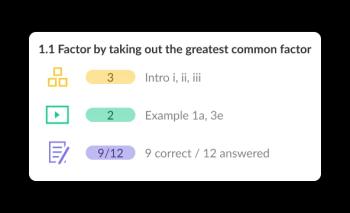
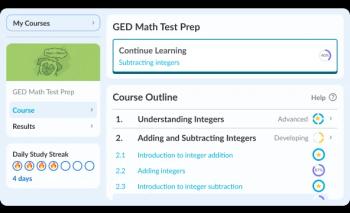
Visual Progress Tracking

See mastery percentage for every topic. Parents get weekly progress emails automatically.
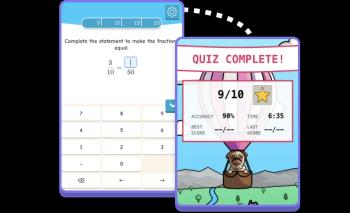
Achievement System
Achievement System

Earn badges for consistency and improvement. Build learning streaks that motivate daily practice
Detailed Analytics
Detailed Analytics

Time spent, problems solved, concepts mastered. Identify exactly where more practice is needed.

parent
CallToActionContent

End Math Struggles Today

Alberta curriculum-aligned help that actually works

mathImage