flagAlberta

Math

Grade 11

Master Mathematics 20-2

Watch Math 20-2 videos, practice with diploma-style problems

students image

Trigonometry was killing my grade. The sine law videos made everything click. Went from D to B+ in two months.

Jordan Lee

pug

Why Mathematics 20-2 Students Choose StudyPug

The complete learning system to master Math 20-2

Search with Photo

Search with Photo

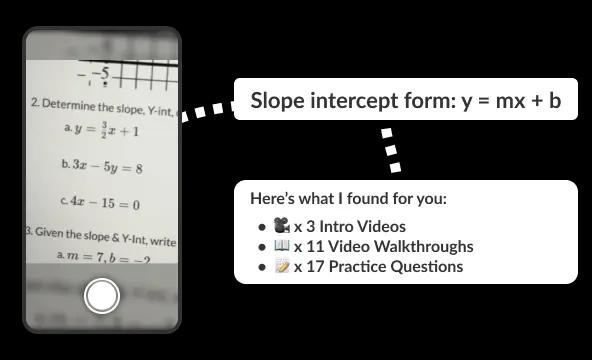
Upload Math 20-2 problems—AI searches and finds the right lesson teaching the concept

Expert Video Teaching

Expert Video Teaching

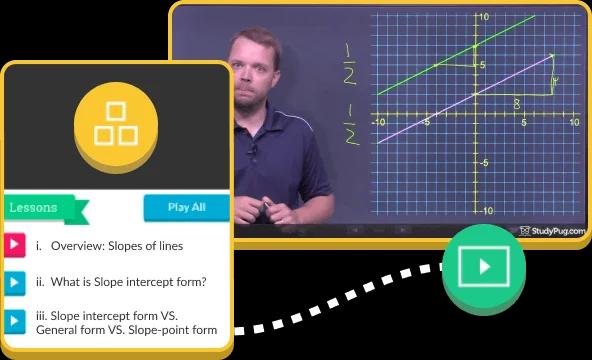
Certified teachers break down rates, trigonometry, and quadratic functions step-by-step

Unlimited Practice

Unlimited Practice

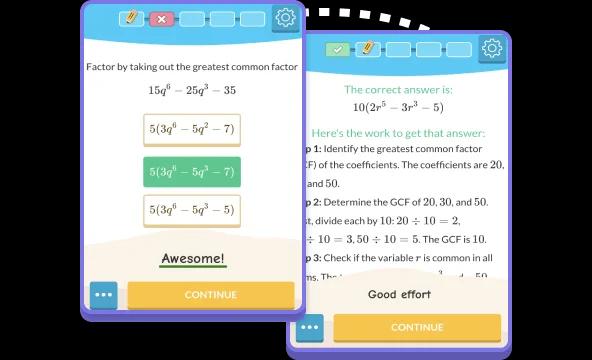
5,000+ teacher-created practice questions prepare you for Mathematics 20-2 exams

How Alberta Students Use StudyPug

1

Select Grade Level
Select Grade Level

Choose your Alberta grade (K-12) and current math topics.

2

Get Unstuck
Get Unstuck

Upload homework problems or browse curriculum-aligned lessons.

3

Practice & Master
Practice & Master

Work through similar problems until concepts stick.

4

See Results
See Results

Track progress and watch grades improve week by week.

Find the right Alberta Grade 11 course

Alberta Math 20-2 Help: Master Concepts FastHelp

Print

LO_ID

Learning Outcome-Skills & Procedures

StudyPug Topic

AB.SO.20-2.1

Solve problems that involve the application of rates: Interpret rates in various contexts, solve rate problems requiring variable isolation, determine and compare rates and unit rates, make and justify decisions using rates, represent rates pictorially and graphically, describe contexts for given rates or unit rates, explain the relationship between graph slope and rate, identify and explain factors influencing rates, solve contextual problems involving rates or unit rates

AB.SO.20-2.2

Solve problems that involve scale diagrams, using proportional reasoning: Explain how scale diagrams are used to model 2-D shapes or 3-D objects, determine scale factors using proportional reasoning, calculate unknown dimensions using proportional reasoning, draw scale diagrams with specified scale factors, solve contextual problems involving scale diagrams

AB.SO.20-2.3

Demonstrate an understanding of the relationships among scale factors, areas, surface areas and volumes of similar 2-D shapes and 3-D objects: Calculate areas of 2-D shapes from scale diagrams, determine surface areas and volumes of 3-D objects from scale diagrams, explain effects of scale factor changes on 2-D shape areas, explain effects of scale factor changes on 3-D object surface areas and volumes, solve spatial problems requiring formula manipulation, solve contextual problems involving scale factors, areas, and volumes

AB.SO.20-2.4

Derive proofs that involve the properties of angles and triangles: Use inductive reasoning to generalize angle relationships in parallel lines, prove properties of angles formed by transversals and parallel lines, generalize rules for triangle interior angle sums, prove triangle congruence, identify and correct errors in angle property proofs

AB.SO.20-2.5

Solve problems that involve properties of angles and triangles: Determine angle measures in diagrams with parallel lines and triangles, identify and correct errors in angle measurement problem solutions, solve contextual problems involving angles or triangles, verify non-applicability of angle properties for non-parallel lines

AB.SO.20-2.6

Solve problems that involve the cosine law and the sine law, excluding the ambiguous case: Draw diagrams representing cosine law or sine law problems, explain proof steps for sine law or cosine law, solve contextual problems using sine law or cosine law, solve problems involving multiple triangles

AB.SO.20-2.7

Analyze puzzles and games that involve numerical and logical reasoning, using problem-solving strategies: Apply various problem-solving strategies to puzzles and games, identify and correct errors in puzzle solutions or game strategies, create variations of puzzles or games and describe solving strategies

AB.SO.20-2.8

Analyze and prove conjectures, using inductive and deductive reasoning, to solve problems: Make and justify conjectures based on observed patterns, explain limitations of inductive reasoning, compare inductive and deductive reasoning, provide counterexamples to disprove conjectures, prove algebraic and number relationships, construct logical arguments to support positions, prove conjectures using deductive reasoning, determine validity of arguments and justify reasoning, identify errors in proofs, solve contextual problems involving inductive or deductive reasoning

AB.SO.20-2.9

Analyze the characteristics of quadratic functions, including vertex, intercepts, domain and range, axis of symmetry: Determine vertex coordinates of quadratic function graphs, find axis of symmetry equations, determine vertex coordinates and maximum/minimum points, find domain and range of quadratic functions, sketch quadratic function graphs, solve contextual problems involving quadratic function characteristics

AB.SO.20-2.10

Solve problems that involve quadratic equations: Determine quadratic function graph intercepts, find quadratic equation roots by factoring, use quadratic formula to find equation roots, explain relationships between roots, zeros, and x-intercepts, explain why graphs may have zero, one, or two x-intercepts, express quadratic equations in factored form, solve contextual problems using quadratic equations

AB.SO.20-2.11

Solve problems that involve operations on radicals and radical expressions with numerical and variable radicands (limited to square roots): Compare and order radical expressions with numerical radicands, convert between entire and mixed radicals, perform operations to simplify radical expressions, rationalize monomial denominators of radical expressions, identify variable values for which radical expressions are defined

AB.SO.20-2.12

Solve problems that involve radical equations (limited to square roots or cube roots): Determine restrictions on variable values in radical equations, solve radical equations algebraically, verify solutions by substitution, explain why some roots may be extraneous, solve problems by modeling situations with radical equations

AB.SO.20-2.13

Demonstrate an understanding of normal distribution, including standard deviation and z-scores: Explain standard deviation concept, calculate population standard deviation using technology, explain normal curve properties, determine if data sets approximate normal distribution, compare properties of multiple normally distributed data sets, apply standard deviation in decision-making contexts, solve contextual problems involving standard deviation, calculate and explain z-scores for normally distributed data

AB.SO.20-2.14

Interpret statistical data, using confidence intervals, confidence levels, margin of error: Explain how sample size affects confidence levels and margins of error, explain significance of confidence intervals, margins of error, and confidence levels, make population inferences from sample data using confidence intervals, analyze media examples using confidence intervals and levels, interpret confidence intervals and margins of error in media examples, support positions using statistical data analysis

AB.SO.20-2.15

Determine the number of combinations of n different elements taken r at a time to solve problems: Explain differences between permutations and combinations, calculate number of ways to select subsets from larger sets, solve problems using combination calculations, explain combination notation relationships, solve equations involving combination notation

AB.SO.20-2.16

Expand powers of a binomial in a variety of ways, including using the binomial theorem (restricted to exponents that are natural numbers): Explain patterns in expanded forms of (x + y)^n, explain Pascal's triangle row determination, relate binomial expansion coefficients to Pascal's triangle, explain coefficient determination using combinations, expand binomials using the binomial theorem, determine specific terms in binomial expansions

AB.SO.20-2.17

Research and give a presentation on a historical event or an area of interest that involves mathematics: Collect relevant primary or secondary data, assess data accuracy, reliability, and relevance, interpret data using statistical methods if applicable, identify and present controversial issues with supporting data, organize and present research projects with or without technology
Complete Alberta Mathematics 20-2 Coverage

Mathematics 20-2 Lessons

84

Video Explanations

565

Practice Problems

793

Alberta Standards

100% Aligned

Why Alberta Mathematics 20-2 Students Love StudyPug
Diploma Exam Preparation

Diploma Exam Preparation

Practice with real diploma-style questions—be ready for your Math 20-2 provincial exam

Canadian Certified Teachers

Canadian Certified Teachers

Learn from expert Alberta teachers who know exactly what you need for Mathematics 20-2

Learn Anywhere

Learn Anywhere

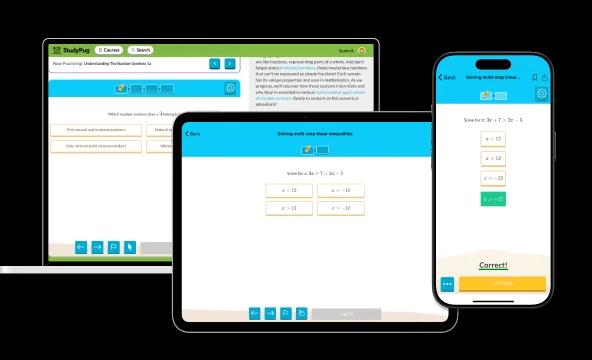
Desktop, tablet, or phone—your Mathematics 20-2 lessons sync across all devices

Success Stories

Scale diagrams confused me for weeks. The AI photo search found the exact lessons I needed. Aced my unit test.

Alex Chen

Used StudyPug all semester for Math 20-2. The step-by-step solutions saved me hours. Finished with 87%.

Taylor Nguyen

Read More

Frequently Asked Questions

Everything you need to know about mastering Mathematics 20-2 with StudyPug

What does Mathematics 20-2 coverage include?

Complete Math 20-2 curriculum with video lessons on rates, geometry, trigonometry, quadratics, and statistics. Includes practice problems, step-by-step solutions, and progress tracking for every topic.

How does the AI photo search work?

Take a photo of any Math 20-2 problem, and our AI finds the exact lesson teaching that concept. It's like having a personal tutor who knows exactly what you need.

Are the teachers certified Alberta educators?

Yes! Our teachers are Canadian certified Alberta educators who understand Mathematics 20-2 curriculum and create lessons specifically for Alberta diploma exam standards.

Can I use StudyPug on my phone or tablet?

Absolutely! StudyPug works on desktop, tablet, and mobile. Your progress syncs automatically so you can study for Math 20-2 anywhere.

How will StudyPug help me prepare for my diploma exam?

We include diploma-style practice questions for every Math 20-2 topic and teach the exact concepts tested. Students report significantly improved scores and confidence on exam day.

Practice Smart, See Real Progress

Unlimited Targeted Practice

10,000+ questions adjust to your exact skill level. Never run out of problems that challenge you.
Visual Progress Tracking

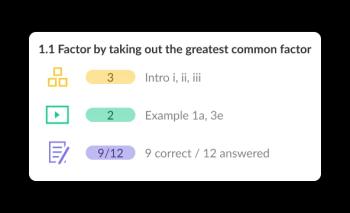
See mastery percentage for every topic. Parents get weekly progress emails automatically.
Achievement System
Achievement System

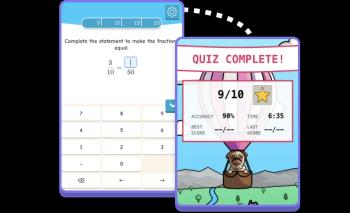
Earn badges for consistency and improvement. Build learning streaks that motivate daily practice
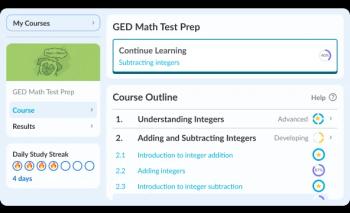
Detailed Analytics
Detailed Analytics

Time spent, problems solved, concepts mastered. Identify exactly where more practice is needed.

student
CallToActionContent

End Math Struggles Today

Alberta curriculum-aligned help that actually works

mathImage