Washington
Join 8,000+ Washington students mastering high school geometry with expert video lessons and unlimited practice
Why Geometry Students Choose StudyPug
Three ways you get help — even when you’re stuck

Search with Photo
Snap a photo of any problem and get the exact lesson
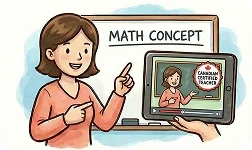
Expert Video Teaching
Certified teachers explain every concept with clear examples

Unlimited Practice
Thousands of practice questions with step-by-step solutions
How StudyPug Works for You
1

Pick Your Course
Choose Geometry and see every topic from your class
2

Get Unstuck
Upload homework problems or browse curriculum-aligned lessons.
3

Practice & Master
Work through similar problems until concepts stick.
4

See Results
Track exactly what you've mastered.
Washington Geometry Help | Master High School GeometryHelp
ID | Standard | StudyPug Topic |
|---|---|---|
CC.HSG.CO.A.1 | Know precise definitions of angle, circle, perpendicular line, parallel line, and line segment, based on the undefined notions of point, line, distance along a line, and distance around a circular arc. |
CC.HSG.CO.A.2 | Represent transformations in the plane using, e.g., transparencies and geometry software; describe transformations as functions that take points in the plane as inputs and give other points as outputs. Compare transformations that preserve distance and angle to those that do not. |
CC.HSG.CO.A.3 | Given a rectangle, parallelogram, trapezoid, or regular polygon, describe the rotations and reflections that carry it onto itself. |
CC.HSG.CO.B.6 | Use geometric descriptions of rigid motions to transform figures and to predict the effect of a given rigid motion on a given figure; given two figures, use the definition of congruence in terms of rigid motions to decide if they are congruent. |
CC.HSG.CO.B.7 | Use the definition of congruence in terms of rigid motions to show that two triangles are congruent if and only if corresponding pairs of sides and corresponding pairs of angles are congruent. |
CC.HSG.CO.B.8 | Explain how the criteria for triangle congruence (ASA, SAS, and SSS) follow from the definition of congruence in terms of rigid motions. |
CC.HSG.CO.C.9 | Prove theorems about lines and angles. |
CC.HSG.CO.C.10 | Prove theorems about triangles. |
CC.HSG.CO.C.11 | Prove theorems about parallelograms. |
CC.HSG.CO.D.12 | Make formal geometric constructions with a variety of tools and methods. |
CC.HSG.CO.D.13 | Construct an equilateral triangle, a square, and a regular hexagon inscribed in a circle. |
CC.HSG.SRT.A.1 | Verify experimentally the properties of dilations given by a center and a scale factor. |
CC.HSG.SRT.A.2 | Given two figures, use the definition of similarity in terms of similarity transformations to decide if they are similar; explain using similarity transformations the meaning of similarity for triangles as the equality of all corresponding pairs of angles and the proportionality of all corresponding pairs of sides. |
CC.HSG.SRT.B.4 | Prove theorems about triangles. |
CC.HSG.SRT.B.5 | Use congruence and similarity criteria for triangles to solve problems and to prove relationships in geometric figures. |
CC.HSG.SRT.C.6 | Understand that by similarity, side ratios in right triangles are properties of the angles in the triangle, leading to definitions of trigonometric ratios for acute angles. |
CC.HSG.SRT.C.7 | Explain and use the relationship between the sine and cosine of complementary angles. |
CC.HSG.SRT.C.8 | Use trigonometric ratios and the Pythagorean Theorem to solve right triangles in applied problems. |
CC.HSG.C.A.1 | Prove that all circles are similar. |
CC.HSG.C.A.2 | Identify and describe relationships among inscribed angles, radii, and chords. |
CC.HSG.C.A.3 | Construct the inscribed and circumscribed circles of a triangle, and prove properties of angles for a quadrilateral inscribed in a circle. |
CC.HSG.C.A.4 | Construct a tangent line from a point outside a given circle to the circle. |
CC.HSG.C.B.5 | Derive using similarity the fact that the length of the arc intercepted by an angle is proportional to the radius, and define the radian measure of the angle as the constant of proportionality; derive the formula for the area of a sector. |
CC.HSG.GPE.A.1 | Derive the equation of a circle of given center and radius using the Pythagorean Theorem; complete the square to find the center and radius of a circle given by an equation. |
CC.HSG.GPE.A.2 | Derive the equation of a parabola given a focus and directrix. |
CC.HSG.GPE.A.3 | Derive the equations of ellipses and hyperbolas given the foci, using the fact that the sum or difference of distances from the foci is constant. |
CC.HSG.GPE.B.4 | Use coordinates to prove simple geometric theorems algebraically. |
CC.HSG.GPE.B.5 | Prove the slope criteria for parallel and perpendicular lines and use them to solve geometric problems. |
CC.HSG.GPE.B.6 | Find the point on a directed line segment between two given points that partitions the segment in a given ratio. |
CC.HSG.GPE.B.7 | Use coordinates to compute perimeters of polygons and areas of triangles and rectangles, e.g., using the distance formula. |
CC.HSG.GMD.A.1 | Give an informal argument for the formulas for the circumference of a circle, area of a circle, volume of a cylinder, pyramid, and cone. |
CC.HSG.GMD.A.3 | Use volume formulas for cylinders, pyramids, cones, and spheres to solve problems. |
CC.HSG.GMD.B.4 | Identify the shapes of two-dimensional cross-sections of three-dimensional objects, and identify three-dimensional objects generated by rotations of two-dimensional objects. |
CC.HSG.MG.A.1 | Use geometric shapes, their measures, and their properties to describe objects. |
CC.HSG.MG.A.2 | Apply concepts of density based on area and volume in modeling situations. |
CC.HSA.SSE.A.1 | Interpret expressions that represent a quantity in terms of its context. |
CC.HSA.SSE.B.3 | Choose and produce an equivalent form of an expression to reveal and explain properties of the quantity represented by the expression. |
CC.HSA.CED.A.1 | Create equations and inequalities in one variable and use them to solve problems. Include equations arising from linear and quadratic functions, and simple rational and exponential functions. |
CC.HSA.CED.A.2 | Create equations in two or more variables to represent relationships between quantities; graph equations on coordinate axes with labels and scales. |
CC.HSA.CED.A.3 | Represent constraints by equations or inequalities, and by systems of equations and/or inequalities, and interpret solutions as viable or non-viable options in a modeling context. |
CC.HSA.CED.A.4 | Rearrange formulas to highlight a quantity of interest, using the same reasoning as in solving equations. |
CC.HSA.REI.C.7 | Solve a simple system consisting of a linear equation and a quadratic equation in two variables algebraically and graphically. |
CC.HSF.IF.C.7 | Graph functions expressed symbolically and show key features of the graph, by hand in simple cases and using technology for more complicated cases. |
CC.HSS.ID.B.6 | Represent data on two quantitative variables on a scatter plot, and describe how the variables are related. |
Complete Geometry Coverage
Chapters
108
Topics
692
Video Lessons
617
Practice Questions
677
Why Washington Geometry Students Love StudyPug
Built specifically for Washington high school success
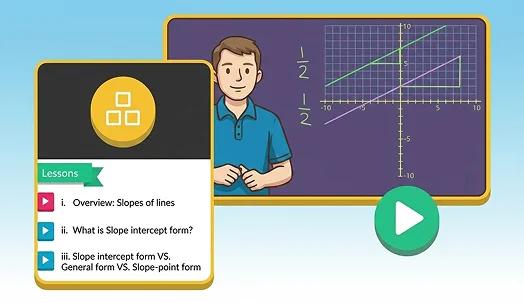
Washington Curriculum Aligned
Every lesson matches Washington Geometry standards—what you learn in class, we teach

Smarter Balanced Prep
Practice with Washington Smarter Balanced assessment questions—be ready for exam day
Expert Washington Teachers
Learn from expert Washington teachers who know exactly what you need for Geometry
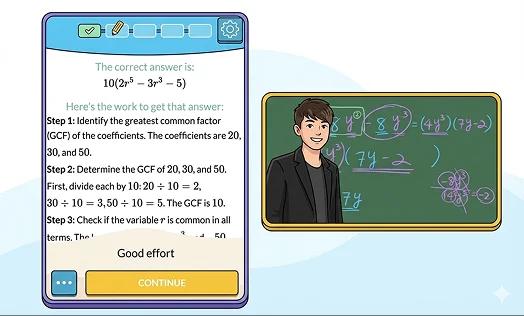
Learn Anywhere
Desktop, tablet, or phone—your Geometry lessons sync across all devices
Frequently Asked Questions
Everything you need to know about mastering Geometry with StudyPug
What does Geometry coverage include?
StudyPug covers all Geometry topics: transformations and congruence, triangle proofs (SSS, SAS, ASA, AAS, HL), circles (central angles, inscribed angles, chords, tangents), trigonometry (sine, cosine, tangent ratios), coordinate geometry (distance, midpoint, slope, parallel and perpendicular lines), conic sections (circles, parabolas, ellipses, hyperbolas), 3D solids (volume and surface area of prisms, pyramids, cylinders, cones), and polygon properties. All 49 chapters, 115 topics, 692 video lessons, and 677 practice questions align with Washington Common Core standards for high school Geometry.
How does photo search work?
Take a photo of any geometry problem with your phone—whether it's a triangle proof, circle theorem, or trig ratio question. Our AI instantly identifies the problem type and shows you the exact video lesson that teaches that concept. You'll see step-by-step solutions and similar practice problems. It works on homework, textbook problems, or worksheet questions. No more searching through hundreds of videos trying to find the right explanation—just snap, match, and learn.
How many practice problems are available?
Geometry has 677 practice questions covering every topic: congruence proofs, circle theorems, trigonometric ratios, coordinate geometry, and 3D solids. Each question includes step-by-step solutions so you can see exactly where you went wrong. Questions adapt to your level—if you're struggling, you get more foundational practice; if you're excelling, you get more challenging problems. You can practice as much as you want with unlimited attempts. Most students work through 20-30 problems per week to build real confidence and mastery.
What if I'm falling behind in Geometry?
Start with our diagnostic assessment to identify exactly which topics you need help with—whether it's triangle proofs, circle angles, trig ratios, or coordinate geometry. Watch the video lessons at your own pace, pausing and rewinding as needed. Work through practice problems until the concepts click. The adaptive practice adjusts to your level, so you're never overwhelmed. Most students who were struggling see improvement within 2-3 weeks of consistent practice. You can catch up on missed concepts while keeping up with current classwork—everything is organized by topic, so you can focus exactly where you need help.
Does StudyPug help with Geometry exams?
Yes. StudyPug prepares you for classroom tests, semester exams, and the Washington Smarter Balanced assessment. Practice questions match the format and difficulty of real exam problems. Review videos before tests to reinforce key concepts like triangle congruence, circle theorems, and trigonometric applications. The progress tracker shows exactly which topics you've mastered and which need more work, so you can focus your study time effectively. Many students use StudyPug as their primary exam review tool, working through topic quizzes and practice problems in the weeks leading up to tests.
How much does StudyPug cost?
StudyPug offers flexible monthly and annual subscription plans with unlimited access to all Geometry content—all 692 video lessons, 677 practice questions, photo search, and progress tracking. Plans start at the cost of a single tutoring session but give you 24/7 access. No per-video charges or hidden fees. You get complete access to Geometry plus every other math course (Algebra, Pre-Calculus, Calculus, Statistics) if you need help in multiple subjects. Most students find it more affordable than private tutoring while offering more flexibility. Visit our pricing page for current rates and discounts.
Smart Study Tools for Real Results
Personalized features that help you stay motivated and make progress
Adaptive Practice
Questions adapt to your level
Stay Motivated
Badges and streaks keep you practising daily
Quiz Mastery
Retake quizzes until you truly get it
Progress Tracking
See exactly where you need more practice