Texas
Texas
Join 85,000+ Texas students building math confidence with StudyPug
Why Geometry Students Choose StudyPug
Three ways you get help — even when you’re stuck
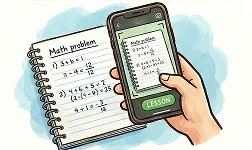
Search with Photo
Snap a photo of any problem and get the exact lesson
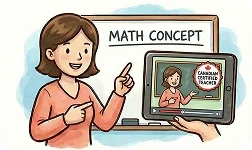
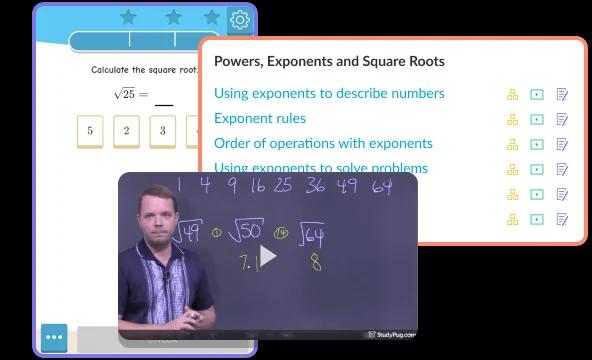
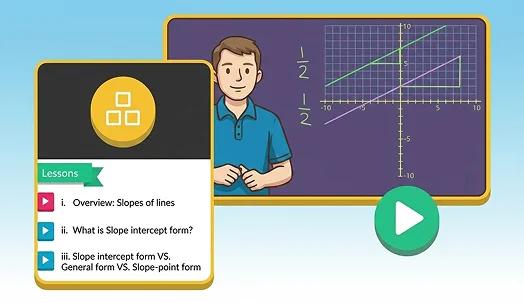
Expert Video Teaching
Certified teachers explain every concept with clear examples

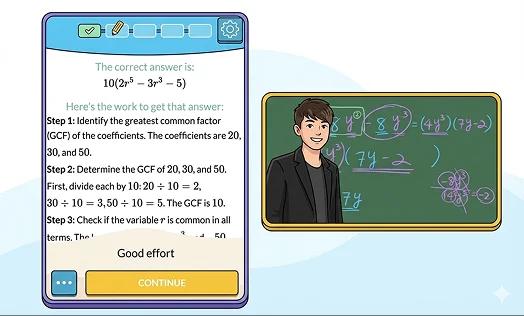
Unlimited Practice
Thousands of practice questions with step-by-step solutions
How StudyPug Works for You
1
Pick Your Course
Choose Geometry and see every topic from your class
2

Get Unstuck
Upload homework problems or browse curriculum-aligned lessons.
3

Practice & Master
Work through similar problems until concepts stick.
4

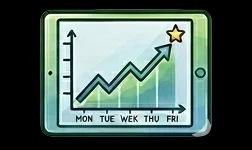
See Results
Track exactly what you've mastered.
Texas Geometry Course | Step-by-Step Video LessonsHelp
ID | Strand & Expectation | StudyPug Topic |
|---|---|---|
TX.G.2.A | Determine the coordinates of a point that is a given fractional distance less than one from one end of a line segment to the other in one- and two-dimensional coordinate systems, including finding the midpoint |
TX.G.2.B | Derive and use the distance, slope, and midpoint formulas to verify geometric relationships, including congruence of segments and parallelism or perpendicularity of pairs of lines |
TX.G.2.C | Determine an equation of a line parallel or perpendicular to a given line that passes through a given point |
TX.G.3.A | Describe and perform transformations of figures in a plane using coordinate notation |
TX.G.3.B | Determine the image or pre-image of a given two-dimensional figure under a composition of rigid transformations, a composition of non-rigid transformations, and a composition of both |
TX.G.3.C | Identify the sequence of transformations that will carry a given pre-image onto an image on and off the coordinate plane |
TX.G.3.D | Identify and distinguish between reflectional and rotational symmetry in a plane figure |
TX.G.4.A | Distinguish between undefined terms, definitions, postulates, conjectures, and theorems |
TX.G.4.B | Identify and determine the validity of the converse, inverse, and contrapositive of a conditional statement and recognize the connection between a biconditional statement and a true conditional statement with a true converse |
TX.G.4.D | Compare geometric relationships between Euclidean and spherical geometries, including parallel lines and the sum of the angles in a triangle |
TX.G.5.A | Investigate patterns to make conjectures about geometric relationships, including angles formed by parallel lines cut by a transversal, criteria required for triangle congruence, special segments of triangles, diagonals of quadrilaterals, interior and exterior angles of polygons, and special segments and angles of circles choosing from a variety of tools |
TX.G.5.D | Verify the Triangle Inequality theorem using constructions and apply the theorem to solve problems |
TX.G.6.A | Verify theorems about angles formed by the intersection of lines and line segments, including vertical angles, and angles formed by parallel lines cut by a transversal and prove equidistance between the endpoints of a segment and points on its perpendicular bisector and apply these relationships to solve problems |
TX.G.6.B | Prove two triangles are congruent by applying the Side-Angle-Side, Angle-Side-Angle, Side-Side-Side, Angle-Angle-Side, and Hypotenuse-Leg congruence conditions |
TX.G.6.D | Verify theorems about the relationships in triangles, including proof of the Pythagorean Theorem, the sum of interior angles, base angles of isosceles triangles, midsegments, and medians, and apply these relationships to solve problems |
TX.G.6.E | Prove a quadrilateral is a parallelogram, rectangle, square, or rhombus using opposite sides, opposite angles, or diagonals and apply these relationships to solve problems |
TX.G.7.A | Apply the definition of similarity in terms of a dilation to identify similar figures and their proportional sides and the congruent corresponding angles |
TX.G.8.B | Identify and apply the relationships that exist when an altitude is drawn to the hypotenuse of a right triangle, including the geometric mean, to solve problems |
TX.G.9.A | Determine the lengths of sides and measures of angles in a right triangle by applying the trigonometric ratios sine, cosine, and tangent to solve problems |
TX.G.9.B | Apply the relationships in special right triangles 30°-60°-90° and 45°-45°-90° and the Pythagorean theorem, including Pythagorean triples, to solve problems |
TX.G.10.A | Identify the shapes of two-dimensional cross-sections of prisms, pyramids, cylinders, cones, and spheres and identify three-dimensional objects generated by rotations of two-dimensional shapes |
TX.G.10.B | Determine and describe how changes in the linear dimensions of a shape affect its perimeter, area, surface area, or volume, including proportional and non-proportional dimensional change |
TX.G.11.B | Determine the area of composite two-dimensional figures comprised of a combination of triangles, parallelograms, trapezoids, kites, regular polygons, or sectors of circles to solve problems using appropriate units of measure |
TX.G.11.C | Apply the formulas for the total and lateral surface area of three-dimensional figures, including prisms, pyramids, cones, cylinders, spheres, and composite figures, to solve problems using appropriate units of measure |
TX.G.11.D | Apply the formulas for the volume of three-dimensional figures, including prisms, pyramids, cones, cylinders, spheres, and composite figures, to solve problems using appropriate units of measure |
TX.G.12.A | Apply theorems about circles, including relationships among angles, radii, chords, tangents, and secants, to solve non-contextual problems |
TX.G.12.B | Apply the proportional relationship between the measure of an arc length of a circle and the circumference of the circle to solve problems |
TX.G.12.D | Describe radian measure of an angle as the ratio of the length of an arc intercepted by a central angle and the radius of the circle |
TX.G.12.E | Show that the equation of a circle with center at the origin and radius r is x^2 + y^2 = r^2 and determine the equation for the graph of a circle with radius r and center (h, k), (x - h)^2 + (y - k)^2 = r^2 |
TX.G.13.A | Develop strategies to use permutations and combinations to solve contextual problems |
TX.G.13.B | Determine probabilities based on area to solve contextual problems |
TX.G.13.C | Identify whether two events are independent and compute the probability of the two events occurring together with or without replacement |
TX.G.13.D | Apply conditional probability in contextual problems |
TX.G.13.E | Apply independence in contextual problems |
Complete Geometry Coverage
Topics
80
Video Lessons
628
Practice Questions
343
Chapters
40
Why Texas Geometry Students Love StudyPug
Built specifically for Texas high school success
Texas TEKS Aligned
Every lesson matches Texas Geometry standards—what you learn in class, we teach

STAAR EOC Prep
Practice with Texas STAAR End-of-Course assessment questions—be ready for exam day
Texas-Certified Teachers
Learn from expert Texas teachers who know exactly what you need for Geometry
Learn Anywhere
Desktop, tablet, or phone—your Geometry lessons sync across all devices
Frequently Asked Questions
Everything you need to know about mastering Geometry with StudyPug
What does Geometry coverage include?
Our Texas Geometry course covers all TEKS standards: coordinate and transformational geometry, logic and proofs, triangle congruence and similarity, right triangle trigonometry, quadrilaterals and polygons, circles and radian measure, 3D geometry and measurement, and probability. You'll find 628 video lessons, 372 practice questions, and step-by-step explanations for every concept in your textbook.
How does photo search work?
Take a photo of any Geometry problem from your homework or textbook. Our AI matches it to the exact lesson you need. If you're stuck on a proof or trigonometry problem, just snap a picture and get instant help. It works with proofs, diagrams, coordinate geometry, and word problems—any Geometry question from your class.
How many practice problems are available?
You get 372 practice questions specifically for Texas Geometry, plus thousands more from related topics. Every question includes step-by-step solutions. Practice adapts to your level—if you're struggling with proofs or circle theorems, you'll get more targeted practice until you master it. Quiz yourself as many times as you need.
What if I'm falling behind in Geometry?
Start with the specific topic you're struggling with—proofs, trigonometry, circles, or any other concept. Watch the video lesson, then practice similar problems. You can rewatch any lesson as many times as you need. Most students see improvement within a few focused study sessions. The adaptive practice identifies exactly what you need to work on.
Does StudyPug help with Geometry exams?
Yes! Our Geometry course is aligned with Texas TEKS standards and includes STAAR End-of-Course prep. You'll practice with exam-style questions and learn test-taking strategies. Review specific topics before unit tests, or use our comprehensive practice to prepare for semester finals and the STAAR EOC assessment.
How much does StudyPug cost?
StudyPug offers flexible monthly and annual plans with unlimited access to all Geometry lessons and practice questions. You also get access to other high school math courses. Plans start at a low monthly rate, and you can cancel anytime. Try it risk-free and see how it helps with your Geometry class.
Smart Study Tools for Real Results
Personalized features that help you stay motivated and make progress
Adaptive Practice
Questions adapt to your level
Stay Motivated
Badges and streaks keep you practising daily
Quiz Mastery
Retake quizzes until you truly get it
Progress Tracking
See exactly where you need more practice