Texas
Texas
Join 12,000+ Texas students getting the help they need to succeed in Algebraic Reasoning
Why Algebraic Reasoning Students Choose StudyPug
Three ways you get help — even when you’re stuck

Search with Photo
Snap a photo of any problem and get the exact lesson that shows you how to solve it step-by-step

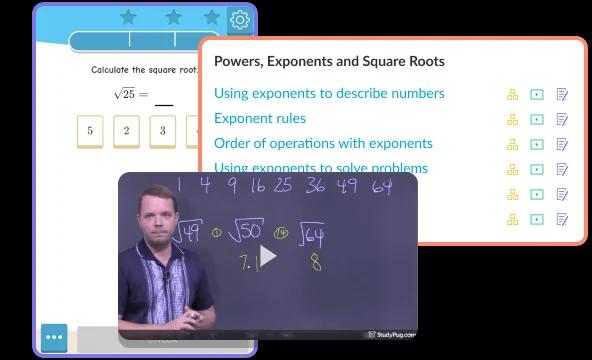
Expert Video Teaching
Certified teachers explain every concept from functions to matrices with clear, easy-to-follow examples

Unlimited Practice
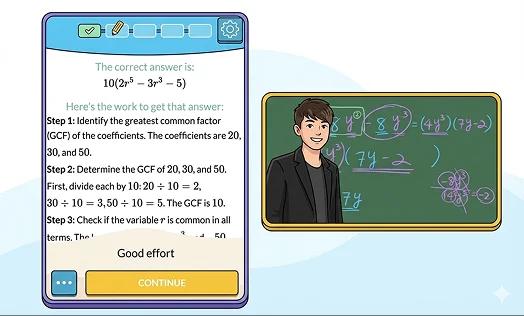
Thousands of practice questions with step-by-step solutions covering all 95 Algebraic Reasoning topics
How StudyPug Works for You
1

Pick Your Course
Choose Algebraic Reasoning and see every topic from your class—functions, polynomials, matrices, and more
2

Get Unstuck
Upload homework problems or browse curriculum-aligned lessons covering Texas TEKS standards
3

Practice & Master
Work through similar problems until concepts stick—from quadratic functions to matrix operations
4

See Results
Track exactly what you've mastered and focus on topics that need more work
Texas Algebraic Reasoning (AR) | StudyPugHelp
ID | Strand & Expectation | StudyPug Topic |
|---|---|---|
TX.AR.2.A | Determine the patterns that identify the relationship between a function and its common ratio or related finite differences as appropriate, including linear, quadratic, cubic, and exponential functions |
TX.AR.2.B | Classify a function as linear, quadratic, cubic, and exponential when a function is represented tabularly using finite differences or common ratios as appropriate |
TX.AR.2.C | Determine the function that models a given table of related values using finite differences and its restricted domain and range |
TX.AR.2.D | Determine a function that models real-world data and mathematical contexts using finite differences such as the age of a tree and its circumference, figurative numbers, average velocity, and average acceleration |
TX.AR.3.A | Compare and contrast the key attributes of a set of functions such as linear, quadratic, and exponential |
TX.AR.3.B | Compare and contrast the key attributes of a function and its inverse when it exists |
TX.AR.3.C | Verify that two functions are inverses of each other tabularly and graphically |
TX.AR.3.D | Represent a resulting function tabularly, graphically, and symbolically when functions are combined or separated using arithmetic operations |
TX.AR.3.E | Model a situation using function notation when the output of one function is the input of a second function |
TX.AR.3.F | Compare and contrast a function and possible functions that can be used to build it |
TX.AR.4.A | Connect tabular representations to symbolic representations when adding, subtracting, and multiplying polynomial functions |
TX.AR.4.B | Compare and contrast the results when adding two linear functions and multiplying two linear functions |
TX.AR.4.C | Determine the quotient of a polynomial function of degree three and of degree four when divided by a polynomial function of degree one and of degree two when represented tabularly and symbolically |
TX.AR.4.D | Determine the linear factors of a polynomial function of degree two and of degree three when represented symbolically and tabularly and graphically where appropriate |
TX.AR.5.A | Add and subtract matrices |
TX.AR.5.B | Multiply matrices |
TX.AR.5.C | Multiply matrices by a scalar |
TX.AR.5.D | Represent and solve systems of two linear equations arising from mathematical and real-world situations using matrices |
TX.AR.5.E | Represent and solve systems of three linear equations arising from mathematical and real-world situations using matrices and technology |
TX.AR.6.B | Solve equations arising from questions asked about functions that model real-world applications, including linear and quadratic functions |
TX.AR.6.C | Approximate solutions to equations arising from questions asked about exponential, logarithmic, square root, and cubic functions that model real-world applications |
TX.AR.7.A | Represent domain and range of a function using interval notation, inequalities, and set notation |
TX.AR.7.C | Determine the accuracy of a prediction from a function that models a set of data compared to the actual data |
TX.AR.7.D | Determine an appropriate function model, including linear, quadratic, and exponential functions, for a set of data arising from real-world situations using finite differences and average rates of change |
Complete Algebraic Reasoning Coverage
Video Lessons
95
Topics Covered
705
Practice Questions
803
Texas TEKS Aligned
100%
Why Texas Algebraic Reasoning Students Love StudyPug
Built specifically for Texas high school success
Texas TEKS Aligned
Every lesson matches Texas Algebraic Reasoning standards—what you learn in class, we teach

STAAR End-of-Course Prep
Practice with Texas STAAR Algebra I assessment questions—be ready for exam day

Texas-Certified Teachers
Learn from expert Texas teachers who know exactly what you need for Algebraic Reasoning
Learn Anywhere
Desktop, tablet, or phone—your Algebraic Reasoning lessons sync across all devices
Frequently Asked Questions
Everything you need to know about mastering Algebraic Reasoning with StudyPug
What does Algebraic Reasoning coverage include?
StudyPug covers all Texas TEKS standards for Algebraic Reasoning: functions and relations, linear and quadratic functions, polynomial operations and factoring, matrices and systems of equations, exponential and logarithmic functions, transformations, and data analysis. We have 705 video lessons and 873 practice questions covering all 95 topics you need for success.
How does photo search work for Algebraic Reasoning?
Snap a photo of any homework problem—whether it's factoring polynomials, solving matrix equations, or graphing functions—and our AI instantly finds the relevant video lesson. You'll see step-by-step solutions that match your exact problem type. It's like having a tutor available 24/7 whenever you get stuck on homework or test prep.
How many practice problems are available?
StudyPug offers 873 practice questions for Algebraic Reasoning, covering everything from basic function notation to advanced matrix operations. Each question includes step-by-step solutions so you can see exactly where you went wrong and learn from mistakes. You can retake quizzes unlimited times until you master each concept.
What if I'm falling behind in Algebraic Reasoning?
Start with topics you're struggling with most. Our diagnostic tool identifies your weak areas, then creates a personalized learning path. Watch video lessons at your own pace, pause and rewatch as needed, then practice with adaptive questions that adjust to your level. Most students see improvement within 2-3 weeks of consistent practice.
Does StudyPug help with Algebraic Reasoning exams?
Yes! StudyPug prepares you for classroom tests, semester finals, and Texas STAAR End-of-Course assessments. Our practice questions mirror real exam formats, and you can filter by topic to focus on what's coming up next. Students who practice regularly report higher test scores and more confidence on exam day.
How much does StudyPug cost?
StudyPug offers flexible monthly and annual plans starting at just a few dollars per day—less than a single tutoring session. All plans include unlimited access to every Algebraic Reasoning lesson, practice question, and feature. Try it free for 7 days with no credit card required, cancel anytime if it's not right for you.
Smart Study Tools for Real Results
Personalized features that help you stay motivated and make progress
Adaptive Practice
Questions adapt to your level—challenging enough to learn, but never overwhelming
Stay Motivated
Badges and streaks keep you practising daily—build the habit that leads to mastery
Quiz Mastery
Retake quizzes until you truly get it—no penalties, just learning
Progress Tracking
See exactly where you need more practice and celebrate every topic you master