Texas
Texas
Join 15,000+ Texas students mastering high school math
Why Algebra II Students Choose StudyPug
Three ways you get help — even when you’re stuck

Search with Photo
Snap a photo of any problem and get the exact lesson

Expert Video Teaching
Certified teachers explain every concept with clear examples

Unlimited Practice
Thousands of practice questions with step-by-step solutions
How StudyPug Works for You
1

Pick Your Course
Choose Algebra II and see every topic from your class
2

Get Unstuck
Upload homework problems or browse curriculum-aligned lessons.
3

Practice & Master
Work through similar problems until concepts stick.
4

See Results
Track exactly what you've mastered.
Texas Algebra II Help | Expert Video Lessons & PracticeHelp
ID | Strand & Expectation | StudyPug Topic |
|---|---|---|
TX.A2.2.A | Graph the functions f(x)=√x, f(x)=1/x, f(x)=x^3, f(x)= ³√x, f(x)=b^x, f(x)= |
TX.A2.2.B | Graph and write the inverse of a function using notation such as f^-1(x) |
TX.A2.2.C | Describe and analyze the relationship between a function and its inverse (quadratic and square root, logarithmic and exponential), including the restriction(s) on domain, which will restrict its range |
TX.A2.2.D | Use the composition of two functions, including the necessary restrictions on the domain, to determine if the functions are inverses of each other |
TX.A2.3.A | Formulate systems of equations, including systems consisting of three linear equations in three variables and systems consisting of two equations, the first linear and the second quadratic |
TX.A2.3.B | Solve systems of three linear equations in three variables by using Gaussian elimination, technology with matrices, and substitution |
TX.A2.3.E | Formulate systems of at least two linear inequalities in two variables |
TX.A2.4.A | Write the quadratic function given three specified points in the plane |
TX.A2.4.B | Write the equation of a parabola using given attributes, including vertex, focus, directrix, axis of symmetry, and direction of opening |
TX.A2.4.C | Determine the effect on the graph of f(x) = √x when f(x) is replaced by af(x), f(x) + d, f(bx), and f(x - c) for specific positive and negative values of a, b, c, and d |
TX.A2.4.D | Transform a quadratic function f(x) = ax^2 + bx + c to the form f(x) = a(x - h)^2 + k to identify the different attributes of f(x) |
TX.A2.4.E | Formulate quadratic and square root equations using technology given a table of data |
TX.A2.4.F | Solve quadratic and square root equations |
TX.A2.4.H | Solve quadratic inequalities |
TX.A2.5.A | Determine the effects on the key attributes on the graphs of f(x) = b^x and f(x) = log_b(x) where b is 2, 10, and e when f(x) is replaced by af(x), f(x) + d, and f(x - c) for specific positive and negative real values of a, c, and d |
TX.A2.5.B | Formulate exponential and logarithmic equations that model real-world situations, including exponential relationships written in recursive notation |
TX.A2.5.C | Rewrite exponential equations as their corresponding logarithmic equations and logarithmic equations as their corresponding exponential equations |
TX.A2.5.D | Solve exponential equations of the form y = ab^x where a is a nonzero real number and b is greater than zero and not equal to one and single logarithmic equations having real solutions |
TX.A2.6.A | Analyze the effect on the graphs of f(x) = x^3 and f(x) = ³√x when f(x) is replaced by af(x), f(bx), f(x - c), and f(x) + d for specific positive and negative real values of a, b, c, and d |
TX.A2.6.D | Formulate absolute value linear equations |
TX.A2.6.F | Solve absolute value linear inequalities |
TX.A2.6.G | Analyze the effect on the graphs of f(x) = 1/x when f(x) is replaced by af(x), f(bx), f(x-c), and f(x) + d for specific positive and negative real values of a, b, c, and d |
TX.A2.6.H | Formulate rational equations that model real-world situations |
TX.A2.6.K | Determine the asymptotic restrictions on the domain of a rational function and represent domain and range using interval notation, inequalities, and set notation |
TX.A2.6.L | Formulate and solve equations involving inverse variation |
TX.A2.7.A | Add, subtract, and multiply complex numbers |
TX.A2.7.B | Add, subtract, and multiply polynomials |
TX.A2.7.C | Determine the quotient of a polynomial of degree three and of degree four when divided by a polynomial of degree one and of degree two |
TX.A2.7.D | Determine the linear factors of a polynomial function of degree three and of degree four using algebraic methods |
TX.A2.7.E | Determine linear and quadratic factors of a polynomial expression of degree three and of degree four, including factoring the sum and difference of two cubes and factoring by grouping |
TX.A2.7.F | Determine the sum, difference, product, and quotient of rational expressions with integral exponents of degree one and of degree two |
TX.A2.7.G | Rewrite radical expressions that contain variables to equivalent forms |
TX.A2.7.H | Solve equations involving rational exponents |
TX.A2.7.I | Write the domain and range of a function in interval notation, inequalities, and set notation |
TX.A2.8.A | Analyze data to select the appropriate model from among linear, quadratic, and exponential models |
TX.A2.8.B | Use regression methods available through technology to write a linear function, a quadratic function, and an exponential function from a given set of data |
TX.A2.8.C | Predict and make decisions and critical judgments from a given set of data using linear, quadratic, and exponential models |
Complete Algebra II Coverage
Topics Covered
94
Video Lessons
709
Practice Questions
1270
Average Rating
4.8/5
Why Texas Algebra II Students Love StudyPug
Built specifically for Texas high school success
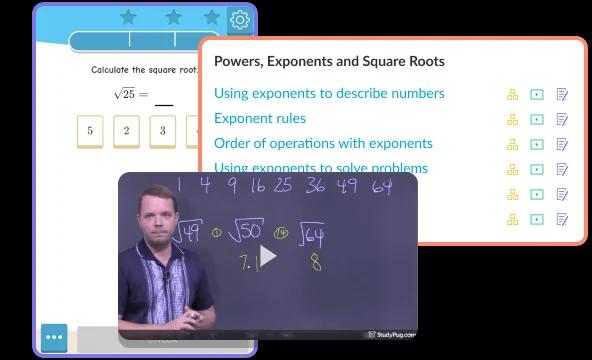
Texas TEKS Aligned
Every lesson matches Texas Algebra II standards—what you learn in class, we teach

STAAR EOC Prep
Practice with Texas end-of-course assessment questions—be ready for exam day
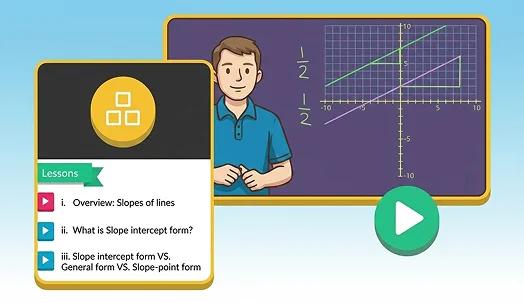
Texas-Certified Teachers
Learn from expert Texas teachers who know exactly what you need for Algebra II

Learn Anywhere
Desktop, tablet, or phone—your Algebra II lessons sync across all devices
Frequently Asked Questions
Everything you need to know about mastering Algebra II with StudyPug
What does Algebra II coverage include?
Our Texas Algebra II course covers all TEKS standards including polynomial and rational functions, exponential and logarithmic functions, quadratic equations, systems of equations, complex numbers, radical functions, absolute value equations, and data analysis. You get 709 video lessons and 1,302 practice problems covering every topic from factoring polynomials to solving logarithmic equations and graphing rational functions.
How does photo search work for Algebra II problems?
Take a photo of any Algebra II problem from your homework or textbook using your phone. Our AI instantly identifies the problem type—whether it's factoring a polynomial, solving an exponential equation, or graphing a rational function—and shows you the exact video lesson that teaches that concept. It's the fastest way to get unstuck on homework, especially for complex topics like polynomial division or logarithmic equations.
How many practice problems are available for Algebra II?
You get access to 1,302 practice problems covering every Algebra II topic. Each problem includes full step-by-step solutions so you can see exactly where you went wrong. Practice questions are organized by topic—from quadratic functions to complex numbers—so you can focus on exactly what you need to master. The adaptive system tracks your progress and recommends which topics need more practice based on your performance.
What if I'm falling behind in Algebra II?
Algebra II builds on Algebra I, so if you're struggling, start with our diagnostic to identify gaps in foundational concepts. You can review prerequisite topics like factoring, exponents, and linear equations at your own pace. Our videos break down every concept step-by-step, and you can pause and rewatch as many times as needed. Students who use StudyPug report catching up within weeks by focusing practice on weak areas identified by our progress tracking.
Does StudyPug help with Algebra II STAAR EOC exams?
Yes. Our Texas Algebra II course is fully aligned to TEKS standards tested on the STAAR End-of-Course exam. You'll practice with problems that mirror STAAR question formats, including graphing functions, solving multi-step equations, and analyzing real-world applications. Our teachers highlight key concepts and problem-solving strategies that frequently appear on the EOC, helping you build confidence before test day.
How much does StudyPug cost?
StudyPug offers flexible monthly and annual plans starting at just a few dollars per week—far less than a single tutoring session. Your subscription gives you unlimited access to all 709 Algebra II video lessons, 1,302 practice problems, photo search, progress tracking, and support across all grade levels and subjects. We offer a money-back guarantee, so you can try it risk-free and see results before committing long-term.
Smart Study Tools for Real Results
Personalized features that help you stay motivated and make progress
Adaptive Practice
Questions adapt to your level
Stay Motivated
Badges and streaks keep you practising daily
Quiz Mastery
Retake quizzes until you truly get it
Progress Tracking
See exactly where you need more practice