Texas
Texas
Trusted by 12,000+ TX families
Why Choose StudyPug for High School
Three ways your child gets help — even when you can't

Search with Photo
Snap a photo of any problem and get the exact lesson

Expert Video Teaching
Certified teachers explain every concept with clear examples

Track Progress
See exactly what they've mastered and what needs more work
How StudyPug Works
1

Pick Their Grade
Choose Algebra I and see every topic from your child's class
2

Get Unstuck
Upload homework problems or browse curriculum-aligned lessons.
3

Practice & Master
Work through similar problems until concepts stick.
4

See Results
Track progress and watch grades improve week by week.
Texas Algebra I Help | StudyPugHelp
ID | Strand & Expectation | StudyPug Topic |
|---|---|---|
TX.A1.2.A | Determine the domain and range of a linear function in mathematical problems; determine reasonable domain and range values for real-world situations |
TX.A1.2.B | Write linear equations in two variables in various forms, given one point and the slope and given two points |
TX.A1.2.C | Write linear equations in two variables given a table of values, a graph, and a verbal description |
TX.A1.2.D | Write and solve equations involving direct variation |
TX.A1.2.E | Write the equation of a line that contains a given point and is parallel to a given line |
TX.A1.2.F | Write the equation of a line that contains a given point and is perpendicular to a given line |
TX.A1.2.G | Write an equation of a line that is parallel or perpendicular to the X or Y axis and determine whether the slope of the line is zero or undefined |
TX.A1.2.H | Write linear inequalities in two variables given a table of values, a graph, and a verbal description |
TX.A1.2.I | Write systems of two linear equations given a table of values, a graph, and a verbal description |
TX.A1.3.A | Determine the slope of a line given a table of values, a graph, two points on the line, and an equation written in various forms |
TX.A1.3.B | Calculate the rate of change of a linear function represented tabularly, graphically, or algebraically in context of mathematical and real-world problems |
TX.A1.3.C | Graph linear functions on the coordinate plane and identify key features |
TX.A1.3.D | Graph the solution set of linear inequalities in two variables on the coordinate plane |
TX.A1.3.E | Determine the effects on the graph of the parent function f(x) = x when f(x) is replaced by af(x), f(x) + d, f(x - c), f(bx) for specific values of a, b, c, and d |
TX.A1.3.F | Graph systems of two linear equations in two variables on the coordinate plane and determine the solutions if they exist |
TX.A1.3.G | Estimate graphically the solutions to systems of two linear equations with two variables in real-world problems |
TX.A1.3.H | Graph the solution set of systems of two linear inequalities in two variables on the coordinate plane |
TX.A1.4.A | Calculate, using technology, the correlation coefficient between two quantitative variables and interpret this quantity as a measure of the strength of the linear association |
TX.A1.4.C | Write, with and without technology, linear functions that provide a reasonable fit to data to estimate solutions and make predictions for real-world problems |
TX.A1.5.A | Solve linear equations in one variable, including those for which the application of the distributive property is necessary and for which variables are included on both sides |
TX.A1.5.B | Solve linear inequalities in one variable, including those for which the application of the distributive property is necessary and for which variables are included on both sides |
TX.A1.5.C | Solve systems of two linear equations with two variables for mathematical and real-world problems |
TX.A1.6.A | Determine the domain and range of quadratic functions and represent the domain and range using inequalities |
TX.A1.6.B | Write equations of quadratic functions given the vertex and another point on the graph, write the equation in vertex form (f(x) = a(x - h)^2 + k), and rewrite the equation from vertex form to standard form (f(x) = ax^2 + bx + c) |
TX.A1.6.C | Write quadratic functions when given real solutions and graphs of their related equations |
TX.A1.7.A | Graph quadratic functions on the coordinate plane and use the graph to identify key attributes |
TX.A1.7.B | Describe the relationship between the linear factors of quadratic expressions and the zeros of their associated quadratic functions |
TX.A1.7.C | Determine the effects on the graph of the parent function f(x) = x^2 when f(x) is replaced by af(x), f(x) + d, f(x - c), f(bx) for specific values of a, b, c, and d |
TX.A1.8.A | Solve quadratic equations having real solutions by factoring, taking square roots, completing the square, and applying the quadratic formula |
TX.A1.8.B | Write, using technology, quadratic functions that provide a reasonable fit to data to estimate solutions and make predictions for real-world problems |
TX.A1.9.A | Determine the domain and range of exponential functions of the form f(x) = ab^x and represent the domain and range using inequalities |
TX.A1.9.B | Interpret the meaning of the values of a and b in exponential functions of the form f(x) = ab^x in real-world problems |
TX.A1.9.C | Write exponential functions in the form f(x) = ab^x (where b is a rational number) to describe problems arising from mathematical and real-world situations |
TX.A1.9.D | Graph exponential functions that model growth and decay and identify key features |
TX.A1.9.E | Write, using technology, exponential functions that provide a reasonable fit to data and make predictions for real-world problems |
TX.A1.10.A | Add and subtract polynomials of degree one and degree two |
TX.A1.10.B | Multiply polynomials of degree one and degree two |
TX.A1.10.C | Determine the quotient of a polynomial of degree one and polynomial of degree two when divided by a polynomial of degree one and polynomial of degree two when the degree of the divisor does not exceed the degree of the dividend |
TX.A1.10.D | Rewrite polynomial expressions of degree one and degree two in equivalent forms using the distributive property |
TX.A1.10.E | Factor, if possible, trinomials with real factors in the form ax^2 + bx + c, including perfect square trinomials of degree two |
TX.A1.10.F | Decide if a binomial can be written as the difference of two squares and, if possible, use the structure of a difference of two squares to rewrite the binomial |
TX.A1.11.A | Simplify numerical radical expressions involving square roots |
TX.A1.11.B | Simplify numeric and algebraic expressions using the laws of exponents, including integral and rational exponents |
TX.A1.12.A | Decide whether relations represented verbally, tabularly, graphically, and symbolically define a function |
TX.A1.12.B | Evaluate functions, expressed in function notation, given one or more elements in their domains |
TX.A1.12.C | Identify terms of arithmetic and geometric sequences when the sequences are given in function form using recursive processes |
TX.A1.12.D | Write a formula for the nth term of arithmetic and geometric sequences, given the value of several of their terms |
TX.A1.12.E | Solve mathematic and scientific formulas, and other literal equations, for a specified variable |
Complete Texas Algebra I Coverage
LESSONS
101
VIDEOS
654
PRACTICE
1039
TX ALIGNED
100%
Why Texas Families Choose StudyPug
Fully aligned to Texas Essential Knowledge and Skills (TEKS) standards with built-in STAAR preparation
100% TEKS-Aligned Curriculum
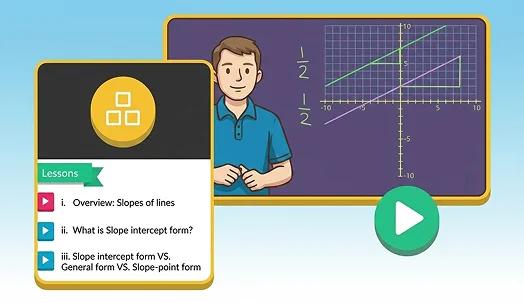
Every lesson matches Texas Algebra I standards exactly as taught in your child's classroom

STAAR Test Preparation
Practice problems and strategies specifically designed for Texas state assessments
Certified Math Teachers
Learn from experienced educators who understand Texas curriculum requirements
Step-by-Step Solutions
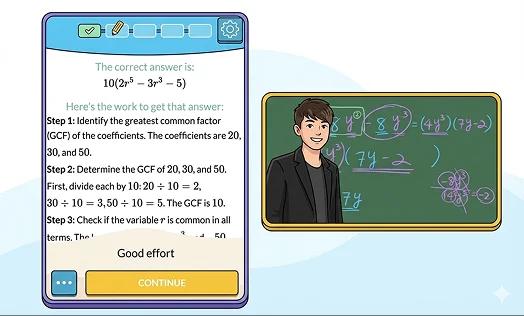
Every practice problem includes complete worked solutions your child can review anytime
Frequently Asked Questions
Everything your child needs to know about Algebra I with StudyPug
Is StudyPug aligned with the Texas Algebra I curriculum?
Yes. StudyPug is 100% aligned to Texas Essential Knowledge and Skills (TEKS) standards for Algebra I. Every lesson, video, and practice problem matches what your child learns in their Texas classroom, covering all required topics from linear functions to exponential growth.
What topics are covered in Algebra I?
Texas Algebra I covers linear functions and equations, systems of equations, quadratic functions, exponential functions, polynomials and factoring, radicals and exponents, sequences and series, and data analysis. StudyPug includes over 250 lessons across these topics with 650+ video lessons and 1,100+ practice problems.
How does StudyPug help my high school child learn math?
StudyPug provides on-demand video lessons taught by certified teachers, adaptive practice that adjusts to your child's level, and step-by-step solutions for every problem. Your child can search for help using a photo of their homework, work at their own pace, and review concepts as many times as needed until they master the material.
Can my child use StudyPug independently?
Absolutely. StudyPug is designed for independent learning. High school students can browse topics by curriculum, search for specific problems using photos, watch video explanations, and complete practice problems entirely on their own. You can monitor progress through the parent dashboard without needing to supervise every session.
Does StudyPug prepare students for the STAAR test?
Yes. StudyPug's Texas Algebra I content is specifically aligned to TEKS standards assessed on the STAAR End-of-Course exam. Practice problems mirror STAAR question formats, and comprehensive topic coverage ensures your child is fully prepared for all concepts tested on the state assessment.
How much does StudyPug cost?
StudyPug offers flexible subscription plans starting at just a few dollars per day for unlimited access to all Algebra I content plus our entire K-12 math library. Plans include all video lessons, practice problems, and progress tracking. Visit our pricing page or start a free trial to find the best plan for your family.
Smart Study Tools for Real Results
Personalized features that help your child stay motivated and make progress
Adaptive Practice
Questions adapt to your child's level
Stay Motivated
Badges and streaks keep your child practising daily
Quiz Mastery
Retake quizzes until your child truly gets it
Progress Reports
See exactly where your child needs help