Texas
Texas
Trusted by 45,000+ TX families
Why Choose StudyPug for Grade 7
Three ways your child gets help — even when you can't
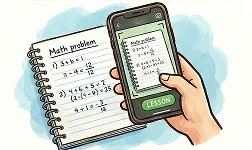
Search with Photo
Snap a photo of any problem and get the exact lesson
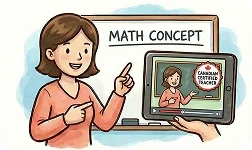
Expert Video Teaching
Certified teachers explain every concept with clear examples

Track Progress
See exactly what they've mastered and what needs more work
How StudyPug Works
1
Pick Their Grade
Choose Grade 7 and see every topic from your child's class
2
Get Unstuck
Upload homework problems or browse curriculum-aligned lessons.
3
Practice & Master
Work through similar problems until concepts stick.
4

See Results
Track progress and watch grades improve week by week.
Texas Grade 7 Math Help | StudyPugHelp
ID | Strand & Expectation | StudyPug Topic |
|---|---|---|
TX.7.2 | Extend previous knowledge of sets and subsets using a visual representation to describe relationships between sets of rational numbers |
TX.7.3.A | Add, subtract, multiply, and divide rational numbers fluently |
TX.7.3.B | Apply and extend previous understandings of operations to solve problems using addition, subtraction, multiplication, and division of rational numbers |
TX.7.4.A | Represent constant rates of change in mathematical and real-world problems given pictorial, tabular, verbal, numeric, graphical, and algebraic representations, including d = rt |
TX.7.4.C | Determine the constant of proportionality (k = y/x) within mathematical and real-world problems |
TX.7.4.D | Solve problems involving ratios, rates, and percents, including multi-step problems involving percent increase and percent decrease, and financial literacy problems |
TX.7.4.E | Convert between measurement systems, including the use of proportions and the use of unit rates |
TX.7.5.A | Generalize the critical attributes of similarity, including ratios within and between similar shapes |
TX.7.5.B | Describe π as the ratio of the circumference of a circle to its diameter |
TX.7.5.C | Solve mathematical and real-world problems involving similar shape and scale drawings |
TX.7.6.A | Represent sample spaces for simple and compound events using lists and tree diagrams |
TX.7.6.B | Select and use different simulations to represent simple and compound events with and without technology |
TX.7.6.C | Make predictions and determine solutions using experimental data for simple and compound events |
TX.7.6.E | Find the probabilities of a simple event and its complement and describe the relationship between the two |
TX.7.6.F | Use data from a random sample to make inferences about a population |
TX.7.6.G | Solve problems using data represented in bar graphs, dot plots, and circle graphs, including part-to-whole and part-to-part comparisons and equivalents |
TX.7.6.I | Determine experimental and theoretical probabilities related to simple and compound events using data and sample spaces |
TX.7.7 | Represent linear relationships using verbal descriptions, tables, graphs, and equations that simplify to the form y = mx + b |
TX.7.8.A | Model the relationship between the volume of a rectangular prism and a rectangular pyramid having both congruent bases and heights and connect that relationship to the formulas |
TX.7.8.C | Use models to determine the approximate formulas for the circumference and area of a circle and connect the models to the actual formulas |
TX.7.9.D | Solve problems involving the lateral and total surface area of a rectangular prism, rectangular pyramid, triangular prism, and triangular pyramid by determining the area of the shape's net |
TX.7.10.A | Write one-variable, two-step equations and inequalities to represent constraints or conditions within problems |
TX.7.10.B | Represent solutions for one-variable, two-step equations and inequalities on number lines |
TX.7.11.A | Model and solve one-variable, two-step equations and inequalities |
TX.7.11.C | Write and solve equations using geometry concepts, including the sum of the angles in a triangle, and angle relationships |
TX.7.12.A | Compare two groups of numeric data using comparative dot plots or box plots by comparing their shapes, centers, and spreads |
Complete Texas Grade 7 Math Coverage
LESSONS
84
VIDEOS
801
PRACTICE
421
TX ALIGNED
100%
Why Texas Families Choose StudyPug
Aligned to Texas TEKS standards and designed to prepare your Grade 7 student for STAAR success
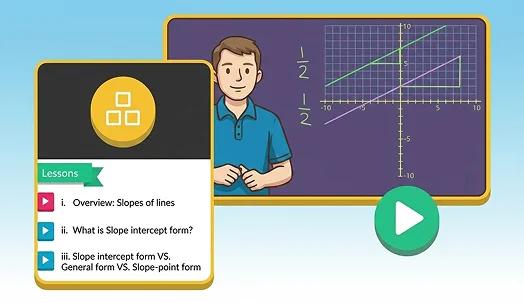
Texas TEKS Curriculum
Every lesson matches your child's Grade 7 Texas math standards
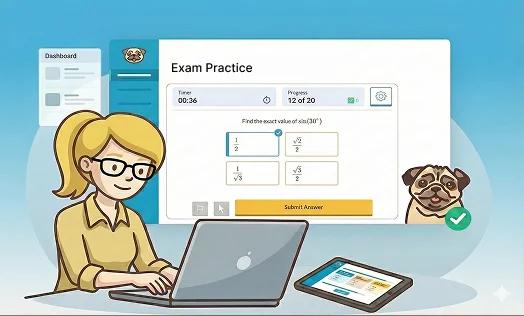
STAAR Test Prep
Practice questions designed to build confidence for state testing
Certified Math Teachers
Learn from experienced educators who know Texas curriculum
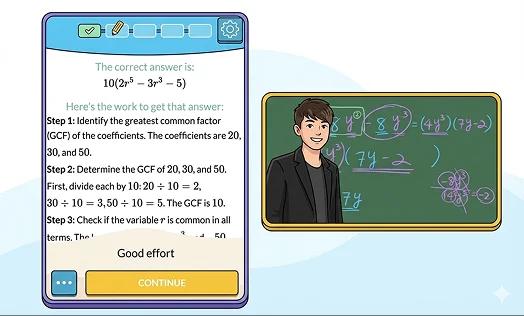
Complete Solutions
See every step explained clearly for homework and practice
Frequently Asked Questions
Everything your child needs to know about Grade 7 Math with StudyPug
Is StudyPug aligned with the Texas Grade 7 curriculum?
Yes, StudyPug is fully aligned to Texas TEKS standards for Grade 7 math. Every lesson, video, and practice problem covers the exact topics your child learns in their Texas classroom, including proportional relationships, integers, linear equations, probability, and geometry.
What topics are covered in Grade 7 Math?
Grade 7 math covers integers and operations, fractions and ratios, proportions and percents, linear relationships and graphing, two-step equations and inequalities, similar figures and scale, surface area and volume, probability and data analysis, and TEKS-aligned problem solving.
How does StudyPug help my Grade 7 child learn math?
Your child can watch video lessons taught by certified teachers, work through practice problems with step-by-step solutions, take quizzes that adapt to their level, and use photo search to get instant help with homework. You can track their progress and see exactly where they need support.
Can my child use StudyPug independently?
Absolutely. StudyPug is designed for Grade 7 students to use on their own. They can search for topics, watch lessons at their own pace, practice problems with instant feedback, and track their own progress. You'll receive reports showing what they're working on.
Does StudyPug prepare students for the STAAR test?
Yes, StudyPug includes STAAR-aligned practice questions and test preparation resources. The curriculum covers all Grade 7 TEKS standards tested on STAAR, and students can practice with similar question formats to build confidence before test day.
How much does StudyPug cost?
StudyPug offers flexible monthly and annual subscription plans that give your child access to all Grade 7 math content plus every other grade level. Plans start at $19.99/month. You can cancel anytime, and there's a money-back guarantee if you're not satisfied.
Smart Study Tools for Real Results
Personalized features that help your child stay motivated and make progress
Adaptive Practice
Questions adapt to your child's level
Stay Motivated
Badges and streaks keep your child practising daily
Quiz Mastery
Retake quizzes until your child truly gets it
Progress Reports
See exactly where your child needs help