Louisiana
Join 8,500+ Louisiana students mastering high school math with step-by-step video lessons
Why Discrete Mathematics Students Choose StudyPug
Three ways you get help — even when you’re stuck
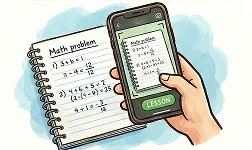
Search with Photo
Snap a photo of any problem and get the exact lesson
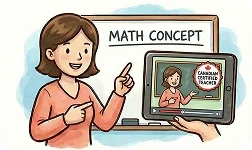
Expert Video Teaching
Certified teachers explain every concept with clear examples

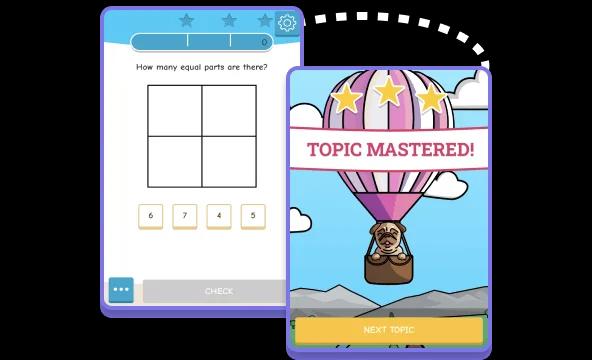
Unlimited Practice
Thousands of practice questions with step-by-step solutions
How StudyPug Works for You
1
Pick Your Course
Choose Discrete Mathematics and see every topic from your class
2
Get Unstuck
Upload homework problems or browse curriculum-aligned lessons on probability, matrices, and vectors.
3
Practice & Master
Work through similar problems until concepts stick.
4
See Results
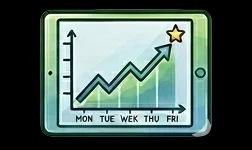
Track exactly what you've mastered.
Discrete Mathematics | Louisiana High School MathHelp
ID | Standard | StudyPug Topic |
|---|---|---|
CC.HSS.CP.B.9 | Use permutations and combinations to compute probabilities of compound events and solve problems. |
CC.HSS.CP.A.1 | Describe events as subsets of a sample space (the set of outcomes) using characteristics (or categories) of the outcomes, or as unions, intersections, or complements of other events ("or," "and," "not"). |
CC.HSS.CP.A.2 | Understand that two events A and B are independent if the probability of A and B occurring together is the product of their probabilities, and use this characterization to determine if they are independent. |
CC.HSS.CP.A.3 | Understand the conditional probability of A given B as P(A and B)/P(B), and interpret independence of A and B as saying that the conditional probability of A given B is the same as the probability of A, and the conditional probability of B given A is the same as the probability of B. |
CC.HSS.CP.A.5 | Recognize and explain the concepts of conditional probability and independence in everyday language and everyday situations. |
CC.HSS.MD.A.1 | Define a random variable for a quantity of interest by assigning a numerical value to each event in a sample space; graph the corresponding probability distribution using the same graphical displays as for data distributions. |
CC.HSS.MD.A.2 | Calculate the expected value of a random variable; interpret it as the mean of the probability distribution. |
CC.HSS.MD.A.3 | Develop a probability distribution for a random variable defined for a sample space in which theoretical probabilities can be calculated; find the expected value. |
CC.HSS.MD.B.7 | Analyze decisions and strategies using probability concepts (e.g., product testing, medical testing, pulling a hockey goalie at the end of a game). |
CC.HSF.IF.A.1 | Understand that a function from one set (called the domain) to another set (called the range) assigns to each element of the domain exactly one element of the range. If f is a function and x is an element of its domain, then f(x) denotes the output of f corresponding to the input x. The graph of f is the graph of the equation y = f(x). |
CC.HSF.IF.A.2 | Use function notation, evaluate functions for inputs in their domains, and interpret statements that use function notation in terms of a context. |
CC.HSF.IF.A.3 | Recognize that sequences are functions, sometimes defined recursively, whose domain is a subset of the integers. |
CC.HSF.IF.B.5 | Relate the domain of a function to its graph and, where applicable, to the quantitative relationship it describes. |
CC.HSF.BF.A.2 | Write arithmetic and geometric sequences both recursively and with an explicit formula, use them to model situations, and translate between the two forms. |
CC.HSF.BF.B.4 | Find inverse functions. |
CC.HSF.LE.A.2 | Construct linear and exponential functions, including arithmetic and geometric sequences, given a graph, a description of a relationship, or two input-output pairs (include reading these from a table). |
CC.HSA.SSE.B.4 | Derive the formula for the sum of a finite geometric series (when the common ratio is not 1), and use the formula to solve problems. |
CC.HSN.VM.C.6 | Use matrices to represent and manipulate data, e.g., to represent payoffs or incidence relationships in a network. |
CC.HSN.VM.C.9 | Understand that, unlike multiplication of numbers, matrix multiplication for square matrices is not a commutative operation, but still satisfies the associative and distributive properties. |
CC.HSN.VM.C.10 | Understand that the zero and identity matrices play a role in matrix addition and multiplication similar to the role of 0 and 1 in the real numbers. The determinant of a square matrix is nonzero if and only if the matrix has a multiplicative inverse. |
CC.HSN.VM.C.11 | Multiply a vector (regarded as a matrix with one column) by a matrix of suitable dimensions to produce another vector. Work with matrices as transformations of vectors. |
CC.HSA.REI.C.8 | Represent a system of linear equations as a single matrix equation in a vector variable. |
CC.HSA.REI.C.9 | Find the inverse of a matrix if it exists and use it to solve systems of linear equations (using technology for matrices of dimension 3 × 3 or greater). |
CC.HSS.ID.A.2 | Use statistics appropriate to the shape of the data distribution to compare center (median, mean) and spread (interquartile range, standard deviation) of two or more different data sets. |
CC.HSS.ID.A.3 | Interpret differences in shape, center, and spread in the context of the data sets, accounting for possible effects of extreme data points (outliers). |
CC.HSS.IC.A.1 | Understand statistics as a process for making inferences about population parameters based on a random sample from that population. |
CC.HSS.IC.B.3 | Recognize the purposes of and differences among sample surveys, experiments, and observational studies; explain how randomization relates to each. |
CC.HSS.IC.B.4 | Use data from a sample survey to estimate a population mean or proportion; develop a margin of error through the use of simulation models for random sampling. |
CC.HSN.VM.A.1 | Recognize vector quantities as having both magnitude and direction. Represent vector quantities by directed line segments, and use appropriate symbols for vectors and their magnitudes. |
CC.HSN.VM.A.2 | Find the components of a vector by subtracting the coordinates of an initial point from the coordinates of a terminal point. |
CC.HSN.VM.B.4 | Add and subtract vectors. |
CC.HSN.VM.B.5 | Multiply a vector by a scalar. |
Complete Discrete Mathematics Coverage
Topics
83
Video Lessons
707
Practice Questions
805
Hours of Content
38+
Why Louisiana Discrete Mathematics Students Love StudyPug
Built specifically for Louisiana high school success
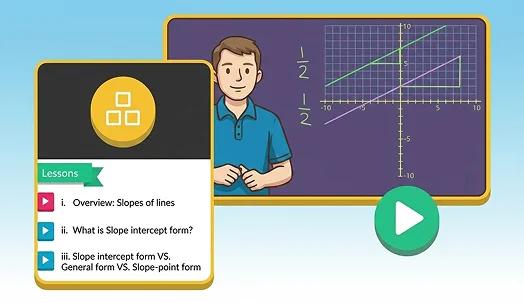
Louisiana Standards Aligned
Every lesson matches Louisiana Discrete Mathematics standards—what you learn in class, we teach
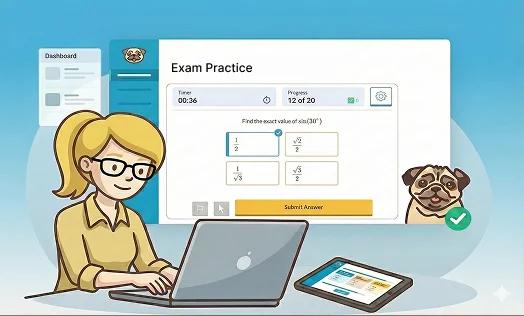
ACT Math Prep
Practice with probability and algebra questions—be ready for exam day
Certified Teachers
Learn from expert Louisiana teachers who know exactly what you need for Discrete Mathematics
Learn Anywhere
Desktop, tablet, or phone—your Discrete Mathematics lessons sync across all devices
Discrete Mathematics Questions?
Everything you need to know about mastering Discrete Mathematics with StudyPug
What does Discrete Mathematics coverage include?
Our Discrete Mathematics course covers 84 topics across probability and statistics, combinatorics (permutations and combinations), set theory, matrices and vectors, sequences and series, conditional probability, binomial distributions, confidence intervals, and statistical analysis. Every topic aligns with Louisiana standards and includes video lessons, practice questions, and step-by-step solutions to help you master advanced mathematical concepts.
How does photo search work for Discrete Math problems?
Snap a photo of any Discrete Mathematics problem from your homework or textbook. Our AI instantly identifies the topic—whether it's a permutation puzzle, matrix operation, or probability question—and shows you the exact video lesson and practice problems you need. Perfect for getting unstuck quickly when working through complex combinatorics or statistical analysis problems at home.
How many practice problems are available for Discrete Mathematics?
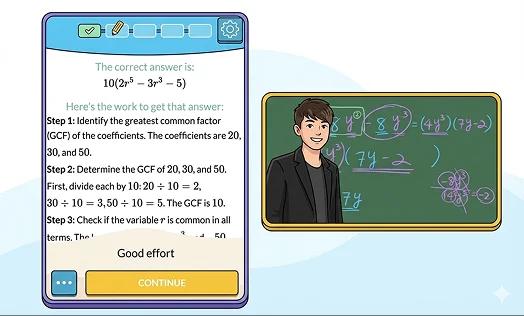
You get access to 909 practice questions covering every Discrete Mathematics topic, from basic probability to advanced matrix operations. Each question includes full step-by-step solutions so you can learn from mistakes. Practice as much as you want—questions adapt to your level and help you build confidence for quizzes, tests, and standardized exams like the ACT.
What if I'm falling behind in Discrete Mathematics?
Start with our diagnostic assessment to pinpoint exactly where you need help. Then work through video lessons at your own pace—rewatch as many times as needed until concepts click. Focus on foundational topics like set theory and probability before moving to advanced content like binomial distributions or matrix inverses. You can catch up without falling further behind in class.
Does StudyPug help with Discrete Mathematics exams?
Yes! Our practice questions mirror the format and difficulty of real Discrete Mathematics tests. You'll work through problems on permutations, conditional probability, matrices, vectors, and statistical analysis—all the topics tested on unit exams and standardized tests. Retake quizzes until you master each concept, and track your progress to focus study time where it matters most before exam day.
How much does StudyPug cost?
StudyPug offers flexible monthly and annual plans starting at just a few dollars per day—far less than traditional tutoring. You get unlimited access to 707 video lessons, 909 practice questions, photo search, and progress tracking for Discrete Mathematics and hundreds of other math courses. Try it risk-free with our money-back guarantee. Cancel anytime if it's not right for you.
Smart Study Tools for Real Results
Personalized features that help you stay motivated and make progress
Adaptive Practice
Questions adapt to your level
Stay Motivated
Badges and streaks keep you practising daily
Quiz Mastery
Retake quizzes until you truly get it
Progress Tracking
See exactly where you need more practice