Ontario

Trusted by 35,000+ ON families
Why Choose StudyPug for Grade 8
Three ways your child gets help — even when you can't
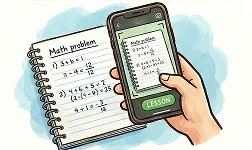
Search with Photo
Snap a photo of any problem and get the exact lesson
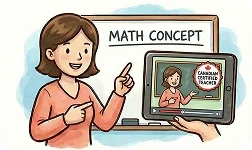
Expert Video Teaching
Certified teachers explain every concept with clear examples

Track Progress
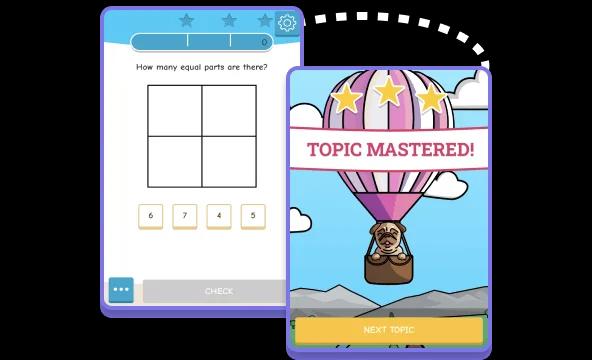
See exactly what they've mastered and what needs more work
How StudyPug Works
1
Pick Their Grade
Choose Grade 8 and see every topic from your child's class
2

Get Unstuck
Upload homework problems or browse curriculum-aligned lessons.
3
Practice & Master
Work through similar problems until concepts stick.
4

See Results
Track progress and watch grades improve week by week.
Ontario Grade 8 Math Help | StudyPugHelp
OE_ID | Expectations | StudyPug Topic |
|---|---|---|
ON.OE.8.B.1.1 | B1.1 Rational and Irrational Numbers: represent and compare very large and very small numbers, including through the use of scientific notation, and describe various ways they are used in everyday life |
ON.OE.8.B.1.2 | B1.2 Rational and Irrational Numbers: describe, compare, and order numbers in the real number system (rational and irrational numbers), separately and in combination, in various contexts |
ON.OE.8.B.1.3 | B1.3 Rational and Irrational Numbers: estimate and calculate square roots, in various contexts |
ON.OE.8.B.1.4 | B1.4 Fractions, Decimals, and Percents: use fractions, decimal numbers, and percents, including percents of more than 100% or less than 1%, interchangeably and flexibly to solve a variety of problems |
ON.OE.8.B.1.5 | B1.5 Fractions, Decimals, and Percents: generate equivalent fractions to simplify computations |
ON.OE.8.B.1.6 | B1.6 Fractions, Decimals, and Percents: represent and compare positive and negative fractions and decimal numbers to thousandths |
ON.OE.8.B.2.1 | B2.1 Properties and Relationships: use the properties and order of operations, and the relationships between operations, to solve problems involving rational numbers, ratios, rates, and percents, including those requiring multiple steps or multiple operations |
ON.OE.8.B.2.2 | B2.2 Math Facts: understand and recall commonly used square numbers and their square roots |
ON.OE.8.B.2.3 | B2.3 Mental Math: use mental math strategies to multiply and divide whole numbers and decimal numbers up to thousandths by powers of ten, and explain the strategies used |
ON.OE.8.B.2.4 | B2.4 Addition and Subtraction: add and subtract integers, using appropriate strategies, in various contexts |
ON.OE.8.B.2.5 | B2.5 Addition and Subtraction: add and subtract fractions, using appropriate strategies, in various contexts |
ON.OE.8.B.2.7 | B2.7 Multiplication and Division: multiply and divide integers, using appropriate strategies, in various contexts |
ON.OE.8.B.2.8 | B2.8 Multiplication and Division: compare proportional situations and determine unknown values in proportional situations, and apply proportional reasoning to solve problems in various contexts |
ON.OE.8.C.1.1 | C1.1 Patterns: identify and compare a variety of repeating, growing, and shrinking patterns, including patterns found in real-life contexts, and compare linear growing and shrinking patterns on the basis of their constant rates and initial values |
ON.OE.8.C.1.2 | C1.2 Patterns: create and translate repeating, growing, and shrinking patterns involving rational numbers using various representations, including algebraic expressions and equations for linear growing and shrinking patterns |
ON.OE.8.C.1.3 | C1.3 Patterns: determine pattern rules and use them to extend patterns, make and justify predictions, and identify missing elements in growing and shrinking patterns involving rational numbers, and use algebraic representations of the pattern rules to solve for unknown values in linear growing and shrinking patterns |
ON.OE.8.C.1.4 | C1.4 Patterns: create and describe patterns to illustrate relationships among rational numbers |
ON.OE.8.C.2.1 | C2.1 Variables and Expressions: add and subtract monomials with a degree of 1, and add binomials with a degree of 1 that involve integers, using tools |
ON.OE.8.C.2.2 | C2.2 Variables and Expressions: evaluate algebraic expressions that involve rational numbers |
ON.OE.8.C.2.3 | C2.3 Equalities and Inequalities: solve equations that involve multiple terms, integers, and decimal numbers in various contexts, and verify solutions |
ON.OE.8.C.2.4 | C2.4 Equalities and Inequalities: solve inequalities that involve integers, and verify and graph the solutions |
ON.OE.8.D.1.1 | D1.1 Data Collection and Organization: identify situations involving one-variable data and situations involving two-variable data, and explain when each type of data is needed |
ON.OE.8.D.1.2 | D1.2 Data Collection and Organization: collect continuous data to answer questions of interest involving two variables, and organize the data sets as appropriate in a table of values |
ON.OE.8.D.1.3 | D1.3 Data Visualization: select from among a variety of graphs, including scatter plots, the type of graph best suited to represent various sets of data; display the data in the graphs with proper sources, titles, and labels, and appropriate scales; and justify their choice of graphs |
ON.OE.8.D.1.4 | D1.4 Data Visualization: create an infographic about a data set, representing the data in appropriate ways, including in tables and scatter plots, and incorporating any other relevant information that helps to tell a story about the data |
ON.OE.8.D.1.5 | D1.5 Data Analysis: use mathematical language, including the terms "strong", "weak", "none", "positive", and "negative", to describe the relationship between two variables for various data sets with and without outliers |
ON.OE.8.D.1.6 | D1.6 Data Analysis: analyse different sets of data presented in various ways, including in scatter plots and in misleading graphs, by asking and answering questions about the data, challenging preconceived notions, and drawing conclusions, then make convincing arguments and informed decisions |
ON.OE.8.D.2.1 | D2.1 Probability: solve various problems that involve probability, using appropriate tools and strategies, including Venn and tree diagrams |
ON.OE.8.D.2.2 | D2.2 Probability: determine and compare the theoretical and experimental probabilities of multiple independent events happening and of multiple dependent events happening |
ON.OE.8.E.1.1 | E1.1 Geometric Reasoning: identify geometric properties of tessellating shapes and identify the transformations that occur in the tessellations |
ON.OE.8.E.1.2 | E1.2 Geometric Reasoning: make objects and models using appropriate scales, given their top, front, and side views or their perspective views |
ON.OE.8.E.1.3 | E1.3 Geometric Reasoning: use scale drawings to calculate actual lengths and areas, and reproduce scale drawings at different ratios |
ON.OE.8.E.1.4 | E1.4 Location and Movement: describe and perform translations, reflections, rotations, and dilations on a Cartesian plane, and predict the results of these transformations |
ON.OE.8.E.2.1 | E2.1 The Metric System: represent very large (mega, giga, tera) and very small (micro, nano, pico) metric units using models, base ten relationships, and exponential notation |
ON.OE.8.E.2.2 | E2.2 Angles: solve problems involving angle properties, including the properties of intersecting and parallel lines and of polygons |
ON.OE.8.E.2.3 | E2.3 Length, Area, and Volume: solve problems involving the perimeter, circumference, area, volume, and surface area of composite two-dimensional shapes and three-dimensional objects, using appropriate formulas |
Complete Ontario Grade 8 Math Coverage
LESSONS
144
VIDEOS
1314
PRACTICE
841
ON ALIGNED
100%
Why Ontario Families Choose StudyPug for Grade 8
Complete alignment with the Ontario Grade 8 math curriculum and direct EQAO preparation
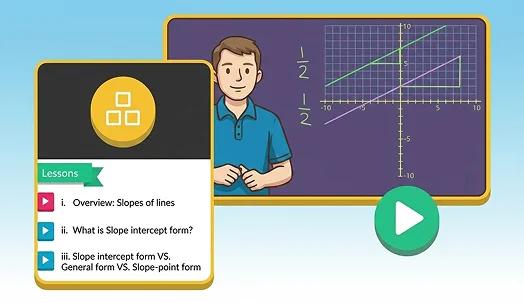
Ontario Curriculum Aligned
Every lesson matches the Ontario Grade 8 math curriculum expectations, organized by strand and specific expectation codes

EQAO Test Preparation
Practice questions and strategies specifically designed to prepare your child for the Grade 9 EQAO assessment
Ontario Certified Teachers
Video lessons taught by teachers who understand Ontario expectations and classroom methods
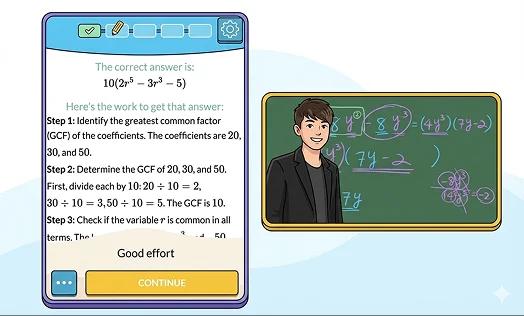
Step-by-Step Solutions
See the complete solution process for every practice problem, showing the exact steps taught in Ontario classrooms
Frequently Asked Questions
Everything your child needs to know about Grade 8 Math with StudyPug
Is StudyPug aligned with the Ontario Grade 8 curriculum?
Yes. Every lesson is directly aligned to the Ontario Grade 8 math curriculum expectations, organized by strand (Number, Algebra, Data, Geometry, Financial Literacy) and specific expectation codes. Your child will find every topic they're learning in class.
What topics are covered in Grade 8 Math?
Grade 8 covers rational and irrational numbers, exponents, integers, polynomials, linear equations and inequalities, linear functions and graphing, Pythagorean theorem, surface area and volume of 3D shapes, probability, data analysis, and financial literacy concepts.
How does StudyPug help my Grade 8 child learn math?
Your child gets 1,300+ video lessons taught by certified teachers, 3,500+ practice problems with step-by-step solutions, and instant photo search for homework help. The adaptive practice system identifies weak areas and focuses learning where it's needed most.
Can my child use StudyPug independently?
Absolutely. Grade 8 students use StudyPug independently for homework help, test prep, and review. The photo search feature lets them find lessons instantly, and the step-by-step solutions teach them how to solve problems on their own.
Does StudyPug prepare students for the EQAO assessment?
Yes. StudyPug includes comprehensive EQAO preparation with practice questions covering all assessment strands, question types that mirror the test format, and strategies for approaching multiple-choice and constructed-response questions.
How much does StudyPug cost?
StudyPug offers flexible monthly and annual plans starting at $19.99/month. One subscription gives your child access to every grade and subject, making it perfect for Grade 8 math and any other courses they need help with.
Smart Study Tools for Real Results
Personalized features that help your child stay motivated and make progress
Adaptive Practice
Questions adapt to your child's level
Stay Motivated
Badges and streaks keep your child practising daily
Quiz Mastery
Retake quizzes until your child truly gets it
Progress Reports
See exactly where your child needs help