Ontario

Trusted by 35,000+ ON families
Why Choose StudyPug for Grade 5
Three ways your child gets help — even when you can't
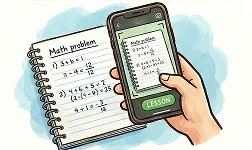
Search with Photo
Snap a photo of any problem and get the exact lesson
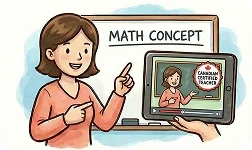
Expert Video Teaching
Certified teachers explain every concept with clear examples

Track Progress
See exactly what they've mastered and what needs more work
How StudyPug Works
1
Pick Their Grade
Choose Grade 5 and see every topic from your child's class
2
Get Unstuck
Upload homework problems or browse curriculum-aligned lessons.
3
Practice & Master
Work through similar problems until concepts stick.
4
See Results
Track progress and watch grades improve week by week.
Ontario Grade 5 Math Help | StudyPugHelp
OE_ID | Expectations | StudyPug Topic |
|---|---|---|
ON.OE.5.B.1.1 | B1.1 Whole Numbers: read, represent, compose, and decompose whole numbers up to and including 100 000, using appropriate tools and strategies, and describe various ways they are used in everyday life |
ON.OE.5.B.1.3 | B1.3 Whole Numbers: round whole numbers to the nearest ten, hundred, or thousand, in various contexts |
ON.OE.5.B.1.4 | B1.4 Fractions, Decimals, and Percents: represent equivalent fractions from halves to twelfths, including improper fractions and mixed numbers, using appropriate tools, in various contexts |
ON.OE.5.B.1.5 | B1.5 Fractions, Decimals, and Percents: compare and order fractions from halves to twelfths, including improper fractions and mixed numbers, in various contexts |
ON.OE.5.B.1.6 | B1.6 Fractions, Decimals, and Percents: read, represent, compare, and order decimal numbers up to hundredths, in various contexts |
ON.OE.5.B.1.8 | B1.8 Fractions, Decimals, and Percents: describe relationships and show equivalences among fractions and decimal numbers up to hundredths, using appropriate tools and drawings, in various contexts |
ON.OE.5.B.2.1 | B2.1 Properties and Relationships: use the properties of operations, and the relationships between operations, to solve problems involving whole numbers and decimal numbers, including those requiring more than one operation |
ON.OE.5.B.2.3 | B2.3 Mental Math: use mental math strategies to multiply whole numbers by 0.1 and 0.01 and estimate sums and differences of decimal numbers up to hundredths, and explain the strategies used |
ON.OE.5.B.2.4 | B2.4 Addition and Subtraction: represent and solve problems involving the addition and subtraction of whole numbers that add up to no more than 100 000 and of decimal numbers up to hundredths, using appropriate tools, strategies, and algorithms |
ON.OE.5.B.2.5 | B2.5 Addition and Subtraction: add and subtract fractions with like denominators, including by creating equivalent fractions, in various contexts |
ON.OE.5.B.2.6 | B2.6 Multiplication and Division: represent and solve problems involving the multiplication of two-digit whole numbers by two-digit whole numbers using the area model and using algorithms, and make connections between the two methods |
ON.OE.5.B.2.7 | B2.7 Multiplication and Division: represent and solve problems involving the division of three-digit whole numbers by two-digit whole numbers using the area model and using algorithms, and make connections between the two methods, while expressing any remainder appropriately |
ON.OE.5.B.2.8 | B2.8 Multiplication and Division: multiply whole numbers by proper fractions, using appropriate tools and strategies |
ON.OE.5.B.2.9 | B2.9 Multiplication and Division: divide whole numbers by proper fractions, using appropriate tools and strategies |
ON.OE.5.B.2.10 | B2.10 Multiplication and Division: represent and solve problems involving the division of decimal numbers up to hundredths by whole numbers up to 10, using appropriate tools and strategies |
ON.OE.5.B.2.11 | B2.11 Multiplication and Division: represent and solve problems involving the multiplication of decimal tenths by whole numbers, using appropriate tools and strategies |
ON.OE.5.C.1.1 | C1.1 Patterns: identify and describe repeating, growing, and shrinking patterns, including patterns found in real-life contexts |
ON.OE.5.C.1.2 | C1.2 Patterns: create and translate growing and shrinking patterns using various representations, including tables of values and graphs |
ON.OE.5.C.1.3 | C1.3 Patterns: determine pattern rules and use them to extend patterns, make and justify predictions, and identify missing elements in growing and shrinking patterns |
ON.OE.5.C.2.1 | C2.1 Variables and Expressions: translate among words, algebraic expressions, and visual representations that describe equivalent relationships |
ON.OE.5.C.2.2 | C2.2 Variables and Expressions: evaluate algebraic expressions that involve whole numbers and decimal tenths |
ON.OE.5.C.2.3 | C2.3 Equalities and Inequalities: solve equations that involve multiple terms and whole numbers in various contexts, and verify solutions |
ON.OE.5.D.1.3 | D1.3 Data Visualization: select from among a variety of graphs, including stacked-bar graphs, the type of graph best suited to represent various sets of data; display the data in the graphs with proper sources, titles, and labels, and appropriate scales; and justify their choice of graphs |
ON.OE.5.D.1.5 | D1.5 Data Analysis: determine the mean and the median and identify the mode(s), if any, for various data sets involving whole numbers and decimal numbers, and explain what each of these measures indicates about the data |
ON.OE.5.E.1.1 | E1.1 Geometric Reasoning: identify geometric properties of triangles, and construct different types of triangles when given side or angle measurements |
ON.OE.5.E.1.2 | E1.2 Geometric Reasoning: identify and construct congruent triangles, rectangles, and parallelograms |
ON.OE.5.E.1.3 | E1.3 Geometric Reasoning: draw top, front, and side views of objects, and match drawings with objects |
ON.OE.5.E.1.4 | E1.4 Location and Movement: plot and read coordinates in the first quadrant of a Cartesian plane using various scales, and describe the translations that move a point from one coordinate to another |
ON.OE.5.E.1.5 | E1.5 Location and Movement: describe and perform translations, reflections, and rotations up to 180° on a grid, and predict the results of these transformations |
ON.OE.5.E.2.1 | E2.1 The Metric System: use appropriate metric units to estimate and measure length, area, mass, and capacity |
ON.OE.5.E.2.2 | E2.2 The Metric System: solve problems that involve converting larger metric units into smaller ones, and describe the base ten relationships among metric units |
ON.OE.5.E.2.5 | E2.5 Area: use the area relationships among rectangles, parallelograms, and triangles to develop the formulas for the area of a parallelogram and the area of a triangle, and solve related problems |
ON.OE.5.E.2.6 | E2.6 Area: show that two-dimensional shapes with the same area can have different perimeters, and solve related problems |
ON.OE.5.F.1.2 | F1.2 Financial Management: calculate unit rates for various goods and services, and identify which rates offer the best value |
Complete Ontario Grade 5 Math Coverage
LESSONS
64
VIDEOS
1060
PRACTICE
579
ON ALIGNED
100%
Why Ontario Families Choose StudyPug
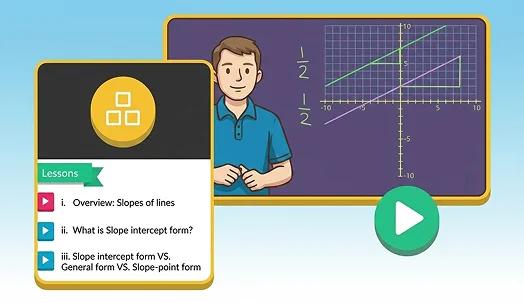
Complete alignment with the Ontario Grade 5 curriculum and EQAO preparation built into every lesson
Ontario Curriculum Aligned
Every lesson matches the ON Grade 5 curriculum expectations for Number Sense, Operations, Algebra, Data Literacy, and Geometry

EQAO Test Preparation
Practice questions and lessons designed to build confidence for provincial assessments
Ontario-Certified Teachers
Video lessons taught by experienced educators who understand the ON math framework
Step-by-Step Solutions
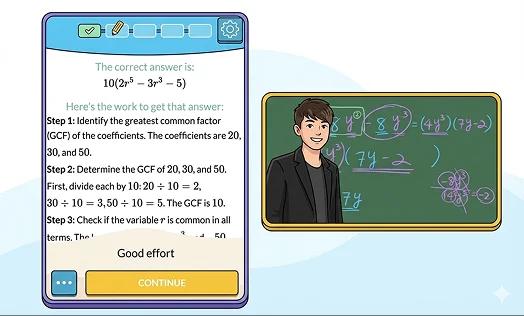
See the complete solution process for every practice problem, just like their teacher would show
Frequently Asked Questions
Everything your child needs to know about Grade 5 Math with StudyPug
Is StudyPug aligned with the Ontario Grade 5 curriculum?
Yes, StudyPug is 100% aligned with the Ontario Grade 5 math curriculum. Every lesson covers the specific expectations outlined by the Ministry of Education, including Number Sense, Operations, Algebra, Data Literacy, Geometry, and Measurement.
What topics are covered in Grade 5 Math?
Grade 5 covers whole numbers and place value, fractions and decimals, multi-digit operations, patterns and algebra, variables and equations, data analysis and probability, geometry (triangles, quadrilaterals, 3D shapes), measurement (metric system, area, perimeter), and money concepts.
How does StudyPug help my Grade 5 child learn math?
StudyPug provides video lessons taught by certified teachers, interactive practice questions that adapt to your child's level, step-by-step solutions for every problem, and progress tracking so you can see exactly where they need help. They can snap photos of homework for instant help.
Can my child use StudyPug independently?
Yes, most Grade 5 students can use StudyPug independently. The video lessons are clear and easy to follow, and the practice questions provide immediate feedback. Your child can upload homework photos and find the exact lesson they need without your assistance.
Does StudyPug prepare students for EQAO assessments?
Yes, StudyPug includes practice questions and lessons specifically designed to build the skills and confidence needed for EQAO testing. The curriculum alignment ensures your child masters all the concepts assessed on provincial tests.
How much does StudyPug cost?
StudyPug offers flexible monthly and annual subscription plans that give your child unlimited access to all Grade 5 content plus every other grade level. Visit our pricing page or start your account to see current rates and choose the plan that works best for your family.
Smart Study Tools for Real Results
Personalized features that help your child stay motivated and make progress
Adaptive Practice
Questions adapt to your child's level
Stay Motivated
Badges and streaks keep your child practising daily
Quiz Mastery
Retake quizzes until your child truly gets it
Progress Reports
See exactly where your child needs help