Ontario

Trusted by 35,000+ ON families
Why Choose StudyPug for Grade 3
Three ways your child gets help — even when you can't
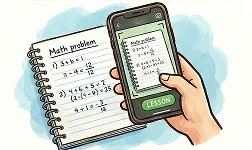
Search with Photo
Snap a photo of any problem and get the exact lesson
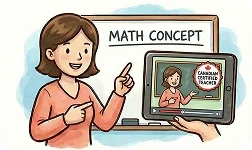
Expert Video Teaching
Certified teachers explain every concept with clear examples

Track Progress
See exactly what they've mastered and what needs more work
How StudyPug Works
1
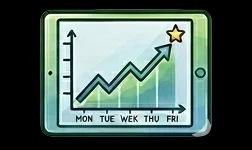
Pick Their Grade
Choose Grade 3 and see every topic from your child's class
2
Get Unstuck
Upload homework problems or browse curriculum-aligned lessons.
3
Practice & Master
Work through similar problems until concepts stick.
4
See Results
Track progress and watch grades improve week by week.
Ontario Grade 3 Math Help | StudyPugHelp
OE_ID | Expectations | StudyPug Topic |
|---|---|---|
ON.OE.3.B.1.1 | B1.1 Whole Numbers: read, represent, compose, and decompose whole numbers up to and including 1000, using a variety of tools and strategies, and describe various ways they are used in everyday life |
ON.OE.3.B.1.2 | B1.2 Whole Numbers: compare and order whole numbers up to and including 1000, in various contexts |
ON.OE.3.B.1.3 | B1.3 Whole Numbers: round whole numbers to the nearest ten or hundred, in various contexts |
ON.OE.3.B.1.5 | B1.5 Whole Numbers: use place value when describing and representing multi-digit numbers in a variety of ways, including with base ten materials |
ON.OE.3.B.1.7 | B1.7 Fractions: represent and solve fair-share problems that focus on determining and using equivalent fractions, including problems that involve halves, fourths, and eighths; thirds and sixths; and fifths and tenths |
ON.OE.3.B.2.1 | B2.1 Properties and Relationships: use the properties of operations, and the relationships between multiplication and division, to solve problems and check calculations |
ON.OE.3.B.2.2 | B2.2 Math Facts: recall and demonstrate multiplication facts of 2, 5, and 10, and related division facts |
ON.OE.3.B.2.3 | B2.3 Mental Math: use mental math strategies, including estimation, to add and subtract whole numbers that add up to no more than 1000, and explain the strategies used |
ON.OE.3.B.2.4 | B2.4 Addition and Subtraction: demonstrate an understanding of algorithms for adding and subtracting whole numbers by making connections to and describing the way other tools and strategies are used to add and subtract |
ON.OE.3.B.2.5 | B2.5 Addition and Subtraction: represent and solve problems involving the addition and subtraction of whole numbers that add up to no more than 1000, using various tools and algorithms |
ON.OE.3.B.2.6 | B2.6 Multiplication and Division: represent multiplication of numbers up to 10 × 10 and division up to 100 ÷ 10, using a variety of tools and drawings, including arrays |
ON.OE.3.B.2.7 | B2.7 Multiplication and Division: represent and solve problems involving multiplication and division, including problems that involve groups of one half, one fourth, and one third, using tools and drawings |
ON.OE.3.B.2.8 | B2.8 Multiplication and Division: represent the connection between the numerator of a fraction and the repeated addition of the unit fraction with the same denominator using various tools and drawings, and standard fractional notation |
ON.OE.3.B.2.9 | B2.9 Multiplication and Division: use the ratios of 1 to 2, 1 to 5, and 1 to 10 to scale up numbers and to solve problems |
ON.OE.3.C.2.1 | C2.1 Variables: describe how variables are used, and use them in various contexts as appropriate |
ON.OE.3.C.2.2 | C2.2 Equalities and Inequalities: determine whether given sets of addition, subtraction, multiplication, and division expressions are equivalent or not |
ON.OE.3.C.2.3 | C2.3 Equalities and Inequalities: identify and use equivalent relationships for whole numbers up to 1000, in various contexts |
ON.OE.3.D.1.1 | D1.1 Data Collection and Organization: sort sets of data about people or things according to two and three attributes, using tables and logic diagrams, including Venn, Carroll, and tree diagrams, as appropriate |
ON.OE.3.D.1.4 | D1.4 Data Analysis: determine the mean and identify the mode(s), if any, for various data sets involving whole numbers, and explain what each of these measures indicates about the data |
ON.OE.3.E.2.7 | E2.7 Area: compare the areas of two-dimensional shapes by matching, covering, or decomposing and recomposing the shapes, and demonstrate that different shapes can have the same area |
ON.OE.3.E.2.8 | E2.8 Area: use appropriate non-standard units to measure area, and explain the effect that gaps and overlaps have on accuracy |
ON.OE.3.E.2.9 | E2.9 Area: use square centimetres (cm2) and square metres (m2) to estimate, measure, and compare the areas of various two-dimensional shapes, including those with curved sides |
ON.OE.3.F.1.1 | F1.1 Money Concepts: estimate and calculate the change required for various simple cash transactions involving whole-dollar amounts and amounts of less than one dollar |
Complete Ontario Grade 3 Math Coverage
LESSONS
52
VIDEOS
195
PRACTICE
191
ON ALIGNED
100%
Why Ontario Families Choose StudyPug
Fully aligned to the Ontario Grade 3 curriculum and EQAO math expectations
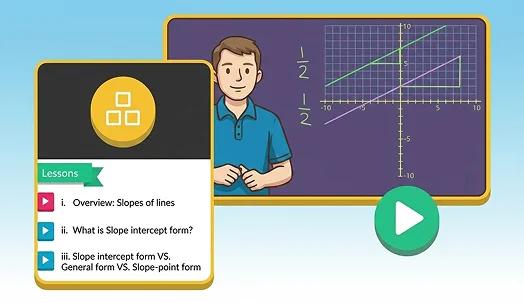
Ontario Curriculum Aligned
Every lesson matches the Ontario Grade 3 expectations for number sense, operations, patterns, and geometry
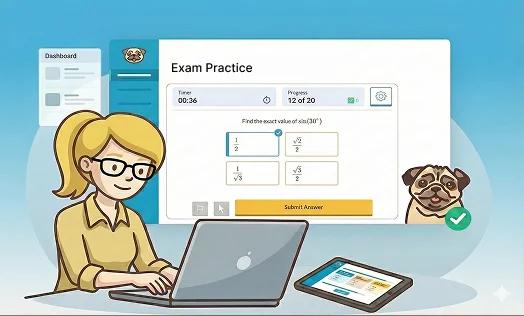
EQAO Math Preparation
Build the foundational skills your child needs for future EQAO assessments
Ontario Certified Teachers
Learn from educators who understand Ontario math expectations inside and out
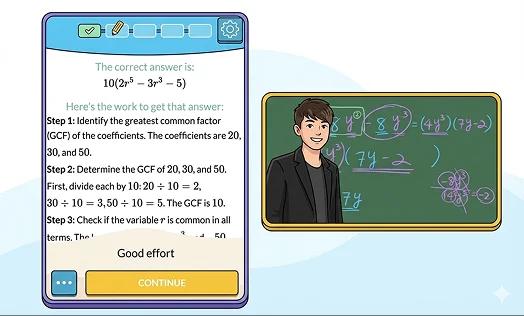
Step-by-Step Solutions
See the complete solution process for every practice problem your child works on
Frequently Asked Questions
Everything you need to know about Grade 3 math with StudyPug
Is StudyPug aligned with the Ontario Grade 3 curriculum?
Yes. Every lesson is fully aligned to the Ontario Grade 3 mathematics curriculum expectations, covering number sense, operations, patterns, algebra, data management, probability, geometry, measurement, and money concepts exactly as outlined by the Ministry of Education.
What topics are covered in Grade 3 math?
Grade 3 covers place value to 1000, addition and subtraction with regrouping, multiplication and division facts, fractions, patterns and relationships, basic equations, data collection and graphing, probability, 2D and 3D shapes, measurement (length, weight, capacity, time, area), and Canadian money.
How does StudyPug help my Grade 3 child learn math?
Your child watches short video lessons taught by certified teachers, then practices with adaptive questions that adjust to their skill level. They can snap photos of homework problems to find the exact lesson they need, and you can track their progress to see where they're improving and where they need more help.
Can my child use StudyPug independently?
Yes. Grade 3 students can browse topics, watch videos, and complete practice on their own. The interface is designed for young learners with simple navigation, visual aids, and clear instructions. You can check their progress anytime to see what they've been working on.
Does StudyPug prepare students for EQAO assessments?
Absolutely. StudyPug builds the foundational math skills that Ontario students need for future EQAO assessments. Grade 3 is critical for developing number sense, problem-solving, and mathematical reasoning that will be tested in Grade 3 EQAO and beyond.
How much does StudyPug cost?
StudyPug offers flexible subscription plans to fit your family's needs. You get unlimited access to all Grade 3 lessons, practice questions, and progress tracking. Visit our pricing page or start your account to see current plan options and get started today.
Smart Study Tools for Real Results
Personalized features that help your child stay motivated and make progress
Adaptive Practice
Questions adapt to your child's level
Stay Motivated
Badges and streaks keep your child practising daily
Quiz Mastery
Retake quizzes until your child truly gets it
Progress Reports
See exactly where your child needs help