Ontario

Join 8,500+ Ontario students mastering MDM4U
Why Data Management Students Choose StudyPug
Three ways you get help — even when you’re stuck
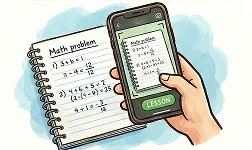
Search with Photo
Snap a photo of any problem and get the exact lesson
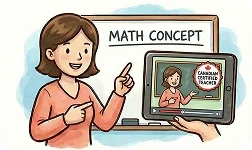
Expert Video Teaching
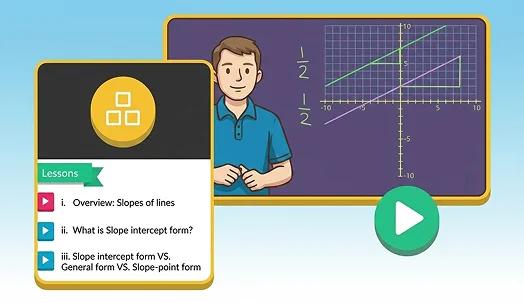
Certified teachers explain every concept with clear examples

Unlimited Practice
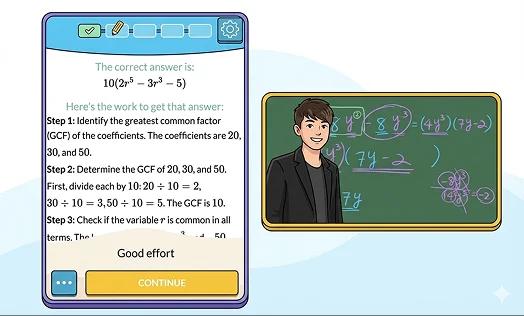
Thousands of practice questions with step-by-step solutions
How StudyPug Works for You
1
Pick Your Course
Choose Grade 12 Data Management and see every topic from your class
2

Get Unstuck
Upload homework problems or browse curriculum-aligned lessons.
3

Practice & Master
Work through similar problems until concepts stick.
4

See Results
Track exactly what you've mastered.
Find the right Ontario Grade 12 course
Ontario Grade 12 Data Management (MDM4U) | StudyPugHelp
OE_ID | Expectations | StudyPug Topic |
|---|---|---|
ON.OE.12DM.A1.2 | 12DM.A1.2: Describe a sample space as a set that contains all possible outcomes of an experiment, and distinguish between a discrete sample space and a continuous sample space |
ON.OE.12DM.A1.3 | 12DM.A1.3: Determine the theoretical probability of each outcome of a discrete sample space, recognize that the sum of the probabilities of the outcomes is 1, recognize that the probabilities form the probability distribution associated with the sample space, and solve related problems |
ON.OE.12DM.A1.4 | 12DM.A1.4: Determine, through investigation using class-generated data and technology-based simulation models, the tendency of experimental probability to approach theoretical probability as the number of trials in an experiment increases |
ON.OE.12DM.A1.5 | 12DM.A1.5: Recognize and describe an event as a set of outcomes and as a subset of a sample space, determine the complement of an event, determine whether two or more events are mutually exclusive or non-mutually exclusive, and solve related probability problems |
ON.OE.12DM.A1.6 | 12DM.A1.6: Determine whether two events are independent or dependent and whether one event is conditional on another event, and solve related probability problems |
ON.OE.12DM.A2.1 | 12DM.A2.1: Recognize the use of permutations and combinations as counting techniques, distinguish between situations that involve the use of permutations and those that involve the use of combinations, and make connections between, and calculate, permutations and combinations |
ON.OE.12DM.A2.2 | 12DM.A2.2: Solve simple problems using techniques for counting permutations and combinations, where all objects are distinct, and express the solutions using standard combinatorial notation |
ON.OE.12DM.A2.3 | 12DM.A2.3: Solve introductory counting problems involving the additive counting principle and the multiplicative counting principle |
ON.OE.12DM.A2.4 | 12DM.A2.4: Make connections, through investigation, between combinations and Pascal's triangle |
ON.OE.12DM.A2.5 | 12DM.A2.5: Solve probability problems using counting principles for situations involving equally likely outcomes |
ON.OE.12DM.B1.1 | 12DM.B1.1: Recognize and identify a discrete random variable, generate a probability distribution by calculating the probabilities associated with all values of a random variable, and represent a probability distribution numerically using a table |
ON.OE.12DM.B1.2 | 12DM.B1.2: Calculate the expected value for a given probability distribution, interpret the expected value in applications, and make connections between the expected value and the weighted mean of the values of the discrete random variable |
ON.OE.12DM.B1.3 | 12DM.B1.3: Represent a probability distribution graphically using a probability histogram, and make connections between the frequency histogram and the probability histogram |
ON.OE.12DM.B1.4 | 12DM.B1.4: Recognize conditions that give rise to a random variable that follows a binomial probability distribution, calculate the probability associated with each value of the random variable, represent the distribution numerically using a table and graphically using a probability histogram, and make connections to the algebraic representation |
ON.OE.12DM.B1.5 | 12DM.B1.5: Recognize conditions that give rise to a random variable that follows a hypergeometric probability distribution, calculate the probability associated with each value of the random variable, and represent the distribution numerically using a table and graphically using a probability histogram |
ON.OE.12DM.B1.6 | 12DM.B1.6: Compare, with technology and using numeric and graphical representations, the probability distributions of discrete random variables |
ON.OE.12DM.B1.7 | 12DM.B1.7: Solve problems involving probability distributions, including problems arising from real-world applications |
ON.OE.12DM.B2.1 | 12DM.B2.1: Recognize and identify a continuous random variable, and distinguish between situations that give rise to discrete frequency distributions and situations that give rise to continuous frequency distributions |
ON.OE.12DM.B2.2 | 12DM.B2.2: Recognize standard deviation as a measure of the spread of a distribution, and determine, with and without technology, the mean and standard deviation of a sample of values of a continuous random variable |
ON.OE.12DM.B2.3 | 12DM.B2.3: Describe challenges associated with determining a continuous frequency distribution, and recognize the need for mathematical models to represent continuous frequency distributions |
ON.OE.12DM.B2.4 | 12DM.B2.4: Represent, using intervals, a sample of values of a continuous random variable numerically using a frequency table and graphically using a frequency histogram and a frequency polygon |
ON.OE.12DM.B2.5 | 12DM.B2.5: Recognize that theoretical probability for a continuous random variable is determined over a range of values, that the probability that a continuous random variable takes any single value is zero, and that the probabilities of ranges of values form the probability distribution associated with the random variable |
ON.OE.12DM.B2.6 | 12DM.B2.6: Recognize that the normal distribution is commonly used to model the frequency and probability distributions of continuous random variables, describe some properties of the normal distribution, and recognize and describe situations that can be modelled using the normal distribution |
ON.OE.12DM.B2.7 | 12DM.B2.7: Make connections, through investigation using dynamic statistical software, between the normal distribution and the binomial and hypergeometric distributions for increasing numbers of trials of the discrete distributions |
ON.OE.12DM.B2.8 | 12DM.B2.8: Recognize a z-score as the positive or negative number of standard deviations from the mean to a value of the continuous random variable, and solve probability problems involving normal distributions using a variety of tools and strategies |
ON.OE.12DM.C1.1 | 12DM.C1.1: Recognize and describe the role of data in statistical studies, describe examples of applications of statistical studies, and recognize that conclusions drawn from statistical studies of the same relationship may differ |
ON.OE.12DM.C1.3 | 12DM.C1.3: Distinguish different types of statistical data |
ON.OE.12DM.C2.1 | 12DM.C2.1: Determine and describe principles of primary data collection and criteria that should be considered in order to collect reliable primary data |
ON.OE.12DM.C2.2 | 12DM.C2.2: Explain the distinction between the terms population and sample, describe the characteristics of a good sample, explain why sampling is necessary, and describe and compare some sampling techniques |
ON.OE.12DM.C2.3 | 12DM.C2.3: Describe how the use of random samples with a bias or the use of non-random samples can affect the results of a study |
ON.OE.12DM.C2.4 | 12DM.C2.4: Describe characteristics of an effective survey, and design questionnaires or experiments for gathering data |
ON.OE.12DM.C2.5 | 12DM.C2.5: Collect data from primary sources, through experimentation, or from secondary sources, and organize data with one or more attributes to answer a question or solve a problem |
ON.OE.12DM.D1.1 | 12DM.D1.1: Recognize that the analysis of one-variable data involves the frequencies associated with one attribute, and determine, using technology, the relevant numerical summaries |
ON.OE.12DM.D1.2 | 12DM.D1.2: Determine the positions of individual data points within a one-variable data set using quartiles, percentiles, and z-scores, use the normal distribution to model suitable one-variable data sets, and recognize these processes as strategies for one-variable data analysis |
ON.OE.12DM.D1.3 | 12DM.D1.3: Generate, using technology, the relevant graphical summaries of one-variable data based on the type of data provided |
ON.OE.12DM.D1.4 | 12DM.D1.4: Interpret, for a normally distributed population, the meaning of a statistic qualified by a statement describing the margin of error and the confidence level, and make connections between the sample size, the margin of error, and the confidence level |
ON.OE.12DM.D1.5 | 12DM.D1.5: Interpret statistical summaries to describe the characteristics of a one-variable data set and to compare two related one-variable data sets; describe how statistical summaries can be used to misrepresent one-variable data; and make inferences, and make and justify conclusions, from statistical summaries of one-variable data |
ON.OE.12DM.D2.1 | 12DM.D2.1: Recognize that the analysis of two-variable data involves the relationship between two attributes, recognize the correlation coefficient as a measure of the fit of the data to a linear model, and determine, using technology, the relevant numerical summaries |
ON.OE.12DM.D2.2 | 12DM.D2.2: Recognize and distinguish different types of relationships between two variables that have a mathematical correlation |
ON.OE.12DM.D2.3 | 12DM.D2.3: Generate, using technology, the relevant graphical summaries of two-variable data based on the type of data provided |
ON.OE.12DM.D2.4 | 12DM.D2.4: Determine, by performing a linear regression using technology, the equation of a line that models a suitable two-variable data set, determine the fit of an individual data point to the linear model, and recognize these processes as strategies for two-variable data analysis |
ON.OE.12DM.D2.5 | 12DM.D2.5: Interpret statistical summaries to describe the characteristics of a two-variable data set and to compare two related two-variable data sets; describe how statistical summaries can be used to misrepresent two-variable data; and make inferences, and make and justify conclusions, from statistical summaries of two-variable data |
ON.OE.12DM.D3.1 | 12DM.D3.1: Interpret statistics presented in the media, and explain how the media, the advertising industry, and others use and misuse statistics to promote a certain point of view |
ON.OE.12DM.D3.2 | 12DM.D3.2: Assess the validity of conclusions presented in the media by examining sources of data, methods of data collection, and possible sources of bias, and by questioning the analysis of the data and conclusions drawn from the data |
ON.OE.12DM.D3.3 | 12DM.D3.3: Gather, interpret, and describe information about applications of data management in occupations, and about university programs that explore these applications |
ON.OE.12DM.E1.1 | 12DM.E1.1: Pose a significant problem of interest that requires the organization and analysis of a suitable set of primary or secondary quantitative data, and conduct appropriate background research related to the topic being studied |
ON.OE.12DM.E1.2 | 12DM.E1.2: Design a plan to study the problem |
ON.OE.12DM.E1.3 | 12DM.E1.3: Gather data related to the study of the problem and organize the data |
ON.OE.12DM.E1.4 | 12DM.E1.4: Interpret, analyse, and summarize data related to the study of the problem |
ON.OE.12DM.E1.5 | 12DM.E1.5: Draw conclusions from the analysis of the data, evaluate the strength of the evidence, specify any limitations of the conclusions, and suggest follow-up problems or investigations |
ON.OE.12DM.E2.1 | 12DM.E2.1: Compile a clear, well-organized, and detailed report of the investigation |
ON.OE.12DM.E2.2 | 12DM.E2.2: Present a summary of the culminating investigation to an audience of their peers within a specified length of time |
ON.OE.12DM.E2.3 | 12DM.E2.3: Answer questions about the culminating investigation and respond to critiques |
ON.OE.12DM.E2.4 | 12DM.E2.4: Critique the mathematical work of others in a constructive manner |
Complete MDM4U Coverage
Video Lessons
62
Practice Questions
502
Topics Covered
721
Course Chapters
10
Why Ontario MDM4U Students Love StudyPug
Built specifically for Ontario university preparation success
Ontario Curriculum Aligned
Every lesson matches Ontario MDM4U standards—what you learn in class, we teach

University Preparation
Master the probability and statistics skills you'll need for university math and science programs
Ontario Certified Teachers
Learn from expert Ontario teachers who know exactly what you need for MDM4U
Learn Anywhere
Desktop, tablet, or phone—your Data Management lessons sync across all devices
Frequently Asked Questions
Everything you need to know about mastering Grade 12 Data Management with StudyPug
What does Grade 12 Data Management coverage include?
StudyPug covers all Ontario MDM4U curriculum expectations: counting principles and probability, discrete and continuous probability distributions, data organization and collection methods, one-variable and two-variable statistical analysis, confidence intervals, hypothesis testing with z-scores and t-distribution, ANOVA, and chi-square tests. You get 502 video lessons, 771 practice questions, and complete alignment with your Ontario textbook and classroom topics.
How does photo search work for Data Management problems?
Snap a photo of any probability, statistics, or data analysis problem from your homework or textbook. Our AI finds the exact lesson that teaches that concept. It works for permutations, combinations, normal distributions, hypothesis testing, regression analysis, and every other MDM4U topic. You get the right help instantly—no searching through endless videos trying to find what you need.
How many practice problems are available for MDM4U?
You get 771 practice questions covering all Data Management topics—from basic probability and counting principles to advanced hypothesis testing and chi-square analysis. Each question includes step-by-step solutions so you can see exactly where you went wrong. The more you practice, the more confident you'll feel walking into tests and working on your culminating investigation project.
What if I'm falling behind in Data Management?
Data Management builds on probability and statistics concepts—if you're lost on hypothesis testing, we'll take you back to normal distributions and z-scores. Every lesson includes clear examples and unlimited practice. You can rewatch videos as many times as you need until probability distributions, confidence intervals, and chi-square tests finally make sense. Thousands of Ontario students have caught up and improved their grades with StudyPug.
Does StudyPug help with MDM4U exams and the culminating project?
Yes. You get complete coverage of all exam topics including probability, distributions, data analysis, and hypothesis testing. The step-by-step practice prepares you for the problem-solving required on tests. Plus, you'll master the statistical analysis skills needed for your culminating investigation project. StudyPug students consistently report better exam results and stronger project grades after using the platform.
How much does StudyPug cost?
StudyPug offers flexible monthly and annual plans with unlimited access to all Grade 12 Data Management content—every video lesson, practice question, and feature. Plans start at just a few dollars per day, less than a single tutoring session. You get complete MDM4U coverage plus access to every other math course from Grade 6 through university. Try it risk-free and see your confidence improve within weeks.
Smart Study Tools for Real Results
Personalized features that help you stay motivated and make progress
Adaptive Practice
Questions adapt to your level
Stay Motivated
Badges and streaks keep you practising daily
Quiz Mastery
Retake quizzes until you truly get it
Progress Tracking
See exactly where you need more practice