Ontario

Join 18,000+ Ontario students mastering MCF3M
Why MCF3M Students Choose StudyPug
Three ways you get help — even when you’re stuck

Search with Photo
Snap a photo of any problem and get the exact lesson
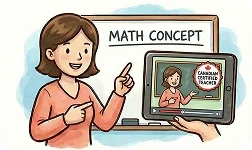
Expert Video Teaching
Certified teachers explain every concept with clear examples

Unlimited Practice
Thousands of practice questions with step-by-step solutions
How StudyPug Works for You
1

Pick Your Course
Choose Grade 11 Functions and Applications (MCF3M) and see every topic from your class
2

Get Unstuck
Upload homework problems or browse curriculum-aligned lessons.
3

Practice & Master
Work through similar problems until concepts stick.
4

See Results
Track exactly what you've mastered.
Find the right Ontario Grade 11 course
Grade 11 Functions MCF3M | Ontario Math Help | StudyPugHelp
OE_ID | Expectations | StudyPug Topic |
|---|---|---|
ON.OE.11FA.A1.1 | 11FA.A1.1: Pose problems involving quadratic relations arising from real-world applications and represented by tables of values and graphs, and solve these and other such problems |
ON.OE.11FA.A1.2 | 11FA.A1.2: Represent situations using quadratic expressions in one variable, and expand and simplify quadratic expressions in one variable |
ON.OE.11FA.A1.3 | 11FA.A1.3: Factor quadratic expressions in one variable, including those for which a ? 1, differences of squares, and perfect square trinomials, by selecting and applying an appropriate strategy |
ON.OE.11FA.A1.4 | 11FA.A1.4: Solve quadratic equations by selecting and applying a factoring strategy |
ON.OE.11FA.A1.5 | 11FA.A1.5: Determine, through investigation, and describe the connection between the factors used in solving a quadratic equation and the x-intercepts of the graph of the corresponding quadratic relation |
ON.OE.11FA.A1.6 | 11FA.A1.6: Explore the algebraic development of the quadratic formula, and apply the formula to solve quadratic equations, using technology |
ON.OE.11FA.A1.7 | 11FA.A1.7: Relate the real roots of a quadratic equation to the x-intercepts of the corresponding graph, and connect the number of real roots to the value of the discriminant |
ON.OE.11FA.A1.8 | 11FA.A1.8: Determine the real roots of a variety of quadratic equations, and describe the advantages and disadvantages of each strategy |
ON.OE.11FA.A2.1 | 11FA.A2.1: Explain the meaning of the term function, and distinguish a function from a relation that is not a function, through investigation of linear and quadratic relations using a variety of representations and strategies |
ON.OE.11FA.A2.2 | 11FA.A2.2: Substitute into and evaluate linear and quadratic functions represented using function notation, including functions arising from real-world applications |
ON.OE.11FA.A2.3 | 11FA.A2.3: Explain the meanings of the terms domain and range, through investigation using numeric, graphical, and algebraic representations of linear and quadratic functions, and describe the domain and range of a function appropriately |
ON.OE.11FA.A2.4 | 11FA.A2.4: Explain any restrictions on the domain and the range of a quadratic function in contexts arising from real-world applications |
ON.OE.11FA.A2.5 | 11FA.A2.5: Determine, through investigation using technology, the roles of a, h, and k in quadratic functions of the form f(x) = a(x ? h)? + k, and describe these roles in terms of transformations on the graph of f(x) = x? |
ON.OE.11FA.A2.6 | 11FA.A2.6: Sketch graphs of g(x) = a(x ? h)? + k by applying one or more transformations to the graph of f(x) = x? |
ON.OE.11FA.A2.7 | 11FA.A2.7: Express the equation of a quadratic function in the standard form f(x) = ax? + bx + c, given the vertex form f(x) = a(x ? h)? + k, and verify, using graphing technology, that these forms are equivalent representations |
ON.OE.11FA.A2.8 | 11FA.A2.8: Express the equation of a quadratic function in the vertex form f(x) = a(x ? h)? + k, given the standard form f(x) = ax? + bx + c, by completing the square |
ON.OE.11FA.A2.9 | 11FA.A2.9: Sketch graphs of quadratic functions in the factored form f(x) = a(x ? r)(x ? s) by using the x-intercepts to determine the vertex |
ON.OE.11FA.B1.1 | 11FA.B1.1: Determine, through investigation using a variety of tools and strategies, the value of a power with a rational exponent |
ON.OE.11FA.B1.2 | 11FA.B1.2: Evaluate, with and without technology, numerical expressions containing integer and rational exponents and rational bases |
ON.OE.11FA.B1.3 | 11FA.B1.3: Graph, with and without technology, an exponential relation, given its equation in the form y = a? (a > 0, a ? 1), define this relation as the function f(x) = a?, and explain why it is a function |
ON.OE.11FA.B1.4 | 11FA.B1.4: Determine, through investigation, and describe key properties relating to domain and range, intercepts, increasing/decreasing intervals, and asymptotes for exponential functions represented in a variety of ways |
ON.OE.11FA.B1.5 | 11FA.B1.5: Determine, through investigation using technology, the roles of a, c, and d in functions in the form f(x) = a?, f(x) = a? + c, and f(x) = a(???), and describe these roles in terms of transformations on the graph of f(x) = a? with angles expressed in degrees |
ON.OE.11FA.B2.1 | 11FA.B2.1: Distinguish exponential functions from linear and quadratic functions by making comparisons in a variety of ways |
ON.OE.11FA.B2.2 | 11FA.B2.2: Determine, through investigation using technology, that the equation of a given exponential function can be expressed using different bases, and explain the connections between the equivalent forms in a variety of ways |
ON.OE.11FA.B3.1 | 11FA.B3.1: Collect data that can be modelled as an exponential function, through investigation with and without technology, from primary sources, using a variety of tools, or from secondary sources, and graph the data |
ON.OE.11FA.B3.2 | 11FA.B3.2: Identify exponential functions, including those that arise from real-world applications involving growth and decay, given various representations, and explain any restrictions that the context places on the domain and range |
ON.OE.11FA.B3.3 | 11FA.B3.3: Solve problems using given graphs or equations of exponential functions arising from a variety of real-world applications by interpreting the graphs or by substituting values for the exponent into the equations |
ON.OE.11FA.C1.1 | 11FA.C1.1: Solve problems, including those that arise from real-world applications, by determining the measures of the sides and angles of right triangles using the primary trigonometric ratios |
ON.OE.11FA.C1.2 | 11FA.C1.2: Solve problems involving two right triangles in two dimensions |
ON.OE.11FA.C1.3 | 11FA.C1.3: Verify, through investigation using technology, the sine law and the cosine law |
ON.OE.11FA.C1.4 | 11FA.C1.4: Describe conditions that guide when it is appropriate to use the sine law or the cosine law, and use these laws to calculate sides and angles in acute triangles |
ON.OE.11FA.C1.5 | 11FA.C1.5: Solve problems that require the use of the sine law or the cosine law in acute triangles, including problems arising from real-world applications |
ON.OE.11FA.C2.1 | 11FA.C2.1: Describe key properties of periodic functions arising from real-world applications, given a numeric or graphical representation |
ON.OE.11FA.C2.2 | 11FA.C2.2: Predict, by extrapolating, the future behaviour of a relationship modelled using a numeric or graphical representation of a periodic function |
ON.OE.11FA.C2.3 | 11FA.C2.3: Make connections between the sine ratio and the sine function by graphing the relationship between angles from 0? to 360? and the corresponding sine ratios, with or without technology, defining this relationship as the function f(x) = sinx, and explaining why the relationship is a function |
ON.OE.11FA.C2.4 | 11FA.C2.4: Sketch the graph of f(x) = sinx for angle measures expressed in degrees, and determine and describe its key properties |
ON.OE.11FA.C2.5 | 11FA.C2.5: Make connections, through investigation with technology, between changes in a real-world situation that can be modelled using a periodic function and transformations of the corresponding graph |
ON.OE.11FA.C2.6 | 11FA.C2.6: Determine, through investigation using technology, the roles of the parameters a, c, and d in functions in the form f(x) = a sinx, f(x) = sinx + c, and f(x) = sin(x ? d), and describe these roles in terms of transformations on the graph of f(x) = sinx with angles expressed in degrees |
ON.OE.11FA.C2.7 | 11FA.C2.7: Sketch graphs of f(x) = a sinx, f(x) = sinx + c, and f(x) = sin(x ? d) by applying transformations to the graph of f(x) = sinx, and state the domain and range of the transformed functions |
ON.OE.11FA.C3.1 | 11FA.C3.1: Collect data that can be modelled as a sine function, through investigation with and without technology, from primary sources, using a variety of tools, or from secondary sources, and graph the data |
ON.OE.11FA.C3.2 | 11FA.C3.2: Identify periodic and sinusoidal functions, including those that arise from real-world applications involving periodic phenomena, given various representations, and explain any restrictions that the context places on the domain and range |
ON.OE.11FA.C3.3 | 11FA.C3.3: Pose problems based on applications involving a sine function, and solve these and other such problems by using a given graph or a graph generated with technology from a table of values or from its equation |
Complete MCF3M Coverage
Topics
60
Videos
322
Practice Questions
569
Course Hours
35+
Why Ontario MCF3M Students Love StudyPug
Built specifically for Ontario high school success
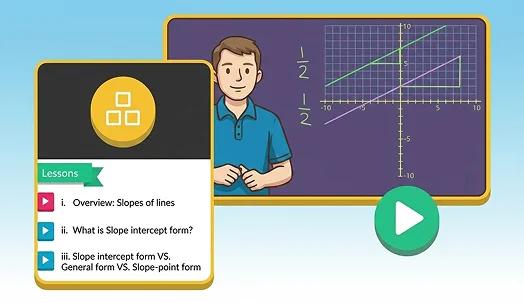
Ontario Curriculum Aligned
Every lesson matches Ontario Grade 11 Functions and Applications standards—what you learn in class, we teach

OSSLT & EQAO Prep
Practice with Ontario graduation numeracy assessment questions—be ready for exam day
OCT-Certified Teachers
Learn from expert Ontario teachers who know exactly what you need for MCF3M
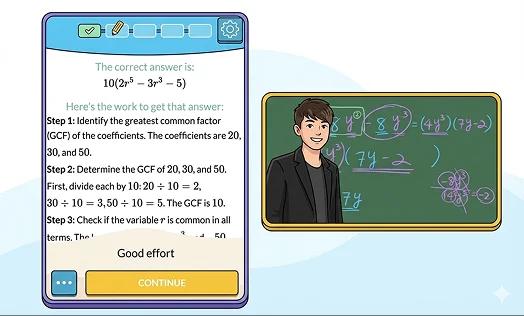
Learn Anywhere
Desktop, tablet, or phone—your MCF3M lessons sync across all devices
Frequently Asked Questions
Everything you need to know about mastering Grade 11 Functions and Applications (MCF3M) with StudyPug
What does MCF3M coverage include?
StudyPug covers all three strands of Ontario's Grade 11 Functions and Applications (MCF3M): Quadratic Functions (solving equations, graphing, vertex and general form), Exponential Functions (growth, decay, compound interest), and Trigonometric Functions (sine law, cosine law, graphing trig functions). You'll find 60 topics, 322 video lessons, and 624 practice questions aligned exactly to the Ontario curriculum.
How does photo search work?
Just snap a photo of any MCF3M problem from your homework or textbook using your phone. Our AI instantly identifies the question and shows you the exact video lesson that explains that concept. It's like having a tutor who knows exactly what you're working on. Works with quadratic equations, exponential graphs, trig problems—everything in MCF3M.
How many practice problems are available?
You get 624 practice questions specifically for Grade 11 Functions and Applications, plus access to thousands more across related topics. Every question includes step-by-step solutions so you can see exactly where you went wrong. The practice adapts to your level—if you're struggling, you get easier problems; if you're mastering concepts, the difficulty increases.
What if I'm falling behind in MCF3M?
Start with our diagnostic assessment to identify your weak spots. Then work through the video lessons at your own pace—pause, rewind, and rewatch as many times as you need. Our teachers break down complex topics like completing the square or graphing sine functions into simple steps. Most students see improvement within 2-3 weeks of consistent practice.
Does StudyPug help with MCF3M exams?
Absolutely. We provide comprehensive exam prep including practice questions that mirror actual MCF3M test formats, review lessons for each major topic, and strategies for solving multi-step problems. You'll also find prep materials for Ontario's graduation numeracy assessment. Many students use StudyPug specifically to prepare for unit tests, midterms, and finals.
How much does StudyPug cost?
StudyPug offers flexible monthly and annual plans starting at just a few dollars per day—much less than a single tutoring session. You get unlimited access to all MCF3M content plus every other math course from Grade 3 through university. We offer a money-back guarantee, and you can cancel anytime. Many students find it pays for itself after replacing just one or two tutoring sessions.
Smart Study Tools for Real Results
Personalized features that help you stay motivated and make progress
Adaptive Practice
Questions adapt to your level
Stay Motivated
Badges and streaks keep you practising daily
Quiz Mastery
Retake quizzes until you truly get it
Progress Tracking
See exactly where you need more practice